 Arlington Restoration Group
The honest answer: it depends, and it's not always what homeowners hope to hear
Wet drywall is one of the most common things people want a simple yes-or-no answer about, and it's also one of the areas where an honest answer genuinely is "it depends." Drywall can sometimes be dried in place and fully saved. In other cases, even a section that looks only lightly affected needs to come out.
The determining factors are consistent and worth understanding, because they explain why two seemingly similar water events can end with very different outcomes for the walls involved.
Three things drive the decision more than anything else: what category of water it was, how long the drywall stayed wet, and how far the moisture actually traveled into and up the wall.
Factor 1: Water category matters more than almost anything else
Not all water is the same from a restoration standpoint, and this is usually the first question a professional will ask. Water damage is generally grouped into three categories, explained in more detail in our guide to water damage categories:
- Category 1 (clean water) — from a source like a supply line break or overflowing sink, with no contaminants. Drywall exposed to clean water that's addressed promptly has the best chance of being dried and saved.
- Category 2 (gray water) — water with some level of contamination, such as from a washing machine or dishwasher discharge, or clean water that has sat long enough to start degrading. Drywall exposed to gray water requires more caution and is saved less often than Category 1 situations.
- Category 3 (black water) — grossly contaminated water, such as sewage backups or floodwater from outside the home. Drywall that has been in contact with Category 3 water is generally not saved, regardless of how it looks, because the material's porous paper facing and gypsum core can absorb contaminants in a way that can't be reliably cleaned out. This is treated as a removal situation, not a drying one.
This is the single biggest factor in the save-or-replace decision, and it's also why the source of the water matters just as much as how much of it there was.
Factor 2: How long it stayed wet
Time works against drywall in two ways. First, the longer it stays wet, the further water wicks upward and outward through the material — drywall behaves somewhat like a sponge or a paper towel dipped in water, drawing moisture up from a wet edge well beyond the visibly wet area.
Second, drywall that stays wet for an extended period — commonly cited around the 24 to 48 hour range, though this varies with humidity, temperature, and the specific situation — moves into higher-risk territory for mold growth within the paper facing, which is much harder to remediate on drywall than on hard, non-porous surfaces.
Drywall addressed quickly, while still wet but before that window closes, has a meaningfully better chance of being dried successfully than drywall discovered days after a slow, hidden leak.
Factor 3: How saturated it is, and how far up the wall it goes
Not all wet drywall is wet the same amount. A section that got splashed or briefly damp on the surface is a different situation than drywall that was submerged or sat in standing water for hours.
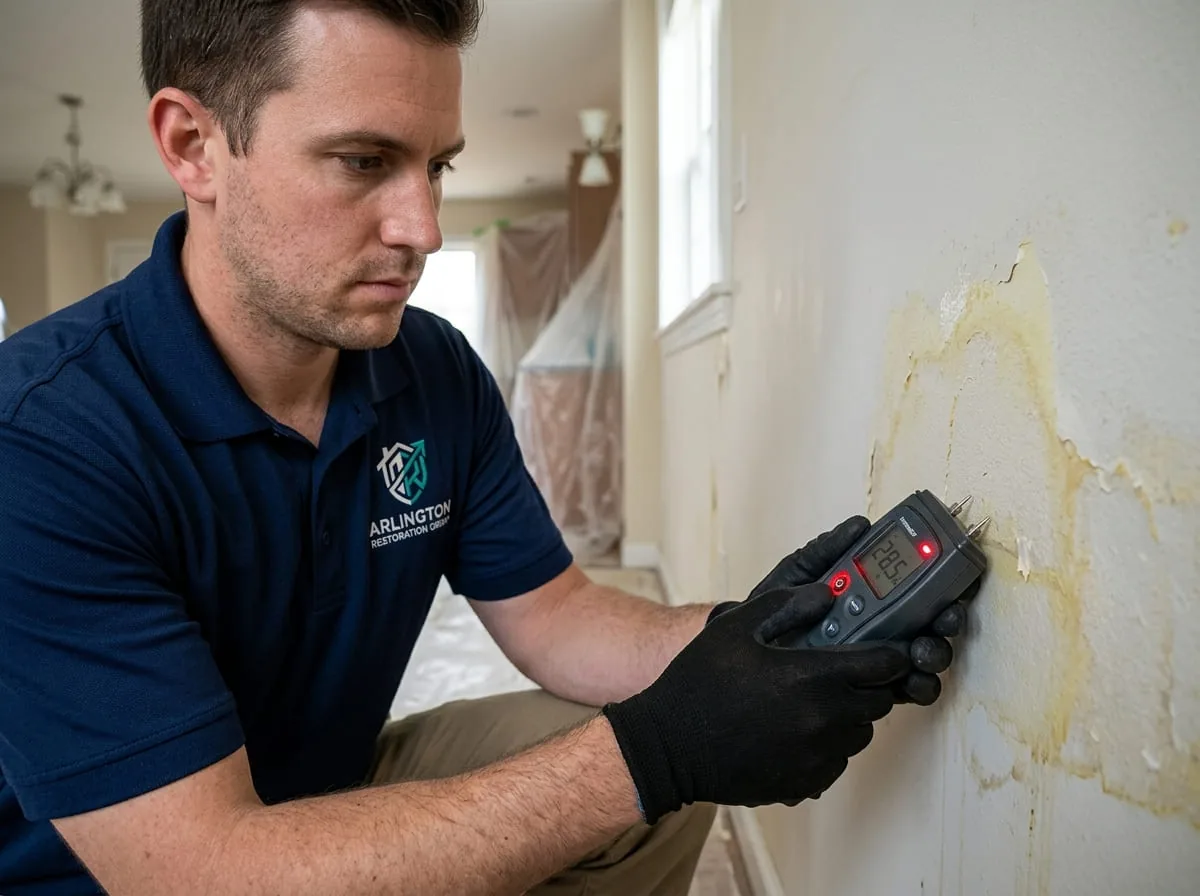
Professionals typically use a moisture meter to measure how far up a wall elevated moisture readings extend — this is the basis for what's often called a "flood cut," where drywall is cut out starting a set distance above the highest point of measured moisture, rather than only removing what looks visibly damaged.
This approach exists because visible staining and actual moisture penetration don't always match — drywall can look fine a few inches above a water line while still reading wet on a meter, and removing only the visibly stained section can leave contaminated or saturated material behind the new patch.
Does paint, texture, or wallpaper change the answer?
Paint and texture
A painted or primed surface doesn't meaningfully block water from soaking into drywall from an edge, a seam, or the back side — most water damage reaches drywall from behind or below, not through the painted face. What paint and texture do affect is what you can see: a coat of paint can hide early staining that would otherwise be an obvious warning sign, and textured surfaces make it harder to spot subtle bulging or softness by eye.
Wallpaper
Wallpaper is a bigger complication — it can trap moisture against the drywall face and slow surface evaporation even after the material behind it would otherwise be drying, and it often needs to be removed entirely to get an accurate moisture reading and to allow the wall to dry properly.
None of this changes the underlying factors (category, dwell time, saturation extent) — it just means a painted, textured, or papered wall can look deceptively fine while masking what's actually happening underneath, which is another reason a meter reading is more reliable than a visual inspection.
Why painting or patching over a still-wet spot is a mistake
It's tempting to deal with a small water stain by priming over it and repainting, especially if the area seems to have dried on the surface. This is one of the more common ways a manageable situation turns into a bigger one.
Paint and primer trap whatever moisture remains underneath rather than sealing it away, and a stain that reappears through fresh paint within days or weeks is a sign the drywall was never actually dry when it was painted — at that point the moisture has had additional time to do further damage while looking cosmetically fixed.
The same logic applies to patching a hole or crack over an area that hasn't been confirmed dry: patching an actively wet spot just relocates the visible problem while the underlying moisture keeps working on the material and anything behind it.
Signs drywall likely needs to be replaced rather than dried
- It was exposed to Category 2 or Category 3 water
- It's sagging, bulging, soft, or crumbling to the touch
- Visible mold growth is present on the surface
- Tape seams are separating or joint compound is bubbling and delaminating
- It stayed wet for an extended period (several days or longer) before being addressed
- Insulation behind it was also saturated (see below)
Drywall showing none of the above, exposed only to Category 1 clean water, and addressed promptly, is a reasonable candidate for drying rather than automatic replacement — though the final call should be based on actual moisture readings, not appearance alone.
What's often overlooked: the insulation behind the wall
Even when drywall itself could technically be dried, what's behind it matters. Wet fiberglass batt insulation loses much of its effectiveness once saturated and is difficult to dry in place behind an intact wall — air movers and dehumidifiers can't reach it efficiently through unbroken drywall.
In many cases, this means a section of drywall gets removed specifically to access and replace wet insulation, even if the drywall itself might otherwise have been salvageable. This is a common source of confusion for homeowners who assume the drywall's condition alone determines whether the wall gets opened up.
How the decision actually gets made
A reasonable process looks like this: assess the water category first, since Category 3 (and often Category 2) situations settle the question immediately in favor of removal. For Category 1 water, moisture readings are taken to map exactly how far saturation extends, both across and up the wall.
That mapping determines the flood-cut line if removal is needed, or confirms that in-place drying is a realistic option if the affected area is limited and the timeline was short. Drying, when attempted, is then monitored against baseline moisture readings — the same way structural drying is tracked more broadly — rather than assumed complete after a fixed number of days.
Related wall and ceiling situations
Drywall on ceilings follows the same logic but often fails faster, since gravity pulls water down through ceiling drywall and it can sag or collapse under saturation in a way that wall drywall generally doesn't.
Water stains on a ceiling are also frequently a sign of damage that started elsewhere — a roof leak, an upstairs plumbing issue, or an HVAC condensation problem — and are worth having assessed rather than just patched over, since the drywall is often only the visible symptom.
For a broader look at how ceiling and wall water damage gets assessed and addressed, see ceiling and wall water damage restoration.
The bottom line
Some wet drywall genuinely can be dried and saved — this isn't a situation where replacement is automatically assumed regardless of condition. But it's also not something to assume the other direction either. The honest answer depends on what kind of water it was, how long it sat, and how far it actually traveled into the material — all things that require an actual assessment, not a guess based on how the wall looks from a few feet away.
Frequently Asked Questions
Can drywall be dried out and saved, or does it always need to be replaced?
It genuinely depends. Drywall exposed to clean water and addressed promptly has a real chance of being dried and saved. Drywall exposed to contaminated water, saturated for an extended period, or showing sagging, bulging, or visible mold is generally not a good candidate for drying and is usually removed instead.
How can I tell how far water has traveled up my drywall?
Visible staining doesn't always match the actual extent of moisture. A moisture meter is used to measure how far up the wall elevated readings extend, which is often further than what's visibly wet or stained — this is why professionals measure rather than estimate by eye.
What is a flood cut, and why not just patch the visibly wet part?
A flood cut removes drywall starting a set distance above the highest point of measured moisture, not just the visibly damaged section. This is because moisture can extend beyond what's visually apparent, and patching only the stained area can leave wet or contaminated material behind the new drywall.
Is drywall that got wet from a clean supply line leak different from drywall that touched sewage?
Yes, significantly. Clean water (Category 1) drywall addressed quickly has the best chance of being saved. Drywall exposed to sewage or contaminated floodwater (Category 3) is generally removed regardless of how it looks, because contaminants can be absorbed into the porous material in a way that can't be reliably cleaned.
If my drywall can be saved, does that mean the wall doesn't need to be opened up at all?
Not necessarily. Insulation behind the drywall can be saturated even when the drywall itself is a candidate for drying, and wet insulation is difficult to dry in place. In that case a section of otherwise-salvageable drywall may still be removed to access and replace the insulation behind it.
How long can drywall stay wet before it needs to be replaced instead of dried?
There's no single universal cutoff, but drywall that stays wet for an extended period — commonly discussed in the range of 24 to 48 hours or more, depending on humidity and conditions — moves into higher risk for mold growth within the paper facing and is less likely to be a good candidate for drying. Addressing wet drywall quickly meaningfully improves the odds it can be saved.