 Arlington Restoration Group
Home Water Damage Looks Different Depending on Where You Live
Arlington's housing stock spans several genuinely different eras and building types, and that matters for how water damage shows up and gets fixed. In the Cape Cods, brick colonials, and garden apartments built from the 1930s through the 1960s across neighborhoods like Arlington Forest, Waverly Hills, and Columbia Forest, water damage tends to trace back to original or since-replaced galvanized supply lines, aging cast iron or clay drain sections, and basements that were built into the county's rolling terrain and see their share of seepage and backups. In the newer high-rise condominium towers around Rosslyn-Ballston and National Landing, the plumbing itself — copper and PEX — holds up better against corrosion, but a leak in one unit travels through shared risers and concrete floor slabs, meaning your water damage might have started two floors up in someone else's kitchen. Whichever category your home falls into, residential water damage restoration is built around getting a household back to normal safely and with as little disruption as possible.
Common Sources of Home Water Damage
Some of the most frequent calls come from appliance failures — washing machine supply hoses, dishwasher lines, refrigerator ice-maker connections, and water heaters, any of which can fail with no warning at any hour. Burst pipes are especially common in older single-family homes with original supply lines. Storm-driven leaks through roofs and windows spike during Arlington's summer thunderstorm season, and basement flooding is common enough in North Arlington's older housing stock that it's treated as a routine, expected scenario rather than a rare event. HVAC condensation leaks, overflowing tubs, and sump pump failures round out the list of everyday residential water sources.
Signs a Home Needs Restoration Rather Than a DIY Fix
- Standing water covering any real area of flooring, or water that's soaked into carpet or hardwood
- Ceiling stains, sagging, or bubbling paint anywhere in the home
- A musty odor that wasn't there before, especially in a basement or closet
- Warped, cupped, or buckled flooring
- Any water from a contaminated source — a drain backup, toilet overflow, or exterior floodwater
- Visible mold growth, which typically signals moisture that's been present longer than a day or two
What the Process Looks Like for a Homeowner
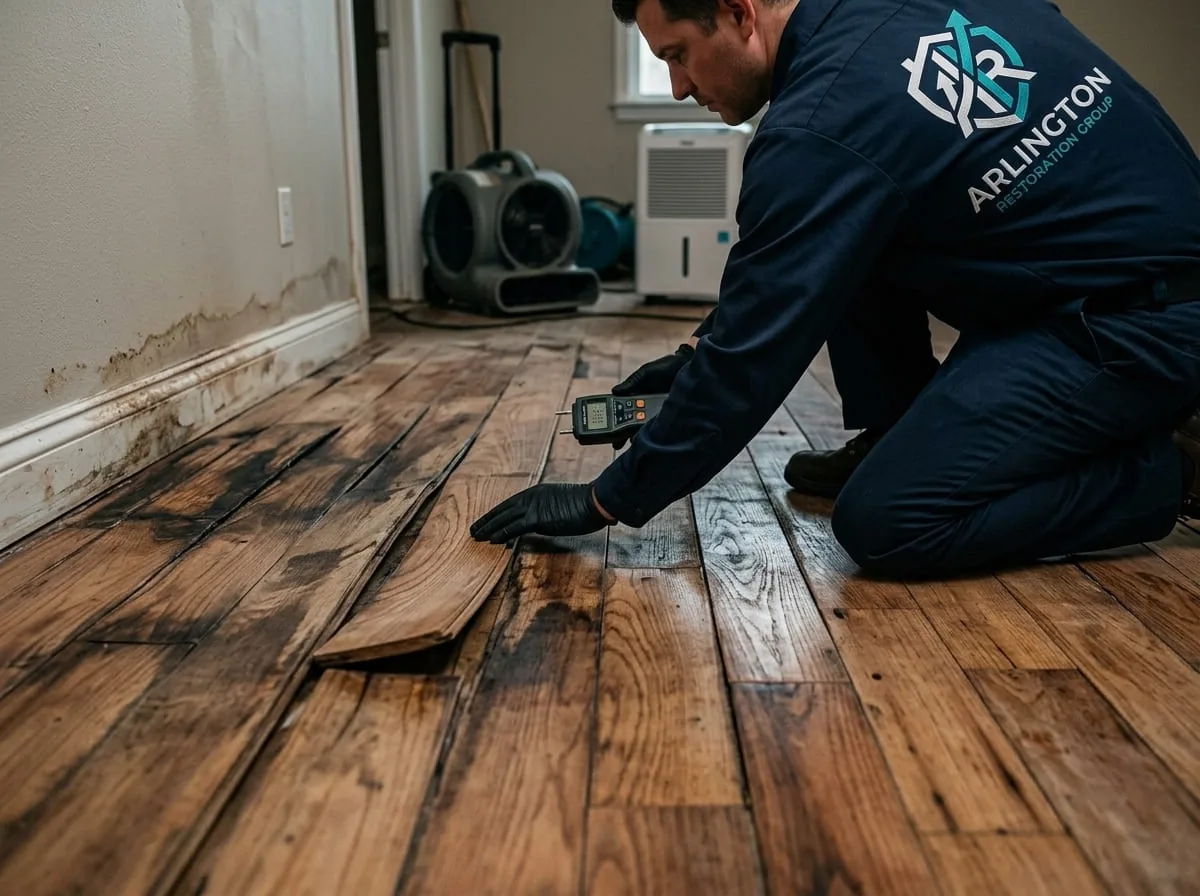
After the initial call, the responding crew assesses the water source and category, then moves into extraction of standing water. From there, moisture mapping identifies how far water traveled into flooring, walls, and framing, followed by structural drying using air movers and dehumidifiers, monitored until materials return to a normal moisture level. Throughout the process, the crew documents the damage in detail, which supports whatever insurance claim you file, and can typically work directly with your adjuster. Once drying is confirmed complete, repair and reconstruction work — replacing drywall, flooring, trim, or cabinetry that couldn't be saved — brings the space back to its pre-loss condition.
Protecting Family and Belongings
For homeowners, restoration isn't just about the structure — it's about getting a household functional again with minimal disruption to daily life. That can mean prioritizing bedrooms and bathrooms for faster drying, coordinating around school and work schedules, and being straightforward about which personal belongings (furniture, rugs, boxed items) are salvageable versus which were too saturated or contaminated to clean. Being upfront about that distinction matters more than promising everything can be saved, since it isn't always true, and a restoration crew that tells you otherwise isn't doing you any favors.
Single-Family Homes, Townhomes, and Condos
A single-family home with a basement has different exposure points than a townhouse on a slab or a high-rise condo unit — basements and crawl spaces bring their own set of issues (see basement water damage cleanup and crawl space water damage), while condo owners often need to coordinate with building management and neighboring units when a leak originates outside their own space. The restoration approach adjusts to the property type rather than applying one standard process to every home.
Insurance and Documentation for Homeowners
Most homeowners policies distinguish between a sudden, accidental water event and one caused by long-term neglect or gradual seepage, and that distinction can affect whether a claim is approved. Detailed photos, a record of when the damage was noticed, and a thorough written assessment from the responding crew all help build a stronger claim file. It's reasonable to ask the crew on site what they're documenting and why, and to keep your own copies of everything before repairs begin, since some materials are removed and discarded once assessed.
What to Do Before Help Arrives
- Shut off the water source if it's safely accessible
- Move furniture, rugs, and valuables away from standing water
- Photograph the damage for your insurance file before anything is moved or cleaned up
- Keep children and pets away from the affected area, especially if the water source isn't clean
What to Avoid
- Don't use household fans alone as a substitute for professional extraction and drying on anything beyond a very small, clean spill
- Don't throw away damaged belongings before documenting them for your insurance claim
- Don't assume a finished basement that looks dry after a day is actually dry underneath the flooring or behind the walls
Related Services
For the urgent first-response side of a home water emergency, see emergency water damage restoration. If your home is a rental property or you manage multiple units, commercial water damage restoration may be the more relevant page. The water damage restoration hub covers the full range of services available.
Serving Homeowners Throughout Arlington
Residential response covers Arlington's full range of home types, from Cape Cods and colonials in neighborhoods like Ballston and Virginia Square to condo towers throughout the county, plus nearby communities including Falls Church.
Frequently Asked Questions
Do I need to be home while restoration work is happening?
It depends on the scope of work and your preference — many homeowners stay in the home during extraction and drying, especially for a contained, single-area event. For larger jobs or contaminated water situations, the crew on site can advise whether it makes sense to be elsewhere temporarily.
How much does residential water damage restoration typically cost?
Cost depends heavily on the amount of water, the materials affected, and how much repair or replacement is needed, so it's not something that can be quoted without an assessment. The responding crew can provide an estimate after evaluating your specific situation, and much of the cost may be covered by insurance depending on the cause.
Can I stay in a hotel and have my insurance cover it during restoration?
Many homeowners policies include additional living expense coverage for situations where a home is temporarily uninhabitable, but this depends entirely on your specific policy. Check directly with your insurance provider about what's covered.
What's the difference between residential and commercial water damage restoration?
The core process — extraction, drying, repair — is similar, but residential work is typically scaled to a household's living space and schedule, while commercial work often accounts for business operations, multiple tenants, or code compliance considerations specific to a business property.
Will restoration crews work with my homeowners insurance directly?
Typically yes — documentation from the initial assessment through completed repairs is usually shared with your insurance adjuster to support your claim, though the claim itself remains between you and your insurance company.