 Arlington Restoration Group
Water Damage Restoration in Crystal City & Pentagon City (National Landing)
A Dense, Fast-Moving Corridor
National Landing — the corridor that runs from Crystal City through Pentagon City toward Potomac Yard — is one of the most tightly built stretches of Arlington County, with office towers, residential high-rises, hotels, and ground-floor retail packed close together near Reagan National Airport and the Amazon HQ2 campus. When a supply line lets go on the twenty-second floor or a sprinkler head triggers in a parking garage, water moves fast, and it moves down.
Calls from this corridor reach licensed, insured restoration crews equipped with professional extraction and drying equipment, dispatched for the kind of emergency response high-rise and mixed-use properties actually require — not a single flooded basement, but water traveling through shared walls, elevator shafts, and floor slabs into units and commercial spaces that had nothing to do with the original failure.
Extraction and the First Hours
The water damage restoration hub covers the full range of services available across the area, and the first hours after a leak are the ones that decide how much of a unit, hallway, or retail space can be saved.
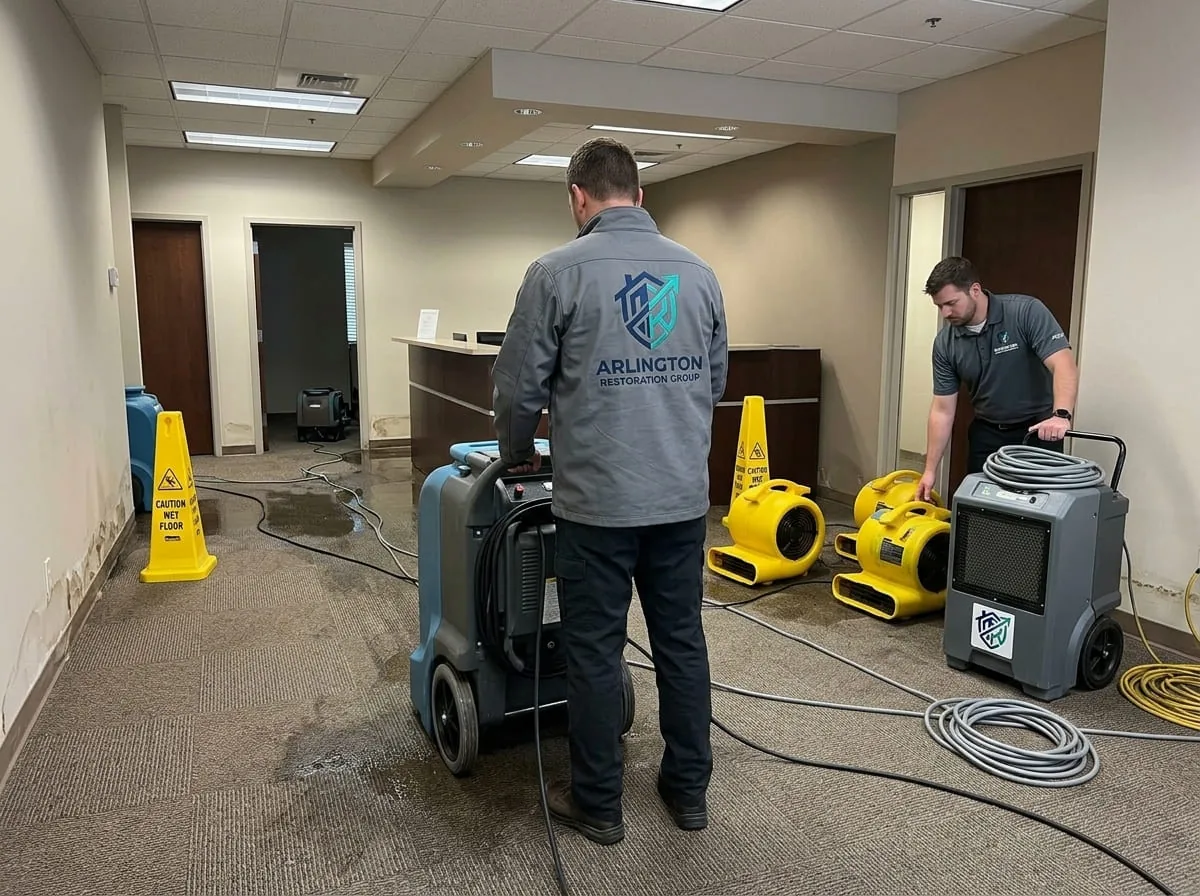
Crews dispatched to Crystal City and Pentagon City properties bring truck-mounted and portable equipment for standing water on carpet, tile, and concrete slab floors, and water extraction and removal covers everything from carpet pad and engineered flooring to furniture and built-ins that absorbed water before the source was shut off.
Where a full unit or a lower-level commercial space has taken on water — from a burst supply line, a storm surge into a below-grade garage, or a failed rooftop mechanical system — the response follows the same flood damage cleanup protocol: remove standing water, assess what's salvageable, and begin drying before secondary damage sets in.
Burst Pipes and Sewage in Shared Buildings
Burst pipe water damage in a high-rise rarely stays contained to one unit — a supply line failure on a mid-floor unit can send water down through electrical chases and floor assemblies into two or three units below before anyone upstairs even notices. Sewage backups are handled with more caution: sewage cleanup in a shared-riser building requires containment and category-3 water protocols, since a stack backup can affect every unit tied to the same drain line.
Once water is out and the source is controlled, structural drying begins — commercial-grade air movers, dehumidifiers, and structural drying and dehumidification equipment sized for concrete and steel-frame construction, which holds moisture differently, and often longer, than wood-frame single-family homes.
Building Stock and Local Water Damage Risk in National Landing
Modern Plumbing, Concentrated Risk
Most of Crystal City and Pentagon City has been rebuilt since the 1970s into a dense corridor of high-rise residential towers, office buildings, and hotels, and that redevelopment has continued through the Amazon HQ2 build-out and the broader National Landing rebranding.
The plumbing behind the walls here is generally modern — copper and PEX supply lines rather than the galvanized steel more common in Arlington's older single-family neighborhoods — but modern materials don't eliminate water damage risk, they just change its shape.
High-rise construction concentrates dozens or hundreds of units on shared risers, shared mechanical rooms, and shared floor slabs, so a single point of failure has a much wider reach than it would in a detached home.
A supply line, water heater, or washing machine hose failure two floors up becomes a ceiling problem, a drywall problem, and a flooring problem for the unit below — sometimes for several units in a stack, if the leak runs down a shared wall cavity or utility chase before it surfaces.
Storm Exposure Near the River
The corridor's proximity to the Potomac and to Four Mile Run, which forms much of Arlington's southern border with the City of Alexandria, puts some of the lower-lying and below-grade areas near Crystal City and Potomac Yard within reach of heavy regional storm events.
Humid Mid-Atlantic summers and intense, fast-moving thunderstorms are a routine part of the area's climate, and below-grade parking garages, loading docks, and mechanical rooms in this corridor are the areas most exposed when storm drainage is overwhelmed.
None of that is unique to National Landing, but the combination of dense high-rise construction and low-lying pockets near the river is a genuinely different risk profile than the tree-lined single-family streets found elsewhere in Arlington. For non-emergency water or sewer service questions on the Arlington County side of the corridor, the county's DES Water/Sewer Engineering section is reachable at (703) 228-3677.
Active Construction and New-Building Issues
The pace of redevelopment tied to Amazon HQ2 and the wider National Landing plan means active construction sites, temporary utility connections, and phased building openings are a routine part of this corridor in a way they aren't in most of the rest of Arlington.
Newly occupied towers and recently renovated retail space can still surface plumbing and fitting issues in the first year or two of use, and buildings under active construction nearby sometimes affect groundwater and drainage conditions for neighboring below-grade levels during heavy rain.
None of that changes the basic response — extraction, moisture mapping, and structural drying — but it's part of why water events in this specific corridor sometimes involve newer construction defects rather than only age-related wear.
Common Water Damage Scenarios in Crystal City and Pentagon City
- Unit-to-unit leaks through shared risers and slabs. A failed supply line, toilet connection, or water heater in one condo or apartment unit travels through the floor assembly into the unit below — a pattern specific to stacked high-rise construction rather than single-family homes, covered further on the ceiling & wall water damage page.
- Washing machine and dishwasher hose failures. With laundry and dishwasher connections stacked above one another floor after floor, a burst supply hose on a mid-level floor can affect several units before it's caught, detailed on the appliance leak & overflow cleanup page.
- Below-grade garage and mechanical room flooding. Parking garages, loading areas, and mechanical rooms sit below street level in most of this corridor's towers, making them the first areas to take on water during heavy storm runoff.
- HVAC condensate line clogs. High-rise HVAC systems generate condensate that has to drain somewhere; a clogged line is a common, slow-building source of ceiling and wall staining in office and residential towers alike.
- Sprinkler and fire suppression discharge. Commercial and residential high-rises rely on wet-pipe sprinkler systems; an accidental discharge or a leak at a sprinkler head introduces water damage even without a fire.
- Ground-floor retail and lobby flooding. Ground-level retail, restaurants, and lobby spaces along Crystal City's underground concourse and street-level storefronts are exposed to water intrusion from above and, during major storms, from street-level runoff.
Residential and Commercial Response
Condos, Offices, and Shared Spaces
National Landing is genuinely mixed-use, and the crews taking calls here work both sides of that line. On the residential side, that means condo and apartment towers, individual units, and the shared hallways, elevator lobbies, and mechanical spaces that connect them — work that has to account for building management coordination, neighboring residents, and sometimes a condo association's own insurance and access requirements.
On the commercial side, it covers Amazon HQ2 office space, hotels near Reagan National Airport, ground-floor retail and restaurants, and the office towers that make up the rest of the corridor. Commercial water damage restoration in a space like this often has to work around live business operations, after-hours access windows, and a building's own property management or engineering staff.
Residential water damage restoration in a condo tower, by contrast, focuses on getting a resident's unit dry and livable while limiting disruption to neighboring units. A flooded retail space and a flooded twelfth-floor bedroom don't dry out the same way, and the response is scoped accordingly.
Hotels Near the Airport
Hotels near Reagan National Airport add another layer to the commercial side of this corridor. A water event in an occupied hotel floor has to be managed around guest rooms that may still be in use, housekeeping and engineering staff, and a property that generally can't simply close for a few days while drying equipment runs.
That kind of response leans on portable extraction and drying equipment that can be moved room to room, along with close coordination with hotel engineering on access, noise, and guest relocation for the units directly affected.
Fire Damage Restoration in Crystal City & Pentagon City
Sprinkler Discharge and Fire Suppression Water
High-rise fires bring a water damage problem along with the fire damage itself. Modern towers in this corridor are built around wet-pipe sprinkler systems, which are effective at limiting fire spread but discharge a significant volume of water in the process — water that has to be extracted and dried out just like a flood, on top of soot and smoke cleanup.
Fire damage restoration for a high-rise unit or floor typically means addressing fire suppression water first, then smoke and soot, which can travel through HVAC systems and shared corridors well beyond the unit where the fire started.
Coordinating With Building Management
Firefighting water itself is treated as its own category of water damage, since it can carry soot, ash, and debris into flooring, drywall, and insulation. Commercial tenants and residential associations dealing with a fire event in a National Landing tower are connected with crews who handle emergency board-up, smoke and soot cleanup, and the structural drying that follows fire suppression, coordinated with the building's own management and engineering teams where required.
Mold Remediation in Crystal City & Pentagon City
Why Hidden Moisture Is Harder to Catch Here
Humid Mid-Atlantic summers combine with enclosed wall cavities, mechanical closets, and below-grade garage and storage areas to make mold a real concern anywhere water sits unaddressed in this corridor.
High-rise construction can actually make hidden moisture harder to catch early — a slow leak inside a wall chase or above a suspended ceiling in an office or condo unit can go unnoticed longer than an obvious puddle on a hardwood floor, giving mold more time to establish itself before anyone calls it in.
Inspection and Remediation Fundamentals
Mold remediation in this area follows the same fundamentals as anywhere else — inspection, containment, removal of affected material, and remediation using recognized industry practices — with extra attention paid to shared wall assemblies and mechanical spaces that connect multiple units or tenant spaces.
Because mold after water damage can begin developing within a day or two of unaddressed moisture, the priority after any leak in a high-rise unit is getting the space fully dried out, not just visibly dry, before materials are closed back up.
What to Expect: The Restoration Process
First Hours on Site
A call about water damage in a Crystal City or Pentagon City property starts with the basics — unit or suite number, building name, and what's actively happening — so the right equipment and crew size can be dispatched.
On arrival, the priority is stopping the source if it hasn't already been shut off, extracting standing water, and using moisture meters and thermal imaging to map how far the water has traveled behind walls, under flooring, and into the floor assembly itself, since high-rise slabs and shared wall cavities can hide moisture that isn't visible from either the affected unit or the one below it.
From there, air movers and dehumidifiers dry the space over the following days, with follow-up moisture checks to confirm materials are actually dry before rebuild work begins. Insurance claim assistance is available throughout to help property owners, residents, and building managers document the damage and work through the claims process with their carrier. For a first-hour checklist, see what to do immediately after finding water damage.
Building Access and Notifying Neighbors
Building access is its own step in a corridor built almost entirely around controlled-entry towers. Front desk staff, a fob or key card, or a call to building engineering is often needed before a crew can even reach the affected floor, and having that contact information ready when placing the emergency call can shave real time off the response.
For condo and apartment residents, notifying the property management office or the unit directly above or below as soon as a leak is discovered — rather than waiting for an inspection to confirm the source — gives neighboring units a head start on protecting their own belongings.
Nearby Service Areas
Emergency water, fire, and mold response also covers the neighborhoods around National Landing, including Shirlington & Fairlington to the southwest and Arlington Ridge & Aurora Highlands, the older residential neighborhoods just west of Crystal City. Properties just across Four Mile Run in the City of Alexandria are covered as well.
Frequently Asked Questions
How fast can someone respond to a water leak in a Crystal City or Pentagon City high-rise?
Emergency water damage response is available 24/7 across the National Landing corridor. Call (703) 419-9452 and a dispatcher will get details about the unit, building, and situation to route the nearest available crew as quickly as possible. A specific arrival time isn't guaranteed, since it depends on the property's location and building access requirements, but emergency calls are prioritized.
My condo association's insurance is separate from my own policy — who handles the claim?
Both can be involved. Insurance claim assistance is available to help document the damage for whichever policy applies — an individual unit owner's policy and/or the association's master policy — though the property owner or association ultimately works directly with their own carrier.
Does a leak from the unit above mean my unit is a total loss?
Not usually. Most unit-to-unit leaks affect ceilings, upper walls, and flooring rather than the entire space. An inspection with moisture meters and thermal imaging determines exactly how far the water traveled before any material is removed, and materials that dry successfully are generally not replaced unnecessarily.
Can building management require a specific restoration vendor?
Some high-rise buildings and condo associations have preferred vendor requirements or access procedures. It's worth checking with building management or the HOA/condo board alongside placing the emergency call, though addressing an active leak shouldn't be delayed over paperwork.
Is mold a bigger risk in high-rise units than in single-family homes?
Not necessarily bigger, but different. Moisture trapped inside shared wall cavities, mechanical chases, or above suspended ceilings can go unnoticed longer than a puddle on a floor, which is why full structural drying after any leak matters even when the visible damage looks minor.
Do you handle commercial office and retail space in National Landing, or just residential units?
Both. Crews dispatched to this corridor handle everything from individual condo and apartment units to office suites, hotel floors, and ground-floor retail and restaurant space.
What should I do immediately after discovering a leak in my unit?
Shut off the water source if it's accessible and safe to do so, move valuables and electronics away from the affected area, and call for emergency service rather than waiting to see if it dries on its own — water can reach flooring and drywall within hours in a high-rise unit.