 Arlington Restoration Group
Why Commercial Fire Restoration Is Its Own Discipline
A fire in an office suite, retail storefront, restaurant kitchen, or multi-tenant building creates pressures a single-family home fire usually doesn't. There's inventory or equipment that may or may not be salvageable, business records that need protecting, employees or tenants who need somewhere to work, and every day the space is closed is revenue the business isn't making. Restoration still follows the same core sequence — assess, stabilize, clean, dry, rebuild — but commercial jobs are typically scoped and sequenced around getting some part of the operation running again as fast as it's safe to do so, not just returning the building to its original condition on its own timeline.
Every call is routed to experienced restoration crews serving Arlington's commercial corridors, from ground-floor retail in Clarendon to office towers in Rosslyn and Ballston, with commercial-scale equipment and documentation practices suited to business interruption claims.
Property Types and What They Typically Need
- Office buildings — smoke migration through shared HVAC and corridors, electronics and server room assessment, and often multi-floor evaluation even from a single-floor fire
- Retail spaces — inventory assessment, storefront board-up and security, and coordination with landlords in multi-tenant strip and mall settings
- Restaurants and commercial kitchens — grease-related fire residue, exhaust hood and ductwork cleaning, and health-code-relevant sanitation on top of standard soot removal
- Multi-unit residential buildings — smoke and water migration between units through shared walls, risers, and floor slabs, often affecting units that had no direct fire exposure
- Warehouses and light industrial space — larger square footage, inventory and equipment protection, and drying equipment scaled to open floor plans
Common Causes of Commercial Fires
Commercial fires often trace back to different causes than residential ones: electrical faults in older wiring or overloaded circuits, cooking equipment in restaurant kitchens, HVAC or mechanical equipment malfunctions, and in older mixed-use buildings, shared electrical or structural systems that let a fire starting in one unit affect several. Understanding the likely cause matters for restoration scoping as well as for the eventual insurance investigation, since it can point to areas of hidden damage beyond the visible fire zone.
What the Commercial Restoration Process Involves
Rapid Assessment and Scoping
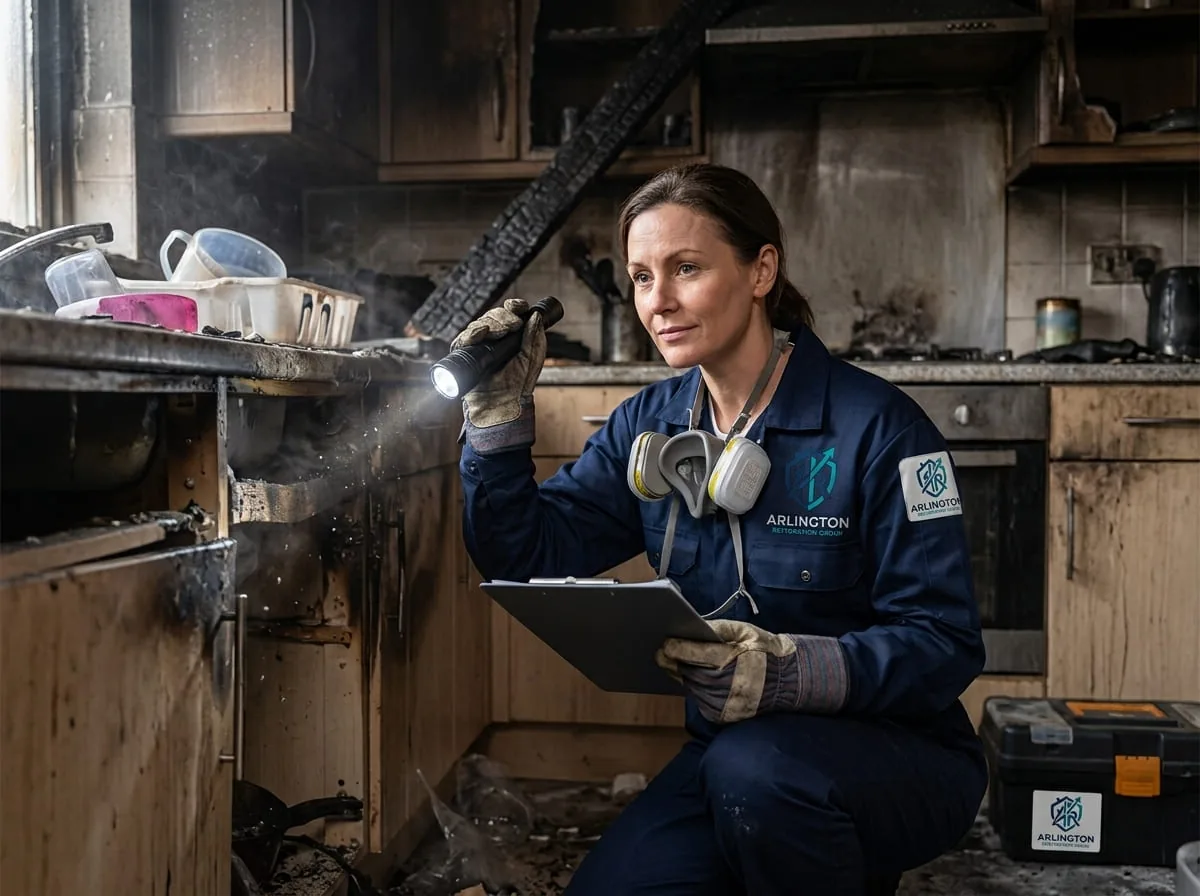
An initial walkthrough documents damage across the full affected footprint, including areas outside the immediate fire zone, since commercial buildings often have interconnected HVAC and structural systems that carry smoke and water further than in a typical home.
Stabilization
Board-up, tarping, and water extraction happen first, the same as in residential restoration but often at a larger scale — securing a storefront's full glass frontage, for instance, rather than a single window.
Cleaning and Drying
Soot removal, smoke cleanup, and structural drying proceed using commercial-grade equipment, often run in phases so that unaffected parts of a building can potentially reopen before the entire restoration is complete.
Contents and Inventory
Salvageable inventory, equipment, and records are cleaned, inventoried, and stored, following the same principles covered on the contents cleaning and pack-out page but scaled to commercial volume.
Reconstruction
Rebuilding is handled by a licensed general contractor, covered in more detail on the fire damage repairs and reconstruction page, often with permitting and code considerations specific to commercial occupancy classes.
Minimizing Downtime
Where the building's layout allows it, restoration can sometimes be phased so unaffected floors, units, or sections reopen while the fire-damaged area is still being worked on. That's not possible in every case — shared HVAC systems or structural work can require a broader shutdown — but it's evaluated as part of the initial scoping rather than assumed one way or the other.
Working With Property Managers and Multiple Stakeholders
Commercial fires frequently involve more than one decision-maker — a landlord, a property management company, individual tenants, and sometimes a homeowners' or condo association in mixed-use buildings. Coordinating access, approvals, and timelines across those parties is a routine part of commercial restoration, and clear, consistent communication with everyone involved tends to keep a project moving rather than stalling on approvals.
Documentation for Business Interruption Claims
Commercial policies often include business interruption coverage alongside property damage, and thorough documentation of the timeline, scope, and affected areas supports both. Insurance claim assistance is available through the receiving restoration contractor, and photo and moisture documentation typically begins at the initial walkthrough.
What to Do Before Crews Arrive
- Notify your insurance carrier and property manager or landlord as soon as possible
- Do not re-enter the space until the fire department has cleared it
- Secure any records, backups, or critical documents you can access safely
- Notify affected tenants or employees about access restrictions
What to Avoid
Do not attempt to reopen or allow staff back into a fire-damaged commercial space before it's been cleared as structurally safe, even if the visible damage looks limited to one area — smoke and heat can compromise structural elements and electrical systems beyond what's obvious. Avoid cleaning soot or smoke residue with standard janitorial products, which can set stains the same way household cleaners do at a residential scale. And don't delay contacting your insurer while waiting to assess damage yourself; most policies require prompt notification.
Related Services
Commercial fire restoration draws on emergency fire damage restoration, smoke damage cleanup, and emergency board-up & tarping as needed. Visit the fire damage restoration hub for the full list of services.
Serving Arlington's Business Districts
Commercial fire restoration is available throughout Arlington's business corridors, including Ballston & Virginia Square and Crystal City & Pentagon City, as well as neighboring Alexandria.
Frequently Asked Questions
Can part of my building reopen while restoration is still underway elsewhere?
Sometimes. It depends on whether the fire, smoke, or water damage affected shared systems like HVAC or structural elements. An initial assessment determines whether phased reopening is realistic for your specific building.
Does commercial fire restoration cover exhaust hood and duct cleaning for restaurants?
Yes, commercial kitchen fires typically require specialized attention to exhaust hoods, ductwork, and grease-affected surfaces in addition to standard soot and smoke cleanup.
Who handles the rebuild after a commercial fire?
Reconstruction is performed by a licensed general contractor, coordinating framing, drywall, electrical, and finish work with any code or permitting requirements specific to the building's commercial occupancy classification.
How is business interruption documented for insurance?
Photo documentation, moisture readings, and a written timeline of the restoration process are typically compiled from the initial assessment onward, supporting both the property damage and business interruption portions of a commercial claim.
What happens to inventory and equipment after a fire?
Salvageable inventory and equipment are cleaned and documented where possible; items with heavy fire, smoke, or water exposure may not be recoverable. An honest, itemized assessment identifies what can realistically be saved.