 Arlington Restoration Group
What Mold Remediation Covers
Mold remediation addresses an existing mold problem: locating the affected materials, containing the area so spores aren't spread to unaffected parts of the property, removing or cleaning what's affected, and confirming afterward that the work was effective. It's different from routine cleaning — a bit of surface mildew on a shower curtain isn't the same as a colony growing inside a wall cavity that's been damp for weeks, and treating the two the same way can leave the underlying problem in place.
Property owners in Arlington typically reach out after visible growth appears, a musty odor won't go away, a past water event comes to mind, or a mold-related finding turns up during a home inspection or real estate transaction.
Why Mold Problems Usually Start With Water
Mold needs moisture to establish and spread, and in most Arlington homes and buildings that moisture traces back to a water event: a slow leak behind a dishwasher, a basement that took on stormwater during a heavy summer thunderstorm, a supply line that failed inside a wall, or a water damage job where a wall cavity or subfloor wasn't fully dried. Addressing the mold without addressing the moisture source usually just buys time until it returns.
How the Two Silos Connect
If your mold problem started with a leak, a flood, or firefighting water inside the structure, it's worth understanding water damage restoration as a companion service — drying a structure correctly the first time is one of the biggest factors in whether mold shows up at all. Our mold prevention and moisture control page covers how professionals manage humidity and residual moisture right after a water loss, and basement water damage cleanup covers a space that's one of the most common places mold shows up after standing water or chronic dampness.
Mold in Arlington's Older Homes and High-Rise Corridors
Arlington's housing stock spans two very different eras, and each carries its own mold risk.
Older North and South Arlington Neighborhoods
Neighborhoods built between the 1930s and 1960s — areas like Arlington Forest, Lyon Park, Waverly Hills, and Columbia Forest — commonly have full or partial basements and, in unrenovated sections, original galvanized or cast iron lines that are more prone to slow leaks than modern piping. Those conditions create favorable spots for hidden growth behind finished basement walls or under flooring.
Rosslyn-Ballston and National Landing High-Rises
In the Rosslyn-Ballston and National Landing (Crystal City/Pentagon City) corridors, the housing stock is largely newer high-rise construction on copper and PEX plumbing, but water damage there tends to move differently — through shared risers, floor slabs, and unit-to-unit leaks — which can introduce moisture into a neighboring unit's wall or ceiling cavity without an obvious source for weeks.
Mold Remediation Services
The mold silo covers the full path from first suspicion to confirmed clearance:
- Mold After Water Damage — addressing mold that developed following a leak, flood, or drying job.
- Basement & Crawl Space Mold Remediation — for below-grade spaces, common throughout Arlington's older housing stock.
- Black Mold Remediation — remediation of dark-colored growth using the same containment and removal standards applied to any species.
- Commercial Mold Remediation — for offices, retail space, and multi-tenant buildings, scheduled around occupancy where possible.
- Residential Mold Remediation — single-family homes, townhomes, and condos.
- Mold Inspection — a visual and moisture-focused assessment to scope a suspected problem.
- Mold Testing & Sampling — air and surface sampling analyzed by an independent laboratory, when testing is appropriate.
- Post-Remediation Verification & Clearance — confirming remediation met its goal before a space goes back into use.
What the Remediation Process Involves
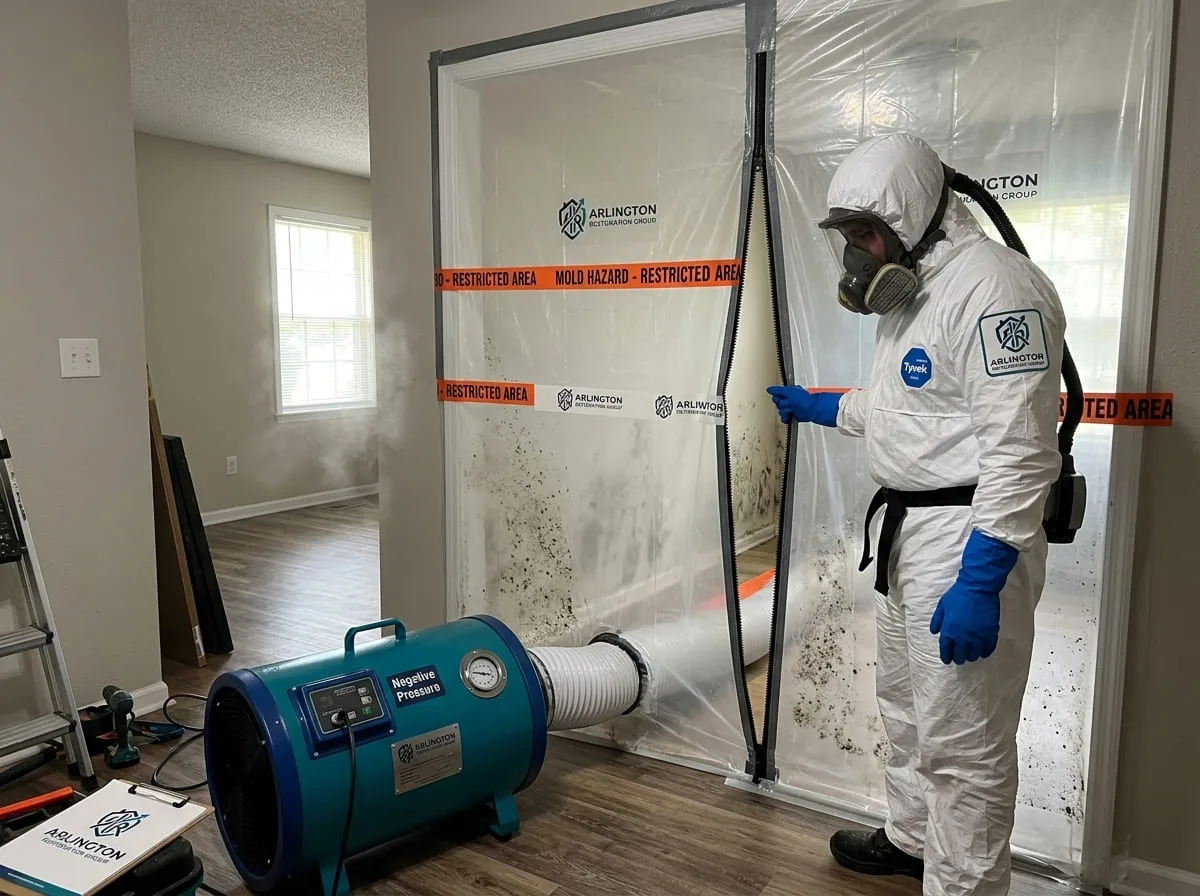
Work typically starts with containment — sealing off the work area with plastic sheeting and, on larger jobs, running negative air machines so spores aren't pushed into the rest of the property while work is underway. Technicians then remove materials that can't be effectively cleaned, such as saturated drywall, insulation, or carpet padding, while salvageable structural materials are cleaned with HEPA vacuuming and appropriate treatment. Once cleaning is complete, the space is dried and, where called for, a post-remediation check confirms the job is finished before containment comes down.
Residential and Commercial Mold Remediation
The fundamentals of containment, removal, and drying apply in both settings, but the logistics differ. A single-family home in Arlington Forest or Westover might involve one or two affected rooms and a homeowner making day-to-day decisions on site. A commercial job in a Ballston office building or a National Landing high-rise more often means coordinating around tenants, property management, and building access, and may be scheduled outside business hours to limit disruption. See residential mold remediation and commercial mold remediation for details specific to each.
Before Help Arrives
If you've found mold or suspect it behind a wall or under flooring, avoid disturbing the material — scrubbing, dry-sanding, or tearing into drywall yourself can release spores into the air rather than contain them. Keep the area closed off where you can, address any ongoing moisture source you can safely reach, such as a running faucet, and avoid operating the HVAC system if you think spores could circulate through it. A phone call can get a qualified technician assessing the situation instead of guessing at next steps from photos.
Mold Remediation Across Arlington and Nearby Communities
Mold remediation is available throughout Arlington County, including Ballston and Virginia Square and the Crystal City and Pentagon City (National Landing) corridor, along with surrounding jurisdictions. See the full service area list for coverage details.
Frequently Asked Questions
What's the difference between mold remediation and mold removal?
The terms are often used interchangeably, but remediation typically implies a more complete process: containing the area, removing or cleaning affected materials, and addressing the moisture source that allowed growth in the first place, rather than just wiping visible spots off a surface.
Do I need a mold inspection before remediation can start?
Not always. If the source and extent of a problem are already clear — a small, visible patch tied to an obvious leak, for example — remediation can often proceed directly. An inspection is more useful when the extent is unclear, the odor has no visible source, or you need documentation for insurance or a real estate transaction.
Can mold come back after remediation?
It can, if the moisture source that caused it in the first place isn't resolved. Remediation addresses the mold that's already there; keeping it from returning depends on fixing whatever kept the material wet, whether that's a leak, poor ventilation, or ongoing humidity.
Does mold have to look black to be worth addressing?
No. Mold can appear white, green, grey, orange, or black depending on the species and the material it's growing on. Color isn't a reliable way to judge whether growth needs attention — extent and location matter more.
Is mold remediation covered by homeowners insurance?
It depends on the cause and your specific policy. Mold tied to a sudden, covered water event is more commonly covered than mold resulting from long-term neglect or a gradual leak. Insurance claim assistance is available through the restoration professionals handling the work.
How quickly should mold be addressed once it's found?
Sooner is generally better, since growth can continue spreading while a decision is pending. That said, there's no need to panic — a contained, well-understood problem can be scheduled and handled methodically once you've made the call.