 Arlington Restoration Group
Flooding in a County That Was Built to Avoid It
Arlington has historically kept a relatively small share of its land inside FEMA's mapped 100-year floodplain, in part because of a 1957 county stormwater plan that preserved flood-prone stream valley land as parkland rather than allowing development on it. That planning history is real, but it isn't a guarantee. FEMA's flood maps were updated effective November 2023, expanding mapped floodplains along several county streams — most significantly Four Mile Run, which forms much of Arlington's southern border with Alexandria, along with Lubber Run and Gulf Branch. Roughly 300 structures are now mapped in the 100-year floodplain, up from 172 previously, and about 1,150 parcels fall within the 500-year floodplain. Flood damage cleanup addresses water intrusion from these external sources — overflowing streams, flash flooding, and groundwater — which behaves differently and carries different risks than an indoor pipe or appliance failure.
What Makes Flood Cleanup Different From an Indoor Water Event
Floodwater that enters a property from outside — whether from a rising stream, storm drain backup, or saturated ground pushing through a foundation — is treated as contaminated water by default, regardless of how clean it looks. It can carry silt, debris, chemicals, and biological contaminants picked up on its way across yards, streets, and storm systems. That changes the cleanup approach: affected porous materials generally can't be cleaned and reused the way they might be after a clean supply-line leak, and technicians work with appropriate protective equipment. This is a meaningfully different process from the roof leaks and wind-driven rain intrusion covered on the storm and rain water damage page — flooding specifically means water arriving from outside the building envelope, at ground level or below.
Signs of Flood Damage to Watch For
- Water entering at or below ground level — through a foundation, window well, or basement floor drain backing up
- Silt, mud, or debris residue left behind after water recedes
- A musty or sewage-like odor accompanying the water
- Water stains or a visible tide line on basement walls
- Saturated ground around the foundation persisting well after rain has stopped
Common Causes Around Arlington
Flash flooding tied to intense summer thunderstorms is a recurring risk across Arlington's stream valleys, and properties near Four Mile Run, Lubber Run, and Gulf Branch carry the most direct exposure given the county's updated floodplain mapping. Larger regional events also matter here — the remnants of Hurricane Ida in early September 2021 brought widespread flash flooding and a statewide State of Emergency across Virginia and the wider D.C. region, a clear example of how a tropical system's remnant rainfall can overwhelm storm drains and stream channels far from the coast. Groundwater intrusion through basement walls and floors during prolonged wet periods is another common, if less dramatic, source of flood-related water damage.
The Cleanup Process
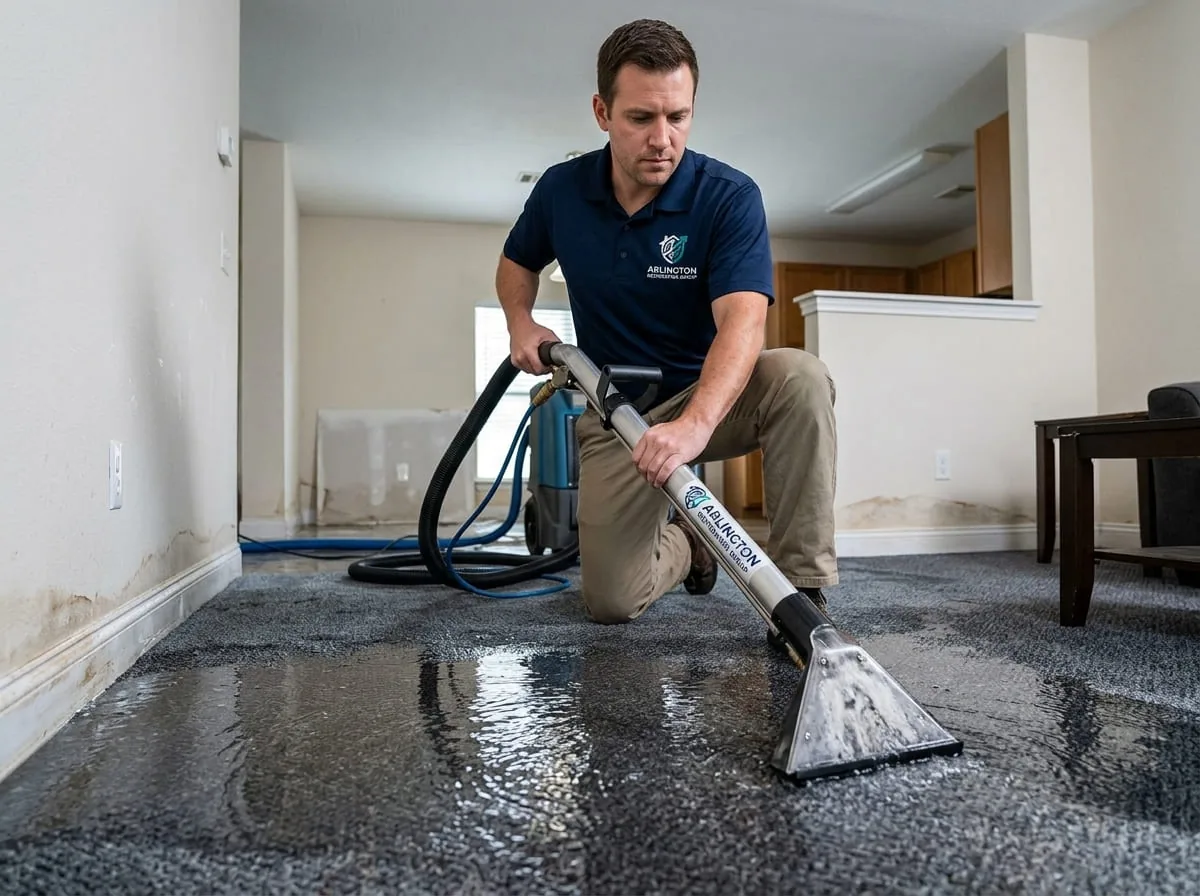
Flood cleanup starts with removing standing water, following the same extraction approach used for any large water event but with contamination-appropriate handling throughout — see water extraction and removal for more on the equipment involved. Affected porous materials are assessed and, where contamination and saturation levels warrant it, removed rather than dried in place. Hard surfaces are cleaned and disinfected. Once contaminated materials are out, the space moves into standard structural drying and dehumidification, monitored with moisture meters until framing and remaining materials return to a normal moisture range.
What Can Usually Be Saved vs. What Typically Requires Removal
Structural framing, concrete, and many hard-surface floors can often be cleaned, disinfected, and dried in place after a flood event. Carpet, carpet pad, drywall that was in contact with floodwater, and insulation are generally not salvageable once contaminated floodwater has reached them — these materials hold contamination in ways that cleaning can't fully reverse, so replacement is the honest recommendation rather than an attempt to save everything.
Basements Are Usually Ground Zero
Because flooding enters at or below grade, basements bear the brunt of it more often than any other part of the property — a particularly relevant point given how common basements are in North Arlington's older single-family housing stock. See basement water damage cleanup for a closer look at that specific scenario.
What to Do Before Help Arrives
- Stay out of floodwater if there's any chance it's contaminated or near electrical systems
- Move valuables, electronics, and important documents to higher ground if it's safe to do so
- Photograph the flooding and its extent before cleanup begins
- Turn off electricity to affected areas at the breaker if accessible without entering standing water
What to Avoid
- Don't attempt to wade through or pump out deep floodwater yourself, especially in a basement where electrical hazards are common
- Don't try to salvage carpet, pad, or drywall that had direct contact with floodwater on the assumption it can just be dried out
- Don't wait for water to recede fully before calling — early documentation and planning helps the response move faster once it's safe to begin
Related Services
Flood damage often overlaps with other pages on this site: sewage cleanup for backup-related contamination, crawl space water damage for properties without a full basement, and the water damage restoration hub for the full range of services available.
Areas Near Arlington's Flood-Prone Waterways
Properties near Four Mile Run and throughout South Arlington, as well as neighboring Alexandria, which shares the Four Mile Run corridor, see the most direct exposure to this kind of flooding and are within the standard response area.
Frequently Asked Questions
Is floodwater from a storm covered by my homeowners insurance?
Standard homeowners policies typically exclude surface flooding, which is usually covered instead by a separate flood insurance policy (often through the National Flood Insurance Program). This varies by policy, so it's worth confirming coverage with your insurance provider — the restoration crew can help document damage regardless of which policy applies.
Why does floodwater require different handling than a burst pipe?
Floodwater arrives from outside the building and can carry silt, debris, and contamination picked up from the ground, storm drains, and surrounding area, which is why it's treated differently from clean supply-line water even when it looks clear.
How do I know if my property is in an updated flood zone?
FEMA's flood maps were updated for Arlington County effective November 2023, expanding mapped floodplains along Four Mile Run, Lubber Run, and Gulf Branch. Arlington County's mapping tools or your insurance provider can confirm whether a specific address falls within the updated boundaries.
Can carpet be saved after a flood?
Generally no, if the carpet had direct contact with floodwater — the contamination risk means replacement is usually the honest recommendation rather than attempting to clean and dry it in place.
What should I do if floodwater is still rising?
Prioritize personal safety first — don't attempt cleanup or enter the property if there's active flooding or safety risk. Once water has receded and it's safe to enter, call to begin documentation and cleanup.