 Arlington Restoration Group
Water Damage Restoration in Ballston & Virginia Square
Ballston and Virginia Square make up one of the densest stretches of the Rosslyn-Ballston Metro corridor, and water damage here rarely behaves the way it does in a single-family home. A supply line failure inside a high-rise unit at Ballston Quarter, The Astoria, or one of the residential towers along Wilson Boulevard and Fairfax Drive doesn't just soak one household's carpet — it drops through a shared floor slab and shows up as a ceiling stain two or three units below.
Calls made through this line are routed to licensed, insured restoration crews who carry professional extraction and drying equipment and are set up for that kind of multi-unit response, not just a single flooded basement.
24/7 Multi-Unit Emergency Response
Emergency water damage doesn't wait for business hours, and neither does dispatch. Whether it's a mid-week pipe failure in a Virginia Square condo tower or a weekend appliance overflow above a Ballston retail space, the same 24/7 line applies.
The professionals we work with handle the full sequence: standing water extraction, moisture mapping to find water that has already migrated into wall cavities and subfloor, structural drying with commercial air movers and dehumidifiers, and — where the water source was gray or black water — sewage cleanup and contamination control before drying even starts.
Related Water Damage Resources
For the full range of water damage services available across Arlington, see the water damage restoration hub. For the emergency response process specifically, the emergency water damage restoration page walks through what happens between the call and the crew's arrival.
Standing water removal is covered in more depth on the water extraction & removal page, and pipe-specific failures — the single most common call type in this corridor's residential towers — are covered on the burst pipe water damage page.
Local Building Stock: High-Rise Corridor Meets Older Garden Apartments
High-Rise Towers vs. Older Garden Apartments
Ballston and Virginia Square are, more than almost anywhere else in Arlington, a study in contrast between two very different water-damage risk profiles sitting a few blocks apart. The commercial core along Wilson Boulevard, Fairfax Drive, and North Glebe Road has been rebuilt since the 1970s into mid-rise and high-rise residential towers on modern copper and PEX plumbing, much of it developed around Ballston Quarter and the Virginia Square institutional cluster near George Mason University's Arlington campus and the Arlington County Central Library.
That construction era brings a specific failure pattern: unit-to-unit leaks that travel through shared risers, chases, and post-tension or standard concrete floor slabs rather than the single-run pipe failures typical of a detached house.
Move a few blocks off the commercial spine, though, and the building stock shifts fast. The edges of Ballston and Virginia Square back directly into older, lower-density neighborhoods — Ashton Heights, Bluemont, and Lyon Park — where garden apartment complexes and brick Cape Cods from the postwar decades are still common, some carrying original or since-replaced galvanized supply lines and, in unrenovated sections, cast iron or clay drain lines.
A restoration call from a garden apartment near Ballston looks very different from one in a 20-story tower: single-unit drain backups and slow supply line leaks behind a bathroom wall, rather than a riser failure cascading down eight floors.
Flood Risk and County Infrastructure
Ballston sits near the upper end of the Lubber Run stream valley, which runs south through Bluemont Park toward Four Mile Run — but the neighborhood's commercial core itself sits well above that valley and is not within Arlington's mapped 100-year floodplain. That doesn't remove flood risk entirely: Arlington's aging combined and separated sewer infrastructure in older sections of the county has been linked to basement backups during intense summer thunderstorms.
A system like the remnants of Hurricane Ida in September 2021 — which triggered a statewide emergency and widespread flash flooding across the D.C. region — can overwhelm storm drains and below-grade parking structures far from any mapped stream valley. For non-emergency water or sewer service questions, Arlington County's Department of Environmental Services (DES) Water/Sewer Engineering section can be reached at (703) 228-3677; active main breaks or sewer backups should go through the county's emergency line.
Common Water Damage Scenarios in Ballston & Virginia Square
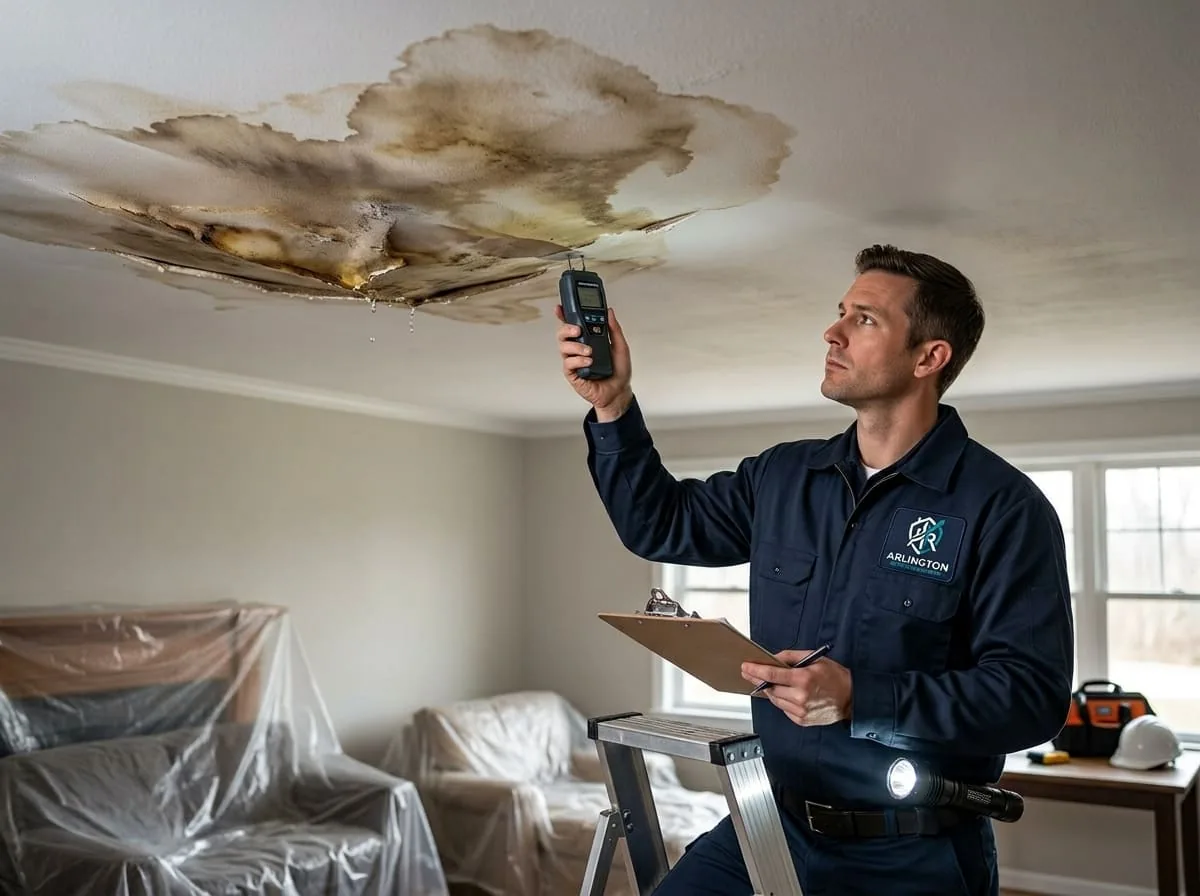
- Riser and stack failures in residential towers. A failed supply riser or a cracked fitting inside a wall chase can send water down through multiple floors before anyone notices, often first appearing as a ceiling stain or bubbling paint in a unit well below the actual source.
- In-unit appliance and fixture leaks. Washing machine supply hoses, dishwasher connections, and water heaters packed into small condo utility closets are a leading cause of individual-unit water damage — see the appliance leak & overflow cleanup page for how that cleanup typically proceeds.
- Shared wall and ceiling damage in condo and apartment buildings. Because floors and walls are shared structural elements in mid-rise and high-rise construction, one unit's water event frequently becomes a multi-unit claim, covered in more detail on the ceiling & wall water damage page.
- Sewage backups from shared drain stacks. Older garden apartment plumbing and, occasionally, a blocked shared stack in a tower, can push contaminated water back into lower-level units — see sewage cleanup.
- Below-grade parking garage and mechanical room flooding. Ballston's mixed-use towers commonly include below-grade parking and mechanical levels, which are vulnerable during heavy thunderstorms when storm drains back up faster than they can drain.
- Slower leaks in the surrounding garden apartments and postwar homes. Aging supply lines and drain pipes in the neighborhoods bordering the commercial core produce the kind of gradual, hidden leaks that are covered further on the hidden moisture behind walls resource page.
Residential and Commercial Response
Ballston's ground-floor retail, restaurant space, and office towers around Ballston Quarter and along Fairfax Drive mean commercial water damage calls are a routine part of coverage here, not an exception. A water event in a mixed-use building can affect a retail tenant's flooring and stock on the ground floor at the same time it's affecting a residential unit two stories up, and the response has to account for both simultaneously — different drying timelines, different business-interruption pressure, and often different points of contact.
The commercial water damage restoration page covers how office, retail, and mixed-use response is typically structured.
On the residential side, whether it's a single condo unit, a full floor of an apartment building, or a garden apartment complex near Bluemont, the process starts the same way: stop the source if it's safely accessible, assess the extent of standing water and hidden moisture, and begin extraction and drying before secondary damage sets in.
The residential water damage restoration page has more detail on what that looks like unit by unit.
Fire Damage Restoration in Ballston & Virginia Square
Fire damage in a dense mid-rise or high-rise building brings its own complications — smoke and soot travel through HVAC systems and shared corridors well beyond the unit where a fire actually started, and a kitchen fire in one condo can leave smoke odor and soot residue in neighboring units and common hallways.
Calls routed through this line reach crews equipped for emergency board-up and tarping to secure a damaged unit or storefront, followed by soot removal, smoke odor treatment, and full reconstruction where needed, since the receiving contractor holds a general contractor license.
Water Damage from Firefighting Operations
Because firefighting operations themselves introduce large volumes of water, fire-damaged units in Ballston and Virginia Square frequently need water extraction and structural drying alongside smoke and soot cleanup — the two problems are addressed together rather than in sequence, which matters more in a sealed high-rise unit than in a detached home with more airflow.
For the full range of fire response, start at the fire damage restoration hub, or see commercial fire damage restoration for retail and office space along the Ballston Quarter and Wilson Boulevard corridor.
Mold Remediation in Ballston & Virginia Square
Mold risk in this part of Arlington tracks closely with the water damage patterns above. A slab leak or riser failure that goes unnoticed for even a few days inside a wall cavity or under carpet in a sealed condo unit — with less natural airflow than a single-family home — can create the humidity and temperature conditions mold needs to establish.
The same is true of the older garden apartments nearby, where a slow leak behind a bathroom wall or under a kitchen sink can go undetected for weeks in an unrenovated unit.
Mold After a Water Event
The mold remediation hub covers inspection, testing and air sampling, containment, remediation, and post-remediation verification in general terms appropriate for a homeowner or condo association trying to understand the process.
Because so much of the mold risk in this corridor follows directly from a prior water event, the mold after water damage page is especially relevant here — it explains the general timeline for how quickly conditions can become favorable for mold growth after a leak or flood, and why fast, verified drying matters as much as the initial extraction.
Humidity, HVAC, and Why Drying Timelines Differ From a House
Washington's summer humidity is a factor in every drying plan in this region, but it plays out differently inside a sealed condo tower than inside a house with operable windows and a walk-out basement. Central HVAC systems in Ballston's residential towers recirculate air across an entire floor or building, which can help move drying equipment's output but can also spread musty odor or airborne moisture if a unit isn't properly contained during drying.
Building engineers typically need to be looped in early so HVAC zoning and any building-wide humidity control can work with, rather than against, the drying equipment placed inside the affected unit. In the older garden apartments nearby, without central building HVAC, drying relies more heavily on portable equipment and depends on how much natural airflow the unit actually has.
Signs You Need Emergency Water Damage Help Now
- Water actively dripping or pooling from a ceiling, light fixture, or above a shared wall — a strong sign the source is in a unit above, not your own.
- A musty odor or soft, spongy drywall near a bathroom, kitchen, or utility closet, which often means moisture has been present longer than it looks.
- Visible water stains that keep reappearing after cleaning, suggesting an ongoing slow leak rather than a one-time spill.
- Standing water in a below-grade parking level or building mechanical room after heavy rain.
- Any backup from a toilet, floor drain, or shared stack, which should be treated as contaminated water rather than a simple spill.
Any of these is a reasonable trigger to call rather than wait and see, since the gap between "damp" and "actively growing mold or spreading structural damage" is often a matter of days, not weeks, inside a sealed unit.
What to Do Next
If water is actively entering a unit, common area, or retail space in Ballston or Virginia Square, the first move is stopping the source if it can be done safely — a unit's own shutoff valve, a building engineer, or Arlington County's water/sewer line for a suspected main break.
From there, a call to this line routes to restoration professionals equipped for 24/7 emergency response, who can assess standing water, begin extraction, and set up structural drying equipment sized to the unit or space involved.
Documentation and Drying Timeline
Photographing visible damage before cleanup begins is worth doing for an insurance claim, and insurance claim assistance is available through the receiving contractor once crews are on site. Moisture readings are typically taken at the start and rechecked over the following days, since drying time depends on the materials and extent of water involved rather than a fixed schedule.
For a step-by-step breakdown of the first hour after discovering damage, see what to do immediately after finding water damage, and for more on how professionals track moisture that isn't visible on the surface, see how professionals find hidden moisture behind walls.
Nearby Service Areas
This line also routes calls for the neighborhoods bordering Ballston and Virginia Square. Clarendon & Courthouse sits just to the east along the same Metro corridor, sharing the high-rise-plus-older-housing pattern described above. To the south and west, Ashton Heights & Bluemont covers the lower-density, older single-family stock that borders Ballston directly, and Westover, Cherrydale & Lyon Park covers the neighborhoods to the north.
Frequently Asked Questions
Do you handle water damage in high-rise condo and apartment buildings in Ballston?
Calls from condo and apartment towers in Ballston and Virginia Square are routed to restoration crews experienced with multi-unit buildings, including riser failures, shared-wall leaks, and coordination with building management or a condo association where needed.
Who do I call first if a pipe bursts in my Ballston condo — the building or a restoration company?
Shut off the water source if it's safely reachable and notify building management or your condo association right away, since the leak may affect neighboring units. A call to this line at the same time gets restoration crews dispatched for extraction and drying without waiting on that other process to finish.
Is Ballston or Virginia Square in a flood zone?
The commercial core of Ballston and Virginia Square sits above the Lubber Run stream valley and is not within Arlington's mapped 100-year floodplain. Heavy summer storms can still overwhelm storm drains and affect below-grade garages or mechanical rooms, but this isn't a riverine flood-zone area in the way parts of southern Arlington are.
Do you clean up water damage in ground-floor retail or office space near Ballston Quarter?
Yes. Commercial water damage response covers ground-floor retail, restaurant, and office space along the Wilson Boulevard and Fairfax Drive corridor, including situations where a leak from a residential unit above affects a commercial tenant below.
How fast can restoration crews respond to an emergency call in Ballston?
24/7 emergency response is available across Ballston and Virginia Square. Exact arrival time depends on current call volume and conditions, so the most reliable way to get a current estimate is to call (703) 419-9452 directly.
What if my leak is in an older garden apartment near Ballston, not a high-rise?
The same emergency response applies. Older garden apartment buildings around Ashton Heights and Bluemont have different plumbing — sometimes original galvanized or cast iron lines — and crews adjust their approach accordingly, but the extraction and drying process follows the same standards.
Can you help with mold after a slow leak I didn't notice right away in my unit?
Yes. Mold inspection, testing, and remediation are available, and if the mold followed a water event, the crew handling the water damage can also address the resulting mold conditions rather than treating them as two separate calls.