 Arlington Restoration Group
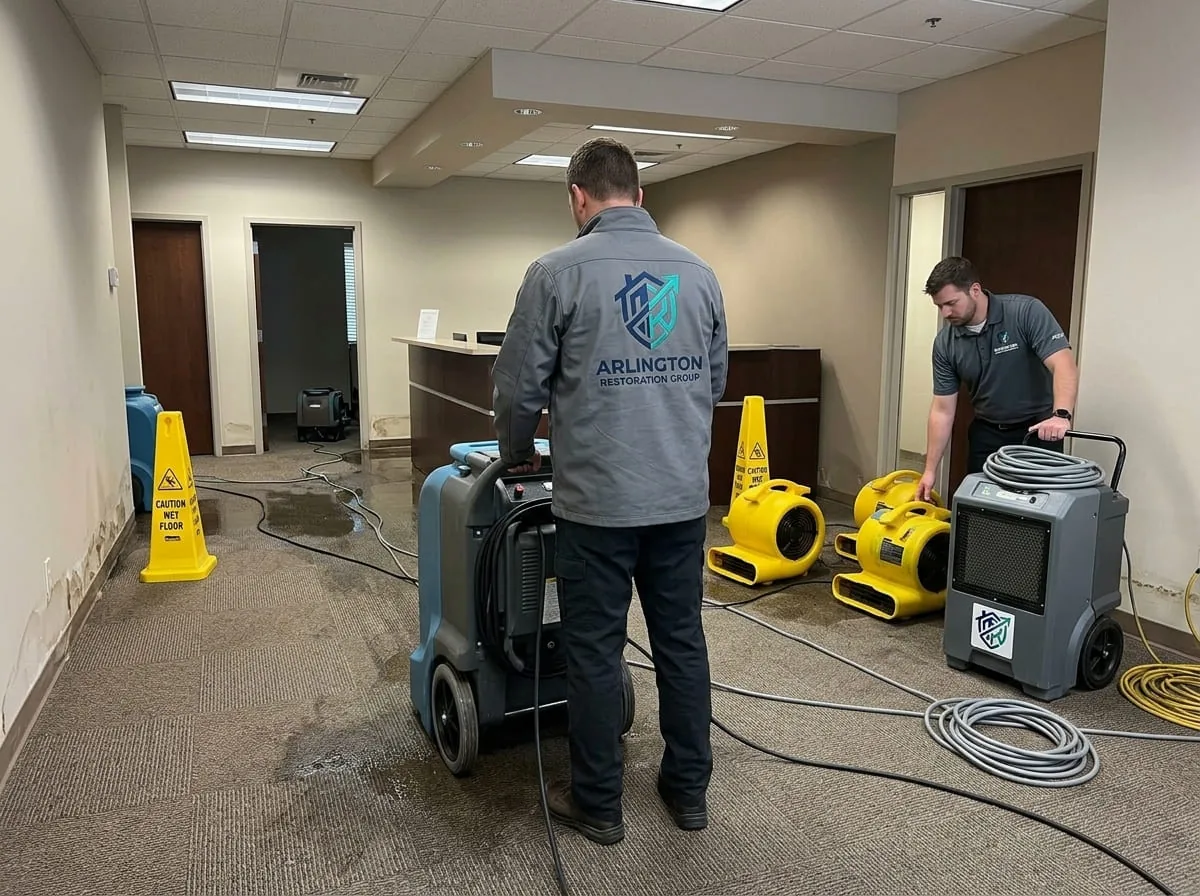
A flooded office suite, retail floor, or multifamily common area is a different problem than a flooded living room. There's more square footage to cover, more equipment and inventory at risk, and usually a lease, a landlord, or a set of tenants asking how fast the space will be usable again. Water damage restoration for commercial property in Arlington follows the same drying science as a residential job, but the equipment, documentation, and coordination scale up to match the building.
Signs a Commercial Property Needs Water Damage Restoration
- Standing water or saturated carpet tile across an office floor, lobby, or retail space
- Water stains spreading across suspended ceiling tiles, often below a floor with a restroom or break room
- A musty smell developing in a storage room, server closet, or supply area within a day or two of a leak
- Warped baseboards, bubbling paint, or soft drywall near an exterior wall or roof line
- A sprinkler head that discharged accidentally, or a fire suppression test that left water behind
- Water intrusion reported by a tenant on a floor below a leak source
Common Causes in Office, Retail, and Multifamily Buildings
Arlington's building stock ranges from low-rise garden apartments and strip retail to the high-rise towers of the Rosslyn-Ballston and National Landing corridors, and each type has its own typical failure points. In older, low-rise commercial buildings, aging supply lines, rooftop HVAC units, and roof drains clogged with debris are frequent sources. In high-rise office and residential towers, shared plumbing risers, unit-to-unit leaks that travel through floor slabs, and rooftop mechanical equipment tend to be the more common culprits. Sprinkler system malfunctions, water heater failures in a mechanical room, and backed-up floor drains round out the list. A single leak on an upper floor of a multi-tenant building can affect several units below it before anyone notices.
What Happens If Commercial Water Damage Sits Unaddressed
Every hour that a commercial space stays wet adds cost. Carpet tile, ceiling tile, and gypsum board that could have been dried often cross into replace-only territory within 24 to 48 hours. Electrical and IT equipment exposed to moisture can develop hidden corrosion that shows up as a failure weeks later. Paper records, files, and inventory stored in cardboard or on lower shelving are especially vulnerable. And because commercial spaces are often climate-controlled and enclosed, elevated humidity from an unaddressed leak can support mold growth behind walls or above ceiling tiles well before it's visible from the floor. None of that helps a business trying to reopen on schedule.
How the Restoration Process Works
Response typically starts with securing the space and stopping the water source where that's within the property's control, followed by an assessment of the affected square footage. Standing water is removed with truck-mounted or portable extraction equipment sized for commercial floor plates, and moisture readings are taken across walls, flooring, and ceiling assemblies to map how far the water traveled. Industrial air movers and commercial dehumidifiers are then positioned to dry the structure in place, with moisture checked periodically until materials return to a normal range. Where suspended ceilings, drywall, or flooring are beyond saving, those materials are removed as part of the same process rather than left to dry and fail later. Water extraction and removal and structural drying and dehumidification are the two phases every commercial job moves through, just at a larger scale than a typical house call.
What Can Usually Be Dried vs. What Typically Needs Removal
Solid surface flooring, structural framing, and many wall cavities can often be dried in place if extraction starts quickly and airflow reaches the wet materials. Carpet tile can sometimes be lifted, extracted, and reset, though carpet exposed to contaminated water is generally not salvageable. Suspended ceiling tile is inexpensive to replace and rarely worth trying to dry once it has sagged or stained. Drywall that has wicked water more than a few inches above the baseboard, and insulation inside a wall cavity, typically needs to come out rather than dry in place — trying to save every material isn't always realistic, and a straightforward answer up front saves time in the claim process.
Moisture Detection Across a Commercial Floor Plate
Because commercial spaces are larger and often compartmentalized with walls, ceilings, and mechanical chases, moisture mapping matters more than it does in a single room. Moisture meters and thermal imaging are used to trace how far water has traveled from the source — under raised flooring, along a wall track, or up into a ceiling plenum — so drying equipment is placed where it's actually needed instead of guessing. This is also how a restoration crew documents the extent of damage for a commercial insurance claim.
Minimizing Downtime, Tenant Disruption, and Loss
Business owners generally have three concerns beyond the water itself: how fast the space can reopen, what obligations exist to tenants or a landlord under a lease, and what's been lost in equipment, inventory, or records. None of those are things a website can promise a specific timeline for, since drying time depends on how much water intruded and what materials absorbed it. What can be said is that faster extraction and drying generally shortens downtime, and that documenting the damage — photos, an inventory of affected equipment or stock, and any tenant notifications — early in the process supports both the restoration work and any insurance or lease-related claim that follows. In multi-tenant buildings, coordinating access with property management and affected tenants is usually part of getting the drying equipment where it needs to be.
Before Restoration Crews Arrive
- Shut off water at the nearest valve if the source is a plumbing failure and it's safe to reach
- Cut power to affected outlets or equipment at the breaker if water is near electrical systems
- Move electronics, inventory, and paper records off the floor and away from the wet area if it's safe
- Photograph the damage before anything is moved or discarded, for insurance purposes
- Notify property management or affected tenants if the building is multi-tenant
What to Avoid
- Running business-critical electronics or equipment that may have gotten wet before they're checked
- Using a shop vacuum rated for dry debris on standing water
- Waiting through a weekend or holiday closure before calling — water damage doesn't pause with the business
- Assuming a small leak is contained without checking the floor below or adjacent units
Related Water Damage Services
Commercial jobs often overlap with several other services depending on the source and scope of the damage. See emergency water damage restoration for after-hours response, sewage cleanup for backups affecting restrooms or floor drains, and ceiling and wall water damage for leaks traveling between floors. The water damage restoration hub has an overview of every service available.
Serving Arlington's Commercial Districts
Commercial water damage calls come from across Arlington's business corridors, including the office towers around Rosslyn and the retail and restaurant strip along Columbia Pike, as well as neighboring commercial areas in Tysons.
Frequently Asked Questions
How is commercial water damage restoration different from a residential job?
The drying science is the same, but commercial jobs usually cover more square footage, involve building systems like suspended ceilings and shared plumbing risers, and require coordination with property management or tenants. Equipment is scaled up accordingly, and documentation for a commercial insurance claim tends to be more detailed.
Can a business stay open during water damage restoration?
It depends on how much of the space is affected and how the drying equipment needs to be positioned. Some businesses can operate around a contained drying area; others need the affected zone cleared until moisture readings return to normal. This is assessed on a case-by-case basis once the extent of the damage is known.
Who handles insurance documentation for a commercial claim?
Insurance claim assistance is available through the restoration contractor handling the job, who can document moisture readings, photos, and the scope of work performed. Property owners typically still need to file the claim with their own commercial policy.
What if water damage affects multiple tenants or floors?
Multi-tenant water damage is common in shared buildings, especially when a leak on an upper floor travels down through a slab or wall cavity. Restoration crews assess each affected unit or floor separately and coordinate access with property management as needed.
Is emergency service available outside business hours?
Yes. Emergency response for commercial water damage is available 24 hours a day, since a leak that starts overnight or over a weekend doesn't wait for the next business day to cause damage.
Can commercial flooring and ceiling tile be saved?
Some flooring can be dried and reset depending on the material and how contaminated the water was. Suspended ceiling tile is generally inexpensive to replace and is rarely worth trying to save once it's stained or sagging. A restoration technician can give a specific assessment once they see the affected materials.