 Arlington Restoration Group
When a Water Problem Becomes a Mold Problem
Not every water event leads to mold, but every water event creates the conditions mold needs: moisture, an organic food source like drywall paper or wood framing, and time. When water intrusion — from a burst pipe, a flooded basement, an appliance leak, or firefighting water — isn't extracted and dried quickly and completely, mold can begin developing in the affected materials. This page covers what to look for and what the remediation process involves once mold has followed a water loss. For the water event itself, see water damage restoration.
How Long It Actually Takes
There's no single number that applies to every situation — humidity, temperature, the material involved, and how much water was present all affect the timeline. In general, materials that stay wet for an extended period carry meaningfully higher risk than materials that are extracted and dried within the first day or two, which is why the drying phase of a water damage job matters just as much as the initial extraction. Our resource article on how quickly mold can become a concern after water damage goes into more detail on the factors involved.
Signs Mold Has Developed After a Leak or Flood
- A musty or earthy odor that persists after the area has dried
- Discoloration on drywall, baseboards, or the underside of flooring
- A water stain that keeps reappearing even after it's been painted over
- Humidity or condensation in a room that felt normal before the water event
- Visible growth in a spot that took on water weeks or months earlier
- A musty smell or stuffiness that eases noticeably when you leave the space
Why Incomplete Drying Is the Most Common Cause
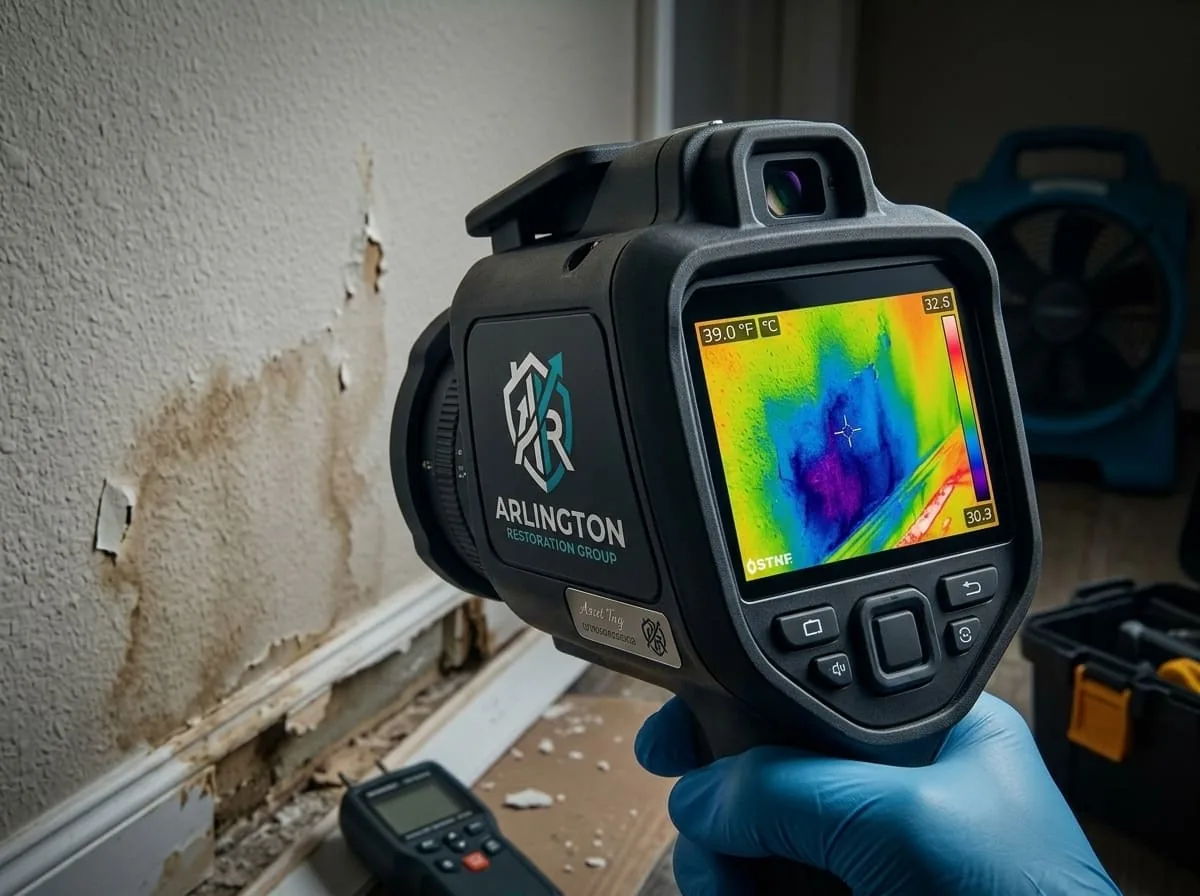
The most common path to post-water-damage mold isn't a dramatic flood — it's a wall cavity, subfloor, or piece of trapped carpet padding that looked dry on the surface but stayed wet underneath. Surface-dry drywall can still be damp inside the wall cavity, and carpet that feels dry to the touch can sit over saturated padding. Professional drying uses moisture meters and, often, thermal imaging to confirm materials are dry all the way through rather than relying on a visual check, which is why structural drying and dehumidification is treated as its own phase of a water damage job rather than an afterthought.
Common Arlington Scenarios
Arlington's mix of housing types produces a few recurring patterns. In older North Arlington homes with basements — common in neighborhoods like Arlington Forest and Westover — a flooded or chronically damp basement that isn't fully dried is one of the most frequent sources of after-the-fact mold; see basement and crawl space mold remediation. In the Rosslyn-Ballston and National Landing high-rise corridors, a leak from a neighboring unit or a shared riser can introduce moisture into a wall or ceiling cavity that isn't discovered until a musty smell or a stain shows up well after the original leak was fixed. A burst supply line inside a wall — see burst pipe water damage — is another common trigger, since it can run for hours before anyone notices.
Risks of Waiting
Once conditions are right, mold can keep developing while a decision about next steps is pending, which means a small, contained problem can become a larger one — spreading to more material or a wider area — the longer it's left alone. Waiting also makes it harder to say with confidence how far a problem has spread, since growth that started behind a baseboard or under flooring isn't visible until it's more advanced.
What the Process Involves
When mold is identified after a water event, the work generally starts by confirming the moisture source has actually been resolved — there's little point remediating mold that will simply come back. From there, the affected area is contained, materials that can't be effectively cleaned are removed, remaining surfaces are cleaned and treated, and the space is dried and monitored. If the original water damage restoration is still underway, mold remediation is coordinated with it rather than treated as a separate, disconnected job.
Residential and Commercial Considerations
In a home, mold after water damage is often confined to one room or a section of a basement, and the priority is usually getting a family back into normal use of the space. In commercial and multi-unit buildings, a leak that caused mold in one unit or suite can affect the space of a tenant who wasn't responsible for the original event, which adds a coordination layer with property management and, often, a building's engineering staff. See commercial mold remediation for more on that side of it.
Before Help Arrives & What to Avoid
If a previous water event has dried but you're now noticing a musty smell, discoloration, or a stain that keeps returning, avoid painting over it or covering it with new flooring — that hides the problem without solving it and can make later assessment harder. Don't aim a fan or dehumidifier directly at visible growth, since that can spread spores rather than contain them. If you're still in the middle of drying out a recent water loss, follow the guidance on our emergency water damage restoration page and get the structure fully dried rather than assuming it's fine because the surface looks dry.
Related Services
For the broader picture, see the mold remediation overview, mold inspection if you're not sure whether a problem exists, mold testing and sampling if you need lab-confirmed results, and water damage restoration if you're dealing with an active leak or flood right now.
Frequently Asked Questions
How soon after a leak should I start worrying about mold?
There's no fixed timeframe that applies to every case — it depends on how much water was involved, the material affected, and how quickly and completely the area was dried. If drying was fast and thorough, risk is lower; if an area stayed damp for an extended period, it's worth having it checked.
My basement flooded and dried out on its own — could there still be mold?
Yes, that's a common scenario. A basement can look and feel dry on the surface while framing, subfloor, or insulation underneath stayed wet long enough to support growth. It's worth having the space assessed, especially if there's any lingering musty odor.
Does insurance cover mold that developed after a covered water loss?
Often, yes, when the mold is directly tied to a sudden, covered event and addressed reasonably promptly, but coverage varies by policy and carrier. Insurance claim assistance is available through the restoration professionals handling the work.
Can the same crew handle both the water damage and the mold that followed it?
In many cases, yes — calls are routed to restoration professionals equipped to handle both water damage restoration and mold remediation, which helps keep the drying and remediation work coordinated instead of split across separate jobs.
Is it normal to still smell a musty odor after a leak has been fixed?
No, a persistent musty smell after the source of a leak has been repaired usually points to hidden moisture or growth somewhere in the affected materials, and it's worth having assessed rather than assumed to be nothing.