 Arlington Restoration Group
Water Damage Restoration in Falls Church, VA
A Small City With a Range of Building Ages
The City of Falls Church is a small, largely residential independent city bordering Arlington County to the northwest — just over two square miles, but home to established single-family neighborhoods, a walkable small-town commercial core, and a growing amount of newer infill development.
Calls from Falls Church reach trained restoration technicians equipped with professional extraction and drying equipment for 24/7 emergency response across the city, whether that's a flooded basement in an older home, a burst supply line, or storm water finding its way into a crawl space.
The response follows the same core priorities everywhere: shut off or contain the source, get standing water out, and start drying before the damage spreads into framing, subfloor, and drywall.
Services Across the City
The water damage restoration hub covers the full service range, starting with water extraction and removal for any standing water, whether it's a few inches in a basement or a fully flooded lower level.
Storm events and heavier rainfall are handled under flood damage cleanup, and a sudden pipe failure — a split copper line in an exterior wall during a cold snap, a failed connector under a sink — is addressed as burst pipe water damage, with the water source located and shut off as the first step.
A backed-up sewer lateral or overwhelmed sump system is treated as sewage cleanup, handled with containment and proper protective procedures rather than a standard water cleanup, since it involves contaminated water. Once the source is controlled and standing water is removed, structural drying and dehumidification equipment goes to work on whatever the water reached — framing, subfloor, insulation, and drywall that can hold moisture well after the surface looks dry.
Falls Church Housing Stock and Local Water Damage Risk
Postwar Homes and Aging Plumbing
Falls Church's residential character developed in the same general era as much of Arlington's older housing stock. A substantial share of the city's homes are Cape Cods, colonials, and ranch-style houses built from the 1930s through the 1960s as the Washington area's postwar suburbs expanded, on tree-lined streets that give the city much of its small-town feel despite sitting inside the Capital Beltway.
That means many of the same age-related plumbing issues found in Arlington's established neighborhoods show up here too — original or partially replaced galvanized supply lines, and cast iron or clay drain lines in homes that haven't been fully re-piped.
Newer infill construction and some multifamily development near the West Falls Church and East Falls Church Metro-adjacent corridors have brought modern copper and PEX plumbing into parts of the city, but the older single-family core still makes up much of Falls Church's housing.
Basements and Storm Exposure
Basements are common in Falls Church's older single-family homes, consistent with the rolling terrain found throughout this part of Northern Virginia, and both basement and crawl space water intrusion are genuinely routine calls rather than an unusual event.
The region's humid summers and pattern of intense, fast-moving thunderstorms put pressure on aging sump systems and storm drainage alike, and the same kind of regional storm events that have caused flash flooding and wind damage elsewhere in the D.C. area — including the remnants of Hurricane Ida in September 2021, which triggered a statewide emergency — affect Falls Church along with its neighboring jurisdictions.
Where Old and New Plumbing Meet
Falls Church's small footprint also means many of its homes sit on lots close to their neighbors, so how one property's stormwater is graded and drained can affect the property next door, not just its own foundation.
In a home that's had a partial plumbing update — a renovated kitchen or bathroom on modern PEX, tied into original galvanized lines feeding the rest of the house — the transition points between old and new materials are a recognized weak spot, and an inspection after a leak generally looks at the surrounding plumbing rather than only the fixture nearest the visible damage.
Common Water Damage Scenarios in Falls Church
- Basement flooding in older single-family homes. Homes built from the 1930s through 1960s commonly have full or partial basements, and sump pump failure, foundation seepage, or a failed water heater in a finished basement are recurring causes.
- Crawl space moisture intrusion. Homes on crawl space foundations are exposed to groundwater and storm runoff intrusion that can go unnoticed for a while, since a crawl space isn't part of everyday living space. See crawl space water damage for what that response looks like.
- Aging supply and drain line failures. Original galvanized supply lines and cast iron or clay drain lines in unrenovated homes are prone to age-related corrosion and failure, particularly in homes that haven't been re-piped since original construction.
- Hardwood flooring damage. Original hardwood floors, common in Falls Church's older single-family homes, cup and buckle when exposed to standing water, and how quickly the water is removed has a direct effect on whether the flooring can be saved — see hardwood & flooring water damage.
- Sump pump failure during summer storms. A sump pump that fails during a heavy thunderstorm, or simply can't keep pace with a fast-moving system, is one of the most common triggers for a basement flooding call — see basement water damage & flooded basement cleanup.
- Roof and ice dam leaks in winter. Older roofs and inadequate attic insulation can lead to ice dam formation in cold snaps, pushing melting snow and ice back under shingles and into ceilings and exterior walls.
- Frozen and burst exterior-wall pipes. A hard freeze can split a supply line running through an uninsulated exterior wall or crawl space, a recurring seasonal cause of sudden, high-volume leaks in older homes across the region.
- Small commercial and main-street flooding. Falls Church's compact commercial core along Broad Street and West Broad Street includes older commercial buildings whose basements and lower levels are exposed to the same storm and plumbing risks as the city's residential stock.
Residential and Commercial Capability
Homes Across the City
Falls Church is a predominantly residential city, and most calls involve single-family homes — basements, crawl spaces, kitchens, and bathrooms where a leak or storm event has caused damage. Residential water damage restoration covers the full range, from an older Cape Cod with original plumbing to a newly built infill home.
A Small but Real Commercial Core
The city's small but real commercial core, along with office and retail space near the East Falls Church and West Falls Church Metro station areas, is also covered under commercial water damage restoration, scoped to keep a business's downtime and disruption to a minimum while the space is dried out and assessed.
Falls Church is one of the smallest self-governing cities in the state, and that scale means most commercial calls involve small, independently run businesses rather than large office campuses — a shop or restaurant that needs to reopen quickly matters just as much here as a larger commercial account does elsewhere in the service area.
Multifamily Buildings Near the Metro Corridors
Multifamily buildings near the East Falls Church and West Falls Church Metro-adjacent corridors bring a smaller version of the stacked-unit leak pattern found in larger high-rise buildings elsewhere in the region — a leak in one unit affecting the unit below it — and that work is scoped the same way it would be in a larger building, just at a smaller scale.
Mold Remediation in Falls Church
Inspection, Containment, and Removal
Basements and crawl spaces that take on water and aren't fully dried out are the most common path to a mold concern in Falls Church's older housing stock. Mold remediation begins with an inspection to identify the extent of growth and its likely source, followed by containment to keep spores from spreading to unaffected areas, removal of affected material, and remediation carried out to recognized industry standards.
It's worth being realistic that not every material exposed to prolonged moisture can be saved — porous materials like drywall, carpet padding, and some insulation may need to be removed rather than treated, and an honest assessment up front avoids surprises later.
Testing and Verification
Mold after water damage is addressed as a natural extension of the water damage response, since the two issues are directly connected: a basement or crawl space that dries completely and promptly has a meaningfully lower chance of developing a mold problem than one that's left even partially wet.
Where growth is already visible, or where an inspection needs to confirm whether hidden moisture behind a wall or under flooring has led to growth, air and surface sampling can help settle the question, and post-remediation verification testing confirms the space is clear once the work is finished.
Fire Damage Restoration in Falls Church
Fire damage in a Falls Church home often comes with its own water damage component, whether from firefighting hose lines or a residential sprinkler system in newer construction. Fire damage restoration covers emergency board-up and tarping to secure a damaged home, smoke and soot cleanup, and, because the receiving contractor holds a general contractor license, full reconstruction back to a livable condition.
Older homes with plaster, original trim, and aging electrical systems sometimes require more careful assessment of smoke penetration into wall cavities and attic spaces than newer construction, and firefighting water needs the same structural drying attention as any other water event before rebuild work starts.
Contents cleaning and pack-out is available for belongings that need to be removed from a home during drying and repair work, so smoke-affected items can be cleaned and stored away from the active job site rather than left in place.
What to Do Next
Stopping Further Damage
If water damage has already happened in a Falls Church home or business, the priority is stopping further damage: shut off the water source if it's safe and accessible, move belongings and electronics out of the affected area, and avoid running a shop vac or fans in a way that spreads contaminated water if a sewage backup is involved.
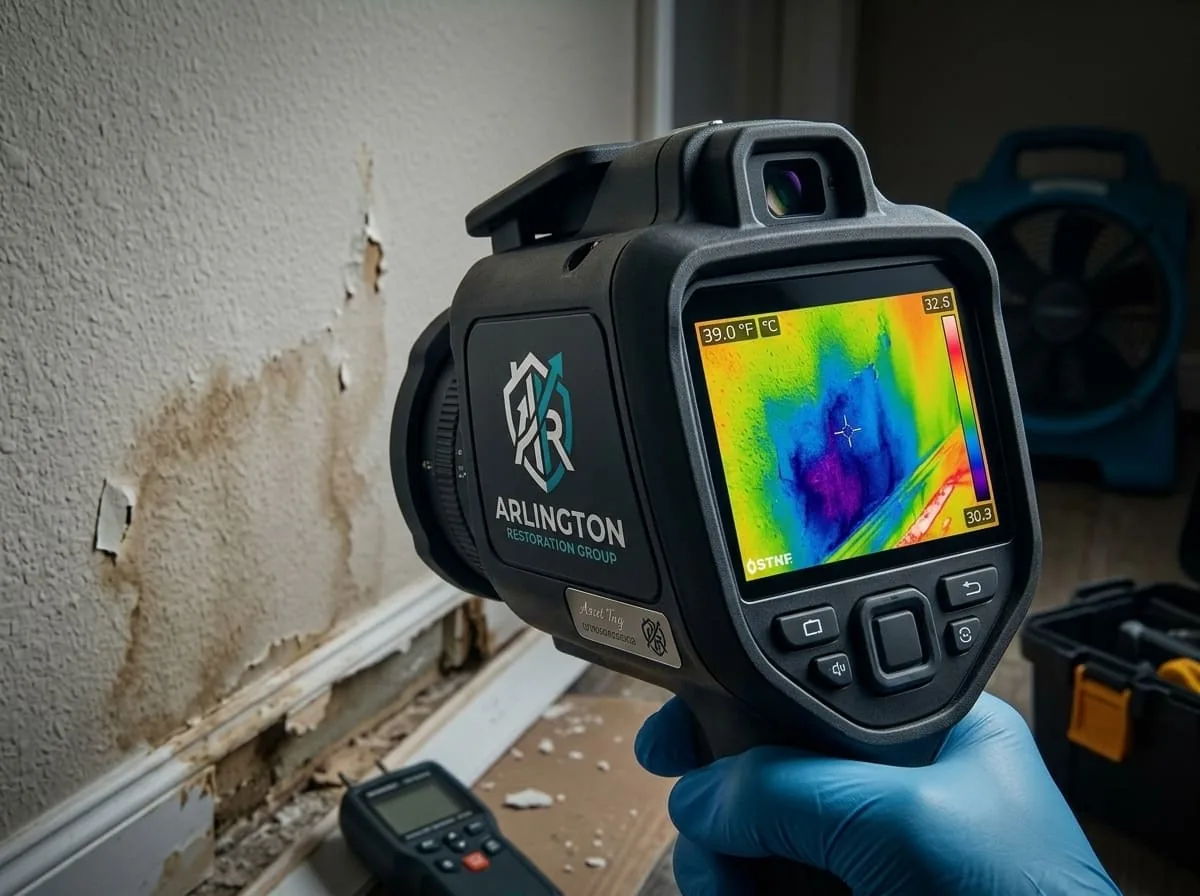
Calling for emergency service starts the process — a dispatcher gathers the basic details, a crew is sent with extraction and drying equipment sized to the job, and once standing water is removed, moisture meters and thermal imaging map how far the water traveled behind walls, under flooring, and into a basement's framing before any drying equipment is set.
Insurance claim assistance is available throughout, helping document the damage for whatever policy applies. See how professionals find hidden moisture behind walls for more on that step.
When It's Worth Calling
For a homeowner who isn't sure whether a wet basement or a stained ceiling is worth an emergency call, a general rule holds up well: if the source hasn't stopped, if the affected area is more than a small, isolated spot, or if it's been more than a day since the water appeared, it's worth calling rather than waiting.
Materials that are caught and dried early are far more likely to be saved than materials that sit wet for several days while a decision gets made.
What Happens to Wet Drywall, Flooring, and Framing
A common question after a basement or crawl space floods in an older Falls Church home is whether the drywall, subfloor, or framing that got wet can be saved at all. The honest answer is that it depends on how long the material was wet, how much water it absorbed, and whether it was clean water or contaminated water — the can wet drywall be saved guide covers the general factors that go into that assessment.
Framing and subfloor that dry out promptly and test dry with a moisture meter are often kept in place; drywall, insulation, and carpet padding that stayed wet too long, or that were exposed to contaminated water, more often need to be removed.
That assessment happens on-site as part of the initial inspection, not guessed at in advance, and it's documented as part of the overall claim so an insurance adjuster can see exactly why a given material was kept or removed.
Nearby Service Areas
Coverage extends into the Arlington neighborhoods that border Falls Church, including Westover, Cherrydale & Lyon Park immediately to the east and Ballston & Virginia Square a short distance further in, as well as neighboring Vienna, VA in Fairfax County.
Frequently Asked Questions
Is Falls Church a separate city from Arlington?
Yes. Falls Church is its own small independent city bordering Arlington County to the northwest, and it's covered under the same 24/7 emergency water, fire, and mold response as the rest of the service area.
My basement floods every time there's a heavy storm — is that a common problem in Falls Church?
It's a recurring issue in the city's older single-family housing stock, which often has full or partial basements. Sump pump failure and foundation seepage during heavy rain are common causes, and an inspection can identify the specific source.
How old does a home's plumbing need to be before it's a water damage risk?
There's no fixed age, but original galvanized supply lines and cast iron or clay drain lines — common in homes built from the 1930s through 1960s that haven't been fully re-piped — are more prone to age-related failure than modern copper or PEX.
Do you handle crawl space water intrusion, or just basements?
Both. Crawl space moisture is addressed with the same extraction, drying, and moisture-verification approach as a basement, since an undetected wet crawl space can lead to the same structural and mold concerns.
What should I avoid doing if I have a sewage backup in my basement?
Avoid direct contact with the water and avoid using a shop vac that isn't rated for contaminated water. Sewage backups are treated as contaminated water requiring containment and proper protective procedures, so it's best to leave extraction to a professional crew.
Can water damage restoration help with an ice dam leak in winter?
Yes. Ice dam-related leaks are treated the same as any other water intrusion — the immediate water is extracted, moisture is mapped through the affected ceiling and wall assembly, and structural drying follows before any repair work begins.
Is emergency response available in Falls Church at night or on weekends?
Yes, 24/7 emergency response covers Falls Church every day of the year, since water damage doesn't wait for normal business hours.