 Arlington Restoration Group
Water Damage Restoration in Alexandria, VA
Alexandria is its own independent city, separate from Arlington County, sitting just south across Four Mile Run — but a burst pipe, flooded basement, or storm-driven water intrusion doesn't care about a jurisdiction line. Every call from Alexandria is routed to qualified, insured restoration specialists prepared for 24/7 emergency dispatch across the city, from the historic brick rowhomes of Old Town to the newer condo and townhome development along the Eisenhower corridor and West End.
Response covers everything from a slow supply line leak found early to a fully flooded lower level, with the same priority in every case: get water out, get the space drying, and limit how much damage spreads before it's addressed.
Water Damage Services Available
The water damage restoration hub outlines the full range of services available, and the initial response focuses on water extraction and removal from flooring, carpet, and any furniture or belongings that took on water, followed by an assessment of what's salvageable.
Larger events — a flooded lower level after a heavy storm, a supply line failure that ran for hours before anyone noticed — follow flood damage cleanup protocols, while a sudden pipe failure is handled as burst pipe water damage, with the source located and shut off before extraction begins.
Where a sewer line or sump system backs up, sewage cleanup is treated as contaminated water requiring containment and proper protective procedures, not a standard cleanup. Once the water itself is gone, the harder part starts — structural drying and dehumidification of framing, subfloor, and drywall that can look dry on the surface while still holding enough moisture to cause problems weeks later.
Alexandria's Housing Stock and Local Water Damage Risk
Alexandria's building stock spans a wider range of eras than almost anywhere else in the immediate D.C. area. Old Town's historic core includes brick rowhomes and townhomes, some well over a century old, many built with below-grade or partially below-grade "English basement" levels that sit close to the water table and are especially exposed to moisture intrusion, sump pump failure, and grading issues that push water toward the foundation instead of away from it.
Surrounding neighborhoods carry a mix of early-to-mid-20th-century single-family homes and postwar construction, similar in general era to the older housing stock found across Arlington, while the West End, Eisenhower Valley, and areas near National Landing have seen substantial newer condo, apartment, and townhome development in recent decades.
That range means the restoration approach genuinely depends on which part of the city a property sits in — an older rowhome's cast iron or galvanized plumbing and below-grade basement level behave differently under water intrusion than a newer townhome or mid-rise condo unit built on modern copper or PEX supply lines.
Four Mile Run and Regional Flood Risk
Four Mile Run, which forms much of the boundary between Alexandria and Arlington County, is the region's principal flood-prone waterway and has been the subject of a long-running regional flood control and stream restoration effort.
Properties near that boundary, and more broadly any low-lying or below-grade space in the city, are the ones most exposed when the Mid-Atlantic's humid summers deliver an intense thunderstorm, or when a tropical system's remnant rainfall — like the flash flooding the wider Washington, D.C. region saw from the remnants of Hurricane Ida in September 2021, which triggered a statewide emergency — overwhelms storm drains faster than they can move water away from foundations and basement walls.
Renovations and Mixed Plumbing Systems
Partial renovations are common across Alexandria's older housing stock, and they add a layer of complexity a fully original or fully renovated home doesn't have. A rowhome that's had a kitchen or bathroom updated with modern PEX or copper supply lines may still have galvanized steel feeding the rest of the house, and the transition points between old and new materials are a recognized weak spot for leaks.
The same applies to drain lines — a section of replaced PVC tied into original cast iron can develop problems at the joint years before either material would fail on its own. None of that changes how a leak is handled once it's found, but it's part of why an inspection in an older Alexandria home often looks at the whole supply and drain system, not just the fixture nearest the visible damage.
Common Water Damage Scenarios Around Alexandria
- English basement and below-grade level flooding in Old Town. Historic rowhomes with below-grade living or storage space are particularly exposed to sump pump failure, backed-up drains, and groundwater intrusion during heavy rain.
- Aging plumbing in older rowhomes and single-family homes. Original or partially replaced galvanized supply lines and cast iron drain lines are still found in unrenovated sections of Alexandria's older housing stock, and both are prone to age-related failure.
- Sump pump failure during storms. A sump pump that fails, or simply can't keep pace with a heavy summer thunderstorm, is one of the most common causes of basement and lower-level flooding calls.
- Water heater and appliance failures in finished basements. Finished lower levels common in Alexandria's single-family and townhome stock mean a failed water heater or washing machine hose can damage flooring, drywall, and stored belongings before it's caught.
- Shared-wall leaks in townhome and rowhome communities. Attached housing common throughout the city means a leak doesn't always stay contained to one address — moisture can travel along a shared wall into a neighboring unit.
- Unit-to-unit leaks in newer condo and mid-rise buildings. Newer development near the West End and National Landing shares the same stacked-unit leak pattern found in high-rise construction elsewhere in the region.
Residential and Commercial Capability
Residential calls make up the majority of the work in Alexandria — Old Town rowhomes, single-family homes throughout the city's established neighborhoods, and newer townhomes and condos — and residential water damage restoration is scoped to the property type, whether that's a historic home with plaster walls and original woodwork or a modern townhome with drywall and engineered flooring.
Alexandria is also home to a dense commercial core along King Street, the Old Town waterfront, and the office and retail development in the West End and Eisenhower corridor, and commercial water damage restoration covers restaurants, retail storefronts, and office space where water damage needs to be addressed with minimal disruption to a business trying to stay open.
Historic District Exterior Repairs
Properties within Old Town's historic district add one more consideration: exterior repair work — siding, trim, masonry, roofing — sometimes needs to go through the city's historic preservation review process before it's completed, separate from the restoration work itself.
That review generally applies to visible exterior changes rather than interior drying and repair, so it typically doesn't slow down the initial water damage response, but it's worth flagging early with the restoration crew and, where needed, the city, so exterior repairs aren't held up unnecessarily once interior drying is complete.
Fire Damage Restoration in Alexandria
Fire events bring their own water damage problem, whether it's firefighting water that soaked into flooring and drywall or sprinkler discharge in a newer commercial or multifamily building. Fire damage restoration in Alexandria covers everything from emergency board-up and tarping to protect a damaged structure, through smoke and soot cleanup, to full reconstruction — the receiving contractor holds a general contractor license, so fire-damaged homes and businesses can be brought all the way from initial mitigation back to a rebuilt, livable condition.
Restaurant and Commercial Kitchen Fires
Older homes in particular tend to have more absorbent, harder-to-clean materials — plaster, original trim, older insulation — which is part of why firefighting water and smoke damage in a historic property often takes more careful assessment than a straightforward drywall-and-carpet home.
Restaurant and food-service kitchens along King Street and elsewhere in the city's commercial corridors carry their own fire risk profile, and a kitchen fire typically brings grease-laden smoke residue and firefighting water into adjoining dining and storage areas — commercial fire damage restoration and soot removal are scoped for that kind of space specifically.
Mold Remediation in Alexandria
Humid summers, older basements, and a genuine mix of housing ages make mold a routine concern across Alexandria rather than a rare one.
Mold remediation starts with inspection to identify the extent of growth and its likely moisture source, followed by containment, removal of affected material, and remediation using recognized industry practices — described honestly, without promising that every affected material can be saved, since porous materials like drywall or carpet padding that have been wet long enough sometimes need to be removed rather than treated.
Mold after water damage is a particular concern in Old Town's English basements and any below-grade space where a leak or flood event isn't caught right away, since enclosed, poorly ventilated lower levels hold moisture longer than above-grade living space. Air sampling and surface testing are available where a visual inspection alone doesn't settle the question of whether growth is present or how far it extends, and post-remediation verification confirms the space is clear once remediation work is finished.
What Happens After You Call
The Extraction and Drying Process
A call about water damage in Alexandria starts with a few basic details — address, what's happening, and whether the water source has been stopped — so the right crew and equipment can be dispatched.
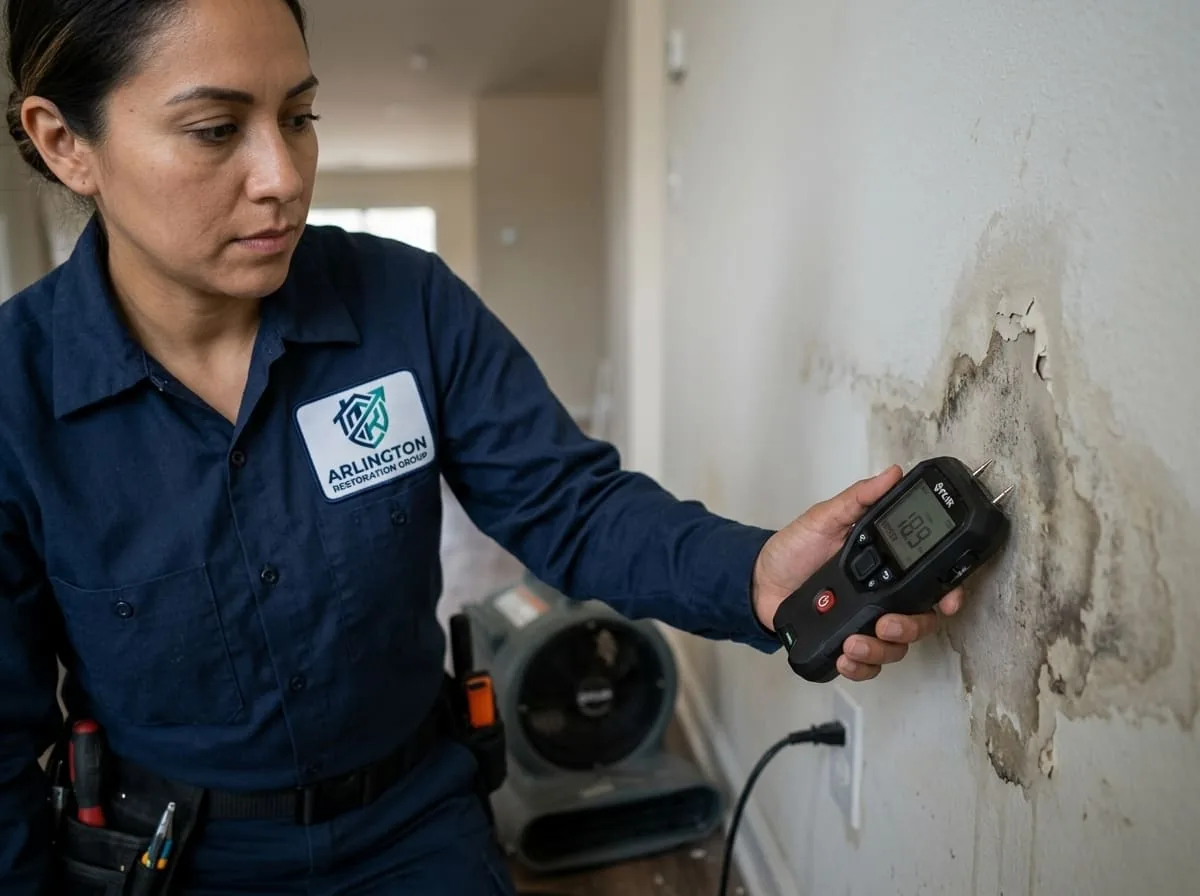
On site, the first priority is controlling the source if it's still active, then extracting standing water and beginning the moisture assessment: checking flooring, drywall, and framing with moisture meters to map how far the water traveled, since damage in an older home with plaster and lath can extend further than it appears from the surface.
Structural drying follows, with air movers and dehumidifiers left in place and monitored until materials test dry rather than just look dry — drying time varies with how much water was involved, what materials absorbed it, and the home's construction, so it's tracked with moisture readings rather than assumed on a fixed schedule (see how long does water damage take to dry for the general factors involved).
Insurance claim assistance is available throughout the process to help document the loss for whichever policy applies. For basement-specific guidance, see flooded basement: immediate steps and common mistakes.
Commercial Response Speed
For a restaurant, retail shop, or office along King Street or elsewhere in Old Town, speed matters more than it does for most residential calls — getting water out and drying equipment running before the next opening shift can be the difference between a short closure and a much longer one.
The same extraction and structural drying process applies whether the water came from a storm, a burst line, or a backed-up drain; what changes is how urgently a commercial space needs to be back in operation, and dispatch and equipment selection account for that.
Why the Water Source Changes the Response
Not all water damage is treated the same way, and the distinction matters in a city with as much older plumbing and as many below-grade spaces as Alexandria.
A clean supply line break is handled differently than gray water from an appliance overflow, which is handled differently again than black water from a sewer backup or storm floodwater that may have picked up contaminants on its way into a basement — the water damage categories explained guide covers how clean, gray, and black water are defined and why the category affects what protective equipment and containment steps a crew uses.
A rowhome's below-grade level that's taken on backed-up sewer water, for instance, needs a different initial approach than the same space flooded by a clean supply line failure upstairs, even though both eventually go through extraction and structural drying. Getting that categorization right at the start is also part of what an insurance adjuster needs to see documented, which is another reason a professional inspection matters even when a homeowner is confident the water looks clean.
Nearby Service Areas
Coverage extends across the Arlington-Alexandria line into Crystal City & Pentagon City (National Landing), immediately north across Four Mile Run, and into Shirlington & Fairlington, the Arlington neighborhoods bordering Alexandria's northern edge, including the Fairlington community whose historic garden-apartment-style townhomes sit right along the city line.
Frequently Asked Questions
Is Alexandria covered even though it's a separate city from Arlington?
Yes. Alexandria is an independent city bordering Arlington County, and emergency water, fire, and mold response is available throughout it, including Old Town, the West End, and the neighborhoods along the Eisenhower corridor.
My Old Town rowhome has an English basement that keeps taking on water during storms — is that normal?
It's a common issue in Old Town's historic housing stock. Below-grade basement levels sit close to grade and the water table, and sump pump failure or poor exterior drainage are frequent causes; an inspection can identify the specific source before drying and any repair work begins.
How is water damage in an older rowhome different from a newer townhome?
Older rowhomes often have plaster walls, original woodwork, and aging galvanized or cast iron plumbing, all of which need more careful handling than drywall and modern PEX plumbing. The drying approach and what can realistically be saved both depend on the materials involved.
Do you work with condo and homeowners associations in Alexandria?
Yes, both individual unit owners and associations can be assisted, including coordinating documentation for a master insurance policy alongside an individual owner's policy where applicable.
What's the difference between water extraction and full water damage restoration?
Extraction is the removal of standing water; restoration is the full process that follows — drying, moisture verification, and any repair or reconstruction needed to bring the space back to a pre-loss condition. Both are handled as part of the same response.
Can mold develop after a basement flood even if it's cleaned up quickly?
It's possible, especially in below-grade spaces with limited airflow. Getting a flooded basement fully dried, not just visibly dry, is the best way to reduce that risk, and mold-after-water-damage concerns are addressed as part of the broader restoration process.
Is emergency service available on weekends and holidays in Alexandria?
Yes, 24/7 emergency response is available every day of the year — water damage doesn't wait for business hours, and neither does the response to it.