 Arlington Restoration Group
Why Basement Flooding Is So Common in Arlington
Older Plumbing and Below-Grade Space
Basements are a fixture of Arlington's older housing stock, especially in North Arlington neighborhoods built on rolling terrain between the 1930s and 1960s. Cape Cods and brick colonials in areas like Arlington Forest, Lyon Park, and Waverly Hills commonly have full or partial basements, many still running on original or since-replaced galvanized supply lines.
That combination of aging plumbing, below-grade square footage, and a county crisscrossed by stream valleys means a flooded basement is one of the most frequent water damage calls in the area, not a rare event.
Flash Flooding Along Stream Valleys
Flash flooding tied to intense summer thunderstorms is a recurring risk along Arlington's stream valleys, including Four Mile Run, which forms much of the county's southern border. Heavy, fast-moving storms can overwhelm storm drains and older combined sewer infrastructure faster than many homeowners expect, which is part of why basement sewer backups tend to spike during and after major rain events.
A basement can take on water from several different directions at once: a failed sump pump, a cracked foundation wall, a backed-up floor drain, or storm water finding its way in through window wells and grading issues. Knowing what to do in the first hour after discovering standing water can make a meaningful difference in how much of the space, and how much of what's stored in it, can realistically be saved.
Immediate Steps to Take Safely
The order of operations matters. Acting too fast in the wrong direction, like wading into standing water without thinking about electrical risk, is how a bad situation becomes a dangerous one.
1. Treat Electrical Safety as the First Decision, Not an Afterthought
Water and electricity sharing the same room is a genuine hazard, and it's the first thing to think through, before touching anything else. If the electrical panel, outlets, or any plugged-in appliances are submerged or partially submerged, do not enter the water.
If the panel is accessible from dry ground and it is safe to reach it without stepping into water, shutting off power to the affected circuits (or the main, if you're unsure which circuits serve the basement) is a reasonable precaution.
If reaching the panel would mean walking through standing water, don't attempt it — call an electrician or the utility provider instead, and stay out of the space until power has been confirmed off by someone qualified to do it. This single decision point causes more entirely preventable injuries than almost anything else in a flooded basement scenario.
2. Try to Identify the Water Source, If You Can Do So Safely
Once it's safe to be in the space, look for an obvious source: a burst supply line, a disconnected washing machine hose, a failed sump pump, water coming in around a window well, or water backing up from a floor drain or toilet. This matters for two reasons. First, if it's an active supply line leak, shutting off the water at the main (or the fixture's shutoff valve) stops the volume of water from growing.
Second, the source tells you something about what kind of water you're dealing with. A supply line break is generally a cleaner water source than a floor drain backup, which may carry sewage. If there's any indication the water is coming from a drain, sewer line, or anywhere near a toilet, treat the water as contaminated and avoid direct contact — don't touch it with bare hands, and keep pets and kids away from the area entirely.
3. Document Before You Start Moving Things
Photos and a short video walkthrough of the standing water and affected areas, taken before anything is moved or cleaned up, are worth having for insurance purposes. This takes a few minutes and doesn't require touching anything.
4. Move What You Safely Can, and Leave the Rest
Once power is confirmed off (or was never a concern) and the water isn't contaminated, moving furniture legs onto blocks, pulling area rugs off wet flooring, and relocating boxes off the floor can reduce how much gets ruined while help is arranged. Don't strain to move heavy furniture alone, and don't attempt to move anything if the water is contaminated — that's a job for someone with the right protective equipment.
5. Improve Airflow If It's Safe to Do So
Opening a basement door or window, if weather allows, and running a fan aimed at the space (not directly onto standing water, which can aerosolize contaminants) can help slow secondary damage while you arrange for extraction. This is a stopgap, not a fix — more on that below.
Common Mistakes That Make Basement Flooding Worse
A lot of the damage that gets blamed on "the flood" actually happens in the days after, because of how the situation gets handled. These are the mistakes that come up again and again.
Running a Household Shop-Vac on a Fully Flooded Basement
A wet/dry shop-vac is a genuinely useful tool for a small spill or a few inches of water in a limited area, but it is not built for extracting standing water across a full basement floor. Most consumer units have a limited tank capacity and no continuous-discharge capability, which means constant stopping to empty the tank while the water they haven't reached yet keeps soaking into drywall, baseboards, and subflooring.
There's also a real electrical hazard in using a standard shop-vac in standing water if the cord, outlet, or the vacuum's own electrical components get wet — household shop-vacs aren't designed as submersible pumps. For anything beyond a shallow, contained spill, a shop-vac slows the damage down instead of solving it, and it gives a false sense that the problem is "handled" while moisture keeps spreading into places it can't reach.
Waiting Because "It'll Dry on Its Own"
This is probably the single most expensive mistake in a flooded basement. Basements are typically the least ventilated, most humid part of a house to begin with, and standing water in an enclosed space with concrete floors, drywall, and framing lumber does not dry itself out in any reasonable timeframe without mechanical airflow and dehumidification.
The longer water sits, the further it wicks up drywall and into wall cavities, the more likely wood framing is to swell and warp, and the sooner conditions become favorable for mold growth. What looks like "it's mostly gone" after a day or two on the surface often means the visible puddle evaporated while a meaningful amount of moisture is still sitting inside baseboards, behind drywall, and under flooring where it can't be seen.
Ignoring a Musty Smell That Shows Up Afterward
If the standing water is gone but a musty, earthy smell develops over the following days, that's a signal worth taking seriously rather than masking with an air freshener. That smell is often a sign that moisture is trapped somewhere — inside a wall cavity, under carpet padding, behind baseboards — and that conditions are becoming favorable for mold growth even though the space looks dry on the surface.
It doesn't mean a health emergency, but it does mean the drying process wasn't actually complete, and it's worth having the moisture level in walls and flooring checked rather than assuming the smell will fade on its own.
Using Fans Without Real Dehumidification
A box fan pointed at wet carpet or drywall moves air, but without pulling actual moisture out of the space (which is what a commercial-grade dehumidifier does), fans alone can extend the drying process and, in some cases, help spread mold spores that have already started to establish rather than removing the conditions that let them grow.
Assuming Everything Can Be Saved
Carpet, carpet padding, particleboard furniture, and drywall that's been wet for more than a short period often can't be fully restored, even after professional drying. It's honest to say that some materials in a flooded basement may need to be removed and replaced rather than saved, and a professional assessment is the fastest way to know which is which for a given situation, rather than guessing.
What Professional Basement Water Extraction Actually Involves
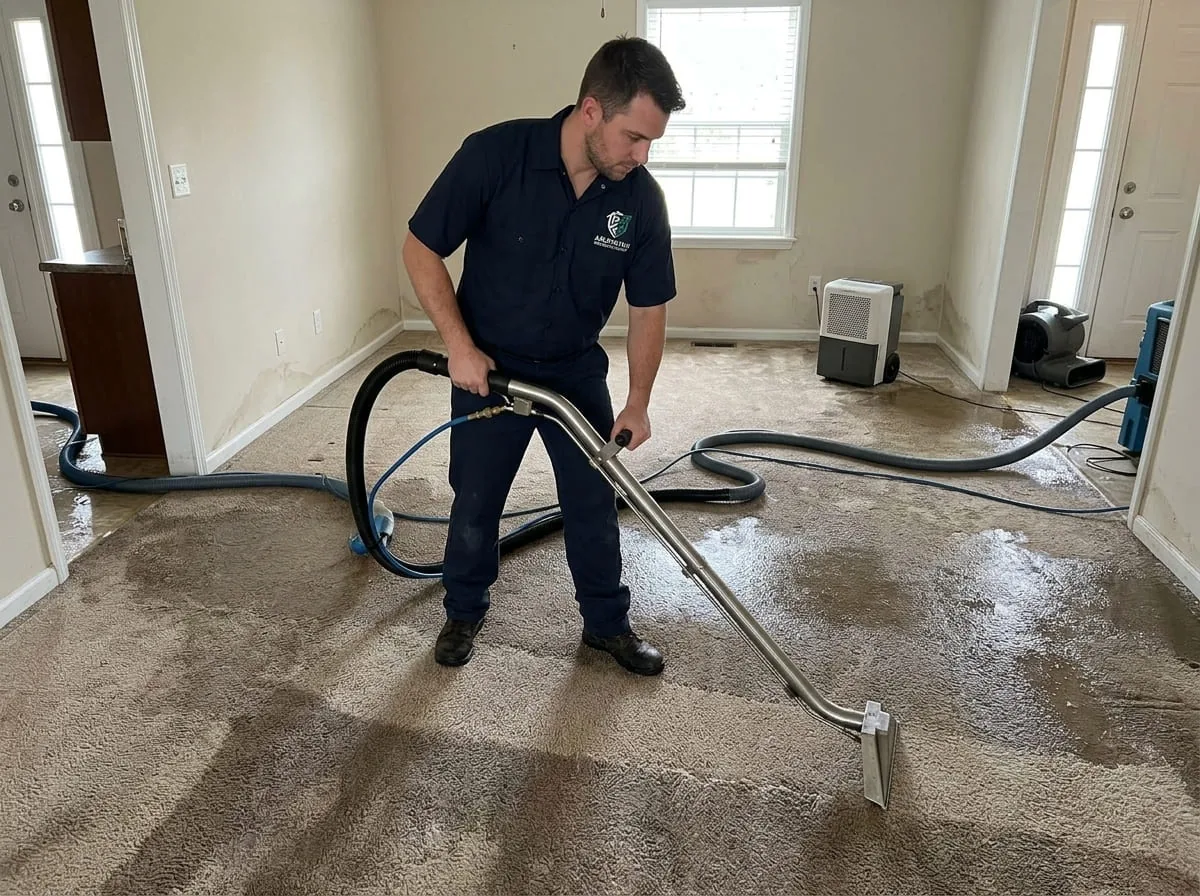
Restoration crews dispatched to a flooded basement bring truck-mounted or portable extraction equipment rated for continuous, high-volume water removal, which is a different category of equipment from a household shop-vac. After extraction, moisture meters and thermal imaging are typically used to map how far moisture has traveled into walls, subflooring, and framing before setting up commercial air movers and dehumidifiers sized for the actual volume of the space.
For a closer look at how that process works for basements specifically, including what's involved in drying wall cavities and slab floors, see basement water damage cleanup.
Watching for Mold After the Water Is Gone
Because basements tend to run more humid and less ventilated than the rest of a house even under normal conditions, they're also one of the more common places for mold to take hold after a flood, particularly if drying wasn't handled thoroughly or moisture was trapped behind finished walls.
If a musty smell persists, if there's visible discoloration on drywall or framing, or if the basement was flooded for more than a day or two before it was addressed, it's worth having the space evaluated specifically for mold rather than assuming that dry-to-the-touch means mold-free. More on what that evaluation and remediation process looks like for below-grade spaces is covered at basement and crawl space mold remediation.
Frequently Asked Questions
Is it ever okay to walk into a flooded basement myself?
Only if you're confident the electrical panel, outlets, and any plugged-in equipment in the space are not submerged or in contact with the water, and only if the water isn't coming from a sewage or drain backup. If there's any doubt about either of those, stay out and arrange for the power to be shut off by someone qualified, or wait for a professional assessment before entering.
Can I just use a shop-vac and box fans to handle a flooded basement myself?
For a small, shallow, contained spill, a shop-vac and fans can be a reasonable stopgap. For a fully flooded basement floor, that combination generally isn't enough — it doesn't remove water fast enough to prevent it from wicking into drywall and framing, and fans without dehumidification don't actually pull moisture out of building materials the way commercial equipment does.
How long can water sit in a basement before it becomes a bigger problem?
There's no exact cutoff, but the risk of secondary damage — swelling, warping, and conditions that favor mold growth — increases the longer water and elevated moisture sit in an enclosed, poorly ventilated space like a basement. Addressing it as soon as it's safely possible reduces how much has to be replaced rather than dried and saved.
What if I don't smell anything unusual — does that mean the basement is fine?
Not necessarily. Moisture trapped behind drywall or under flooring doesn't always produce a noticeable odor right away, especially in the first few days. A visual check and, ideally, a moisture reading on walls and flooring gives a more reliable picture than smell alone.
Will my homeowners insurance cover a flooded basement?
That depends on the cause and your specific policy — a sudden pipe failure is often treated differently than groundwater or storm surface flooding, for example. Photographing the damage before cleanup and documenting the likely source helps regardless of how the claim is ultimately handled, and insurance claim assistance is available through the restoration contractor handling the work.
Does a flooded basement always mean mold will develop?
Not always, but the risk goes up the longer moisture sits and the less thoroughly the space is dried, particularly behind finished walls where moisture isn't visible. Prompt extraction and proper structural drying are the two biggest factors in preventing mold from taking hold after a basement flood.