 Arlington Restoration Group
Two terms that get used interchangeably — and shouldn't be
"Water extraction" and "water damage restoration" often show up in the same sentence, sometimes even used as if they mean the same thing. They don't. Extraction is one specific, early task. Restoration is the entire process that extraction sits inside. Understanding the difference matters if you're trying to figure out what's actually going to happen after you call for help, how long the process realistically takes, and what to expect at each stage.
The short version: extraction is about removing water. Restoration is about returning the property to its pre-loss condition — which includes extraction as its first physical step, but also covers everything that has to happen after the water itself is gone.
What water extraction actually is
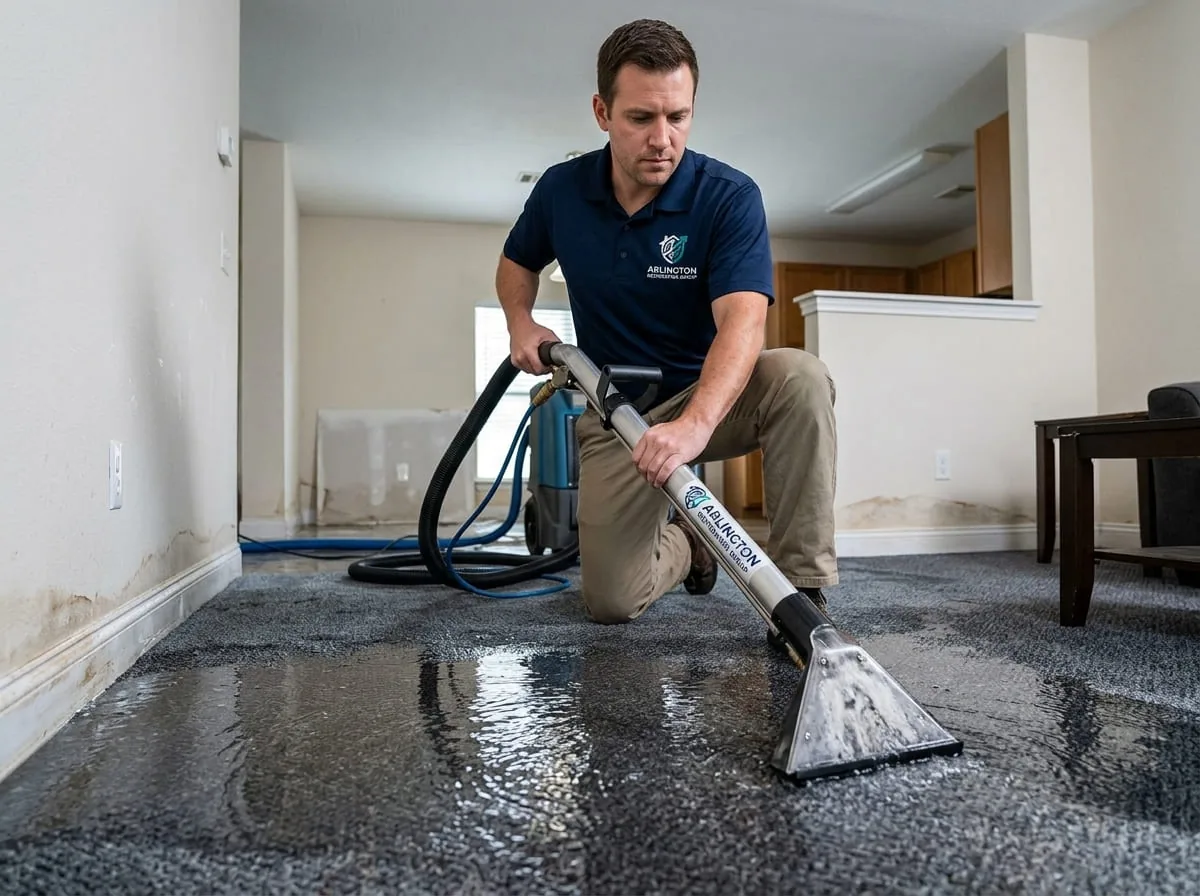
Water extraction is the physical removal of standing and free-flowing water from a structure. It's typically done with truck-mounted or portable extraction units — far higher-capacity than a household wet/dry vacuum — that pull water out of carpet, flooring, and low areas quickly. Extraction is a narrow, well-defined task with a clear endpoint: when there's no more standing or free water left to pull out.
Extraction typically includes:
- Removing standing water from floors, carpets, and hard-surface flooring
- Extracting water absorbed into carpet padding, which often can't be fully removed without also pulling water out of the carpet fibers above it
- Pumping out larger volumes of water in flooded basements or lower levels
- Initial moisture assessment to identify where water has spread beyond what's visible
What extraction does not include: getting remaining moisture out of materials that have absorbed water (drywall, subfloor, framing), addressing odor, repairing or replacing damaged materials, or verifying the space is actually back to a safe, dry, pre-loss condition. That's where restoration picks up.
What water damage restoration actually covers
Restoration is the full arc of the response, from the moment water is discovered through to the property being repaired and usable again. It includes extraction as its opening phase, then continues through several additional stages:
- Assessment and moisture mapping — identifying the category and extent of water involved, and locating hidden moisture with meters and thermal imaging.
- Extraction — the water removal step described above.
- Structural drying and dehumidification — using air movers and dehumidifiers to bring remaining moisture in materials down to a normal baseline, monitored over days rather than treated as a one-time event.
- Cleaning and, where applicable, antimicrobial treatment — addressing surfaces exposed to gray or black water, and general sanitation of the affected area.
- Removal of unsalvageable materials — carpet pad, sections of drywall, insulation, or flooring that can't be dried or safely restored are removed rather than dried in place.
- Repairs and reconstruction — replacing drywall, flooring, trim, cabinetry, or other materials that were removed, and repairing anything structurally affected.
- Final verification — confirming the space reads dry against baseline moisture levels before the job is considered complete.
In other words, extraction is a single chapter. Restoration is the whole book — and the water damage restoration process as a whole is what actually gets a property back to normal, not extraction on its own.
The equipment difference actually reflects the task difference
The tools used for each phase are a useful way to picture how different the two tasks really are.
Extraction Equipment
Extraction relies on high-capacity pumps and extraction wands or truck-mounted units built to move large volumes of liquid water quickly — the goal is raw removal, as fast as possible.
Restoration Equipment
Restoration's drying phase uses an entirely different set of equipment: air movers positioned and angled to sweep air across specific wet surfaces, and refrigerant or desiccant dehumidifiers running continuously to pull moisture out of the air over days, not minutes.
Moisture meters and thermal imaging cameras, used throughout restoration to find hidden moisture and confirm when materials are actually dry, have no real equivalent in the extraction phase, where the water is either visibly standing or it isn't.
Telling the Two Phases Apart
If a crew shows up with pumps and wands and leaves once the floor is clear, that's an extraction visit. If air movers and dehumidifiers stay running in the space for several days afterward with follow-up moisture checks, that's the restoration phase actively underway.
Does the type of water change which phase matters more?
Water category affects both phases, but in different ways. For any category, extraction removes the same way — pumps and wands don't care whether the water is clean or contaminated.
Where category matters more is in restoration: water contaminated by sewage or floodwater (often referred to as gray or black water) usually means more materials get removed rather than dried, since porous materials that absorbed contaminated water generally can't be cleaned to a safe standard the way they can be dried after a clean-water event.
So a Category 3 loss and a Category 1 loss might have nearly identical extraction visits, but very different restoration scopes afterward — one leaning toward drying in place, the other leaning toward removal and reconstruction.
Residential vs. larger commercial losses
In a typical single-family home, extraction and the start of restoration often happen in the same visit, since the affected area is contained and accessible.
In larger commercial spaces or multi-unit buildings, the two phases are more likely to be clearly separated — extraction crews may focus purely on getting standing water out of a large footprint quickly (an office floor, a retail space, a parking garage level) before a separate, more detailed moisture-mapping and drying phase begins across that same footprint.
The underlying difference between the two tasks doesn't change, but the scale can make the line between them more visible in a commercial setting than in a typical home.
Why you almost always need extraction before restoration can properly start
You can't effectively dry a room, assess which materials are salvageable, or begin repairs while there's still standing water on the floor. Extraction has to happen first because it's what makes the rest of the process possible — it's the reason the two terms get bundled together so often in casual use, even though they refer to different things. A restoration timeline effectively can't start its drying phase in earnest until extraction is substantially complete.
Is extraction alone ever enough?
In genuinely minor situations — a small, shallow, clean-water spill on a hard, non-porous surface with no absorption into surrounding materials — extraction (or even careful mopping) really can be close to the whole job. Wipe up the water, let the surface air-dry, and there's nothing further to restore.
Why a Small Spill Can Still Need a Full Assessment
But this is the exception, not the rule, and it's easy to underestimate how much a given spill has actually spread. Water travels along subfloor seams, wicks up baseboards and drywall, and pools under cabinetry in ways that aren't obvious from a glance at the visible puddle.
A room that looks like "just a spill" on the surface can have several feet of wet drywall and a soaked section of subfloor that extraction alone won't address — which is why a proper moisture assessment, not just a visual check, is what actually determines whether extraction is sufficient or whether full restoration and drying are needed.
How the two phases typically fit together on a timeline
For an active water event — a burst pipe, appliance overflow, or storm intrusion — the practical sequence usually looks like this: emergency response and extraction happen first, typically within hours of the call, since that's the time-sensitive part. Moisture mapping and drying equipment placement follow immediately after, often the same visit. Structural drying then runs over the following days, monitored with moisture readings rather than run on a fixed schedule.
Once materials read dry, any necessary removal of unsalvageable materials and reconstruction work happens last, on its own separate timeline depending on scope. Extraction might take a few hours. Full restoration, start to finish, can span anywhere from several days for a straightforward, well-contained loss to several weeks for something involving significant material replacement and reconstruction.
What this means for insurance documentation
Because extraction and restoration are distinct phases, they're often documented and billed as related but separate line items, particularly on larger losses. Extraction is typically the emergency mitigation cost — the kind of expense insurers expect to see acted on quickly, since prompt water removal limits the size of the overall claim.
Restoration and reconstruction costs are usually assessed and documented separately, often requiring their own scope of work once the drying phase is complete and it's clear which materials need replacement versus which were successfully saved. Keeping photos and records from the extraction stage (see our guide on what to do immediately after finding water damage) makes it easier to support both parts of the claim.
The practical bottom line
If someone tells you they're sending a crew to "do extraction," expect water removal and an initial assessment — not a finished, repaired room. If someone describes a full restoration scope, expect the process to include extraction plus drying, cleaning, and any necessary repairs, spanning a longer timeline.
Knowing which phase you're in helps set realistic expectations for both the schedule and the eventual cost, and helps you ask more specific questions about what's been done and what's still ahead.
Frequently Asked Questions
Is water extraction the same as water damage restoration?
No. Extraction is the specific task of physically removing standing water from a structure. Restoration is the full process — extraction plus drying, cleaning, removal of unsalvageable materials, and repairs — that returns a property to its pre-loss condition.
Do I need full restoration, or is extraction enough?
It depends on how much water was involved and how far it spread into materials. A small, shallow, clean-water spill on a hard surface may need little beyond extraction. Anything involving carpet, drywall, or standing water that sat for a while typically needs the full drying and restoration process, even if the visible puddle looked minor — water spreads into materials in ways that aren't obvious at a glance.
How long does extraction take compared to full restoration?
Extraction itself is usually a matter of hours for most residential situations. Full restoration, including structural drying, monitoring, and any necessary repairs, typically takes several days to a few weeks depending on how much water was involved and how much material needs replacement.
Why does my insurance paperwork list extraction and restoration separately?
They're often billed and documented as distinct phases because they represent different scopes of work — extraction is generally treated as emergency mitigation, while restoration and any reconstruction are assessed separately once the extent of drying and material damage is known.
Can restoration start before extraction is finished?
Not effectively. Drying, assessment, and repair work depend on standing water being removed first, so extraction is generally the necessary first phase before the rest of the restoration process can properly begin.
If a room looks dry on the surface, do I still need extraction and restoration?
Possibly. Surface appearance can be misleading — water often wicks into flooring, baseboards, and wall cavities beyond what's visible. A proper moisture assessment is a better way to determine scope than a visual check alone.