 Arlington Restoration Group
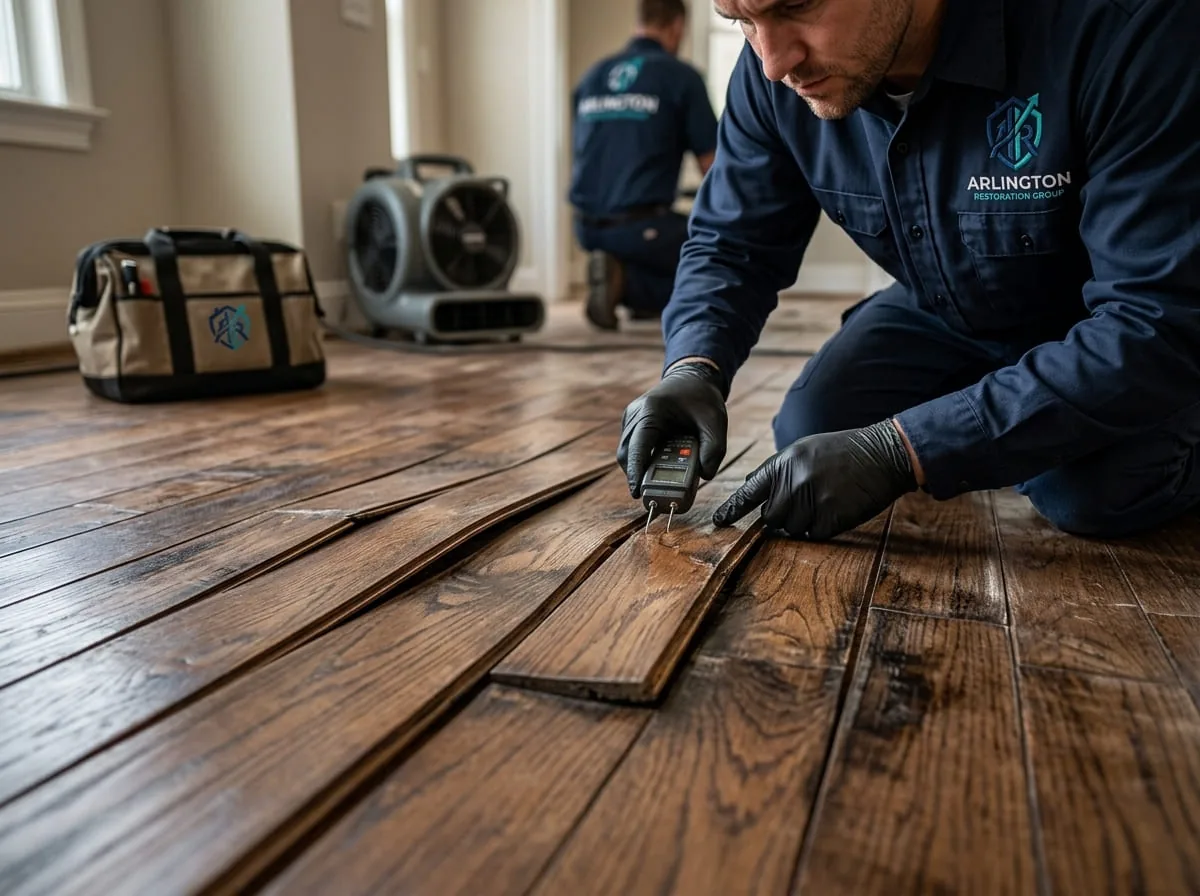
The window between "it just burst" and help arriving
A burst pipe rarely gives warning. One moment the house is normal, the next there's water actively flowing from a wall, ceiling, or under a fixture, and it doesn't stop on its own. What you do in the window before professional help arrives has a real effect on how much damage spreads and how much of it can ultimately be saved.
This isn't about attempting the repair yourself — it's about containing the situation safely and setting up the space so that burst pipe water damage restoration can start effectively the moment help arrives, rather than starting from an even bigger mess.
Step 1: Shut off the water at the main valve
A burst pipe keeps flowing until the water supply to it is cut off — closing a single fixture's valve won't help if the break is somewhere in the supply line itself, which is often the case with a burst pipe as opposed to a leaking fixture.
Locate your home's main water shutoff valve and turn it off completely. It's typically found near where the water line enters the home — a basement, crawl space access point, utility closet, or near the water meter. Turning the valve clockwise ("righty-tighty") shuts it off; it may take some real effort if it hasn't been operated in a while, but avoid excessive force that could damage an old valve.
If you can't locate the main shutoff, or it won't turn, do not keep searching while water actively floods the space — call your water utility's emergency line or a plumber immediately, and in the meantime focus on containment (buckets, towels, moving belongings) and getting people clear of the area rather than continuing to hunt for the valve.
Step 2: Cut power to the affected area — if you can do so safely
Water and electrical systems in the same space are dangerous together. If your electrical panel is dry and safely reachable without walking through or near standing water, shut off the breaker(s) serving the affected area. If the panel is wet, located in a flooded space, or only reachable by crossing standing water, do not attempt it yourself — leave it as-is, stay out of the area, and have an electrician or your utility provider assess it before anyone re-enters.
Never touch a wet outlet, switch, or plugged-in appliance, and keep children and pets away from the affected area entirely until it's confirmed safe.
Why this is a particularly common issue in parts of Arlington's older housing stock
Older single-family homes and galvanized pipe
Burst pipes aren't random. In much of North and South Arlington, large numbers of homes were built between the 1930s and 1960s — the Cape Cods, brick colonials, and garden apartments found in neighborhoods like Arlington Forest, Lyon Park, Waverly Hills, and Columbia Forest. Many of these homes still carry original or since-replaced galvanized steel supply lines, and in unrenovated sections, cast iron or clay drain lines remain in place.
Galvanized pipe corrodes from the inside over decades, gradually narrowing the interior diameter and weakening the pipe wall until a section fails, sometimes with no prior warning.
A different pattern in newer high-rises
This is a genuinely different failure pattern than what's typical in Arlington's high-rise corridors — Rosslyn-Ballston and National Landing buildings, largely built since the 1970s on copper and PEX plumbing, tend to see leaks originate from shared risers or floor-to-floor unit leaks rather than a single aging supply pipe bursting.
If your home is one of Arlington's older single-family properties and you've never had the supply plumbing inspected or updated, a burst galvanized line is a realistic enough scenario that it's worth knowing where your main shutoff is well before it happens.
A common trigger worth knowing: frozen pipes
Freezing is one of the most common causes of a genuine pipe burst, and it explains why bursts often cluster during and right after a hard cold snap rather than happening evenly year-round. Water expands as it freezes, and that expansion inside a section of pipe — especially an older, already-corroded galvanized line, or any pipe running through an unheated space like a crawl space, exterior wall, or unheated garage — can split the pipe wall.
The failure often isn't obvious until the ice plug thaws and full water pressure returns, which is why a burst sometimes seems to happen well after the coldest part of a cold snap rather than during it. If freezing temperatures are involved, it's worth checking other exposed or exterior-wall plumbing in the home for similar risk once the immediate emergency is handled, rather than assuming the one failure was an isolated event.
Step 3: Move valuables and furniture out of the water's path
Once the water is shut off and the area is confirmed electrically safe, shift focus to limiting what gets damaged:
- Move furniture, rugs, boxes, and electronics away from the wet area and onto a dry, elevated surface.
- Pull curtains and drapery up and away from a wet floor.
- Prioritize paper documents, photographs, and electronics — these are the items most easily and permanently ruined by even brief water contact.
- If a ceiling is actively dripping or visibly sagging from water trapped above it, move everything out from directly underneath rather than trying to catch the drips — a sagging ceiling can give way without much additional warning.
Step 4: Be careful with a shop vac on larger volumes
A wet/dry shop vac can be genuinely useful for a burst pipe's worth of water in a contained area, but a few cautions apply. Don't use a shop vac near standing water if there's any question about electrical safety in the area — extension cords and water don't mix. Empty the tank frequently rather than letting it overflow, which can happen faster than expected with a genuine burst-pipe volume of water.
Recognize the limits, too: a household shop vac moves a relatively small amount of water per pass, and a burst pipe that's been flowing for even a short time before the main was shut off can easily represent more water than a shop vac is a practical solution for on its own. It's a reasonable tool for slowing the spread while help is on the way, not a substitute for professional extraction equipment on anything beyond a small, contained amount.
Step 5: Document before you clean up
Photograph the source of the burst — the pipe itself, if visible, before any repair work covers it up — along with the affected rooms from multiple angles and any damaged belongings. This documentation is genuinely useful for an insurance claim, and it takes only a few minutes. For a fuller breakdown of what to capture and why, see our guide on what to do immediately after finding water damage.
What to leave for the professionals
- The pipe repair itself — this is plumbing work, not a DIY water-damage task, and attempting a quick patch can mask the real extent of the failure or lead to a repeat burst.
- Large-volume water extraction — professional extraction equipment removes far more water, far faster, than towels or a household shop vac.
- Moisture mapping — finding where water has traveled inside walls, under flooring, or into insulation isn't something visible to the eye; it requires moisture meters and often thermal imaging.
- The save-or-replace call on wet materials — drywall, insulation, and flooring saturated by a burst pipe need an actual assessment to determine what can be dried versus what needs removal.
Don't turn the water back on until the pipe is actually repaired
Once the immediate flow has stopped and the space is calmer, it can be tempting to briefly turn the main valve back on to check whether the leak has stopped or to use water elsewhere in the house.
Resist this until the failed section has been properly repaired or replaced — a burst pipe is a structural failure in the pipe itself, not something that resolves on its own, and restoring pressure to a still-broken line simply starts the flooding again, often faster than the first time since the break may have widened.
If other household members need water for an urgent reason before repairs are complete, treat it as a separate, deliberate decision rather than an assumption that it's fine to leave the main valve open in the meantime.
If you're in a condo, apartment, or shared building
In multi-unit buildings — common throughout Arlington's high-rise corridors as well as older garden apartment complexes — a burst pipe often affects more than just your own unit, particularly if it's on a shared riser or the unit below is at risk of ceiling damage.
Notify building management or your property manager immediately in addition to the steps above, since access to shared shutoff valves, the building's own emergency protocols, and notification to neighboring units are often outside what a single resident can control directly.
If the burst pipe involves contaminated water
Most burst supply-line pipes carry clean water, but if the burst involves a drain line, sewer line, or you're unsure which line failed, treat the water as potentially contaminated: avoid direct contact, keep people and pets out of the area, and skip the shop-vac and hands-on cleanup steps above entirely in favor of calling for professional help right away.
The bottom line before crews arrive
Shut off the water at the main, cut power to the area if it's safe to reach the panel, move what you can move, document what you're seeing, and use a shop vac cautiously if the volume is manageable — then let the rest, from extraction through the actual repair and drying, go to people equipped to handle it properly.
Frequently Asked Questions
How do I find my main water shutoff valve before a pipe bursts?
It's typically located near where the water line enters the home — commonly in a basement, crawl space access area, utility closet, or near the water meter. It's worth locating and testing it before an emergency, since finding it for the first time during an active burst wastes valuable time.
Should I try to patch a burst pipe myself before crews arrive?
No. Shutting off the water supply is the right immediate step, but the repair itself is plumbing work. A quick DIY patch can mask the extent of the damage, fail again under pressure once the water is turned back on, or delay a proper assessment of why the pipe failed in the first place.
Is a burst pipe more common in older Arlington homes?
Older single-family homes across North and South Arlington, many built from the 1930s through the 1960s, commonly still have original or since-replaced galvanized steel supply lines, which corrode internally over decades and can fail without warning. This is a different pattern than Arlington's high-rise corridors, which are largely on newer copper and PEX plumbing and tend to see leaks originate from shared risers between units instead.
Can I use a shop vac on a burst pipe's worth of water?
For a contained, manageable amount, a wet/dry shop vac rated for water pickup can help slow the spread while you wait for help — as long as it's safe to use given any electrical exposure in the area. For a larger volume, it's not a practical substitute for professional extraction equipment, and emptying it repeatedly can eat up time better spent on other immediate steps.
What if I can't tell whether the burst pipe is a clean supply line or a drain line?
If there's any uncertainty about the source, treat the water as potentially contaminated. Avoid direct contact, keep people and pets away from the area, and call for professional help rather than attempting hands-on cleanup.
Do I need to turn off electricity even if the water hasn't reached any outlets yet?
If you can safely reach your electrical panel without crossing wet flooring, shutting off the breakers for the affected area is a reasonable precaution, since water can spread further than it first appears. If reaching the panel means walking through or near standing water, don't attempt it — leave it and call an electrician instead.