 Arlington Restoration Group
Why there's no single honest answer to this question
Anyone searching for a drying timeline is usually hoping for a specific number of days. The honest answer is that a responsible number doesn't exist without knowing the specifics of the situation — what got wet, how wet it got, what the air around it is doing, and how much airflow is reaching it.
Two rooms with the same amount of standing water can dry at very different rates depending on those variables. A shallow spill on a tile floor with good ventilation might be fully dry within a day. A saturated carpet pad and wet subfloor in a closed, humid basement can take a week or more even with equipment running, and materials that have been wet for an extended period before drying begins may not be fully dryable at all.
Rather than offer a single guaranteed figure, it's more useful to understand the actual factors that drive drying time, because those are the things that determine whether a given situation is closer to "a few days" or "two weeks or more."
The four factors that actually determine drying time
1. Temperature
Warmer air holds more moisture and speeds evaporation, which is why drying tends to move faster in summer conditions than in a cold, unheated space in winter. Professional drying setups often work to keep the space in a moderate, consistent temperature range rather than either extreme, since very hot conditions without adequate airflow and dehumidification can actually encourage mold growth rather than speed drying.
2. Relative humidity
This is arguably the single biggest lever. Water evaporates from wet materials into the surrounding air, but that only keeps happening efficiently if the air can keep absorbing more moisture. In a closed room with high humidity, the air becomes saturated quickly and evaporation slows to a crawl — which is exactly why simply opening windows in already-humid weather, or running fans without dehumidification, often stalls out well short of actually dry.
Commercial dehumidifiers pull moisture out of the air continuously, which is what lets evaporation from wet materials keep happening at a meaningful rate.
3. Air movement
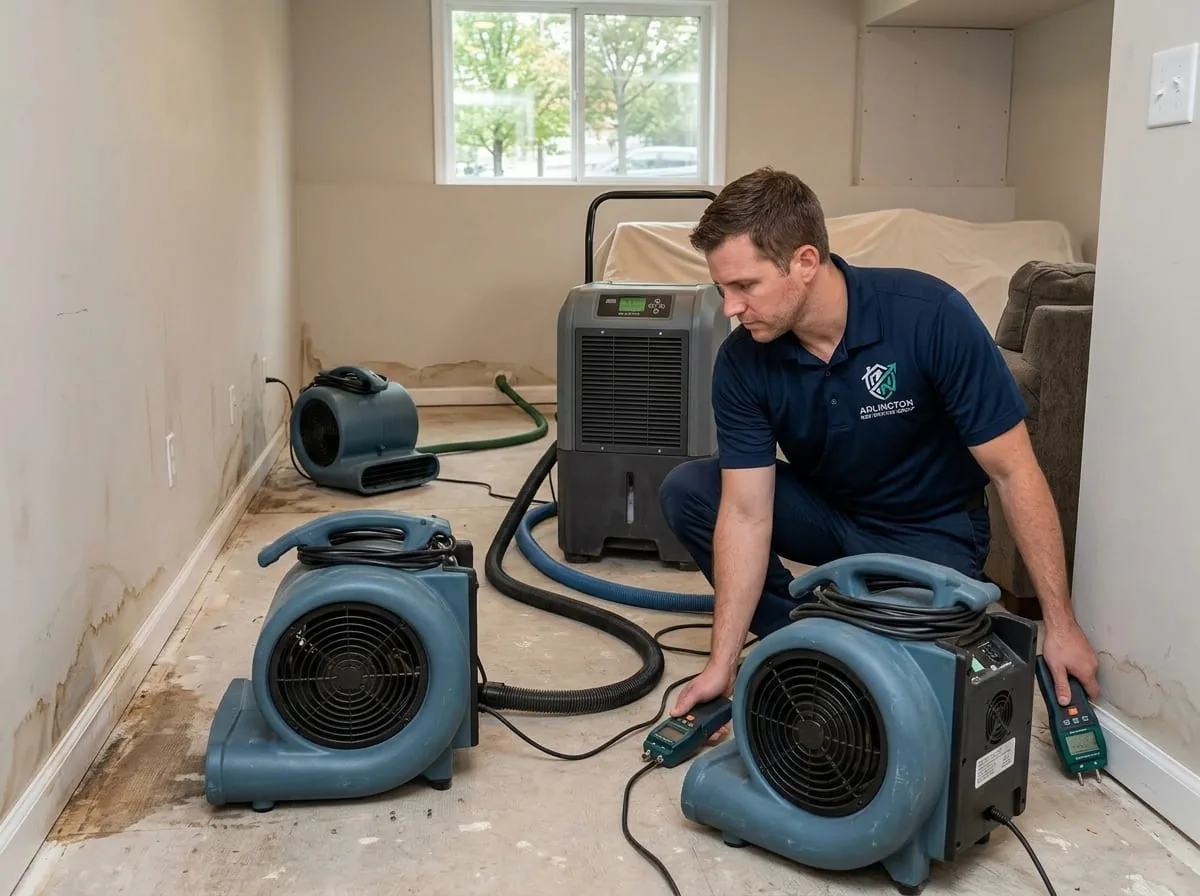
Moving air across a wet surface breaks up the thin layer of saturated air sitting directly against it, which is what lets evaporation continue. This is the role air movers (not just circulating room fans) play — placed and angled specifically to sweep air across wet flooring, baseboards, and walls, not just to move air around the room generally.
4. Material porosity and how much water it absorbed
Hard, non-porous surfaces like tile, sealed concrete, and glass hold almost no water in the material itself — wipe up the surface water and they're essentially dry. Porous materials are a different story:
- Carpet and carpet pad — the pad especially can hold a large volume of water and often needs to be removed entirely rather than dried in place once heavily saturated.
- Drywall — wicks water upward from the bottom edge; how far it has wicked and how long it stayed wet determines whether it's dryable (see our guide on whether wet drywall can be saved).
- Hardwood flooring — dries slowly and unevenly, and can cup or warp during the process even when handled correctly.
- Wall and floor insulation — once wet, fiberglass batt insulation in particular tends to lose its effectiveness and often needs replacement rather than drying.
- Subfloor and framing lumber — thick, dense materials that absorb slowly but also release moisture slowly; these are frequently the slowest-drying part of a water-damaged structure even after visible surfaces look fine.
Why the room itself changes the timeline
The same amount of water dries at different rates depending on where in the house it happened, largely because of how enclosed the space is and what materials surround it.
Slower-drying spaces
- Basements — common throughout North Arlington's older Cape Cods and colonials — are typically the slowest-drying spaces in a house. They sit below grade, have limited natural ventilation, and often run naturally humid even without a water event, all of which work against evaporation. A finished basement with carpet, drywall, and a wood-framed ceiling below the joists adds several more absorbent materials to dry through.
- Crawl spaces — common under South Arlington's post-war bungalows — combine poor airflow with ground moisture that can keep humidity elevated even after standing water is gone, which is part of why crawl space drying is often treated as its own specialized process rather than a smaller version of a room upstairs.
Faster-drying spaces
- Kitchens and bathrooms tend to dry a bit faster on the surface because they often have more hard, non-porous flooring (tile, vinyl), but cabinetry, subfloor beneath tile, and the wall cavity behind a bathtub surround can hold moisture much longer than the visible floor does.
- Open living spaces with good natural airflow and hard flooring are generally the fastest-drying rooms in a house, assuming the water didn't sit long enough to soak baseboards and wall cavities.
Signs drying is progressing normally — and signs it isn't
A few practical indicators, useful alongside (not instead of) actual moisture readings: air movers and dehumidifiers running continuously without being turned off overnight is expected — drying equipment is generally left on around the clock during an active job, since stopping and restarting loses ground. A dehumidifier's collection tank filling steadily over the first day or two is a normal sign that moisture is actively being pulled out of the air.
If a musty odor is getting stronger rather than fading after several days of equipment running, or if a previously dry-seeming area develops new staining or softness, that's worth flagging rather than waiting out — it can mean moisture trapped in a spot the equipment isn't effectively reaching, such as inside a wall cavity or under flooring that's sealed rather than porous.
General ranges — not guarantees
With professional-grade air movers and dehumidification running, and no ongoing water intrusion, many residential water losses reach a dry standard measured against baseline moisture readings somewhere in the range of three to seven days. Situations involving heavy saturation, dense or layered materials, limited airflow (a closed crawl space, for instance), high ambient humidity, or a delay before drying equipment was in place can extend that to two weeks or more.
Some materials — especially those with contaminated water exposure or extended saturation — may not be candidates for drying at all and are removed and replaced instead, which is a different process with its own timeline for reconstruction.
Any specific number given for your situation should come from someone who has actually taken moisture readings on your affected materials, not from a general online estimate — this article is intended to help you understand the variables, not to substitute for that assessment.
Why DIY drying with fans and open windows often falls short
Running a couple of box fans and opening windows can help with light, surface-level moisture, but it usually isn't enough on its own for anything beyond a minor spill, for a few reasons: household fans move a fraction of the air volume that commercial air movers do, and open windows introduce whatever humidity level is outside, which in the Mid-Atlantic's humid summers can actually work against drying rather than for it.
And without a dehumidifier pulling moisture out of the air, the room can hit a point where the air is too saturated to accept more evaporation, no matter how long the fans run.
This is why a room can feel "dry to the touch" on the surface while flooring, baseboards, or wall cavities underneath remain wet for much longer.
How professionals actually determine "dry" — measurement, not guessing
Rather than drying for a set number of days and hoping, structural drying and dehumidification is typically managed against measured moisture readings. Technicians take baseline moisture readings in affected materials and in comparable unaffected areas of the same structure, then track those readings over the course of the drying process using moisture meters and, often, infrared thermal imaging to spot moisture that isn't visible on the surface.
Equipment placement and airflow are adjusted based on those readings rather than left running blind, and the drying process is considered complete when affected materials read consistent with the unaffected baseline — not on a fixed calendar schedule.
This is also why professional drying tends to actually finish in the range it's expected to, rather than dragging on indefinitely: the equipment and its placement are matched to the specific volume, humidity, and material mix in the room instead of a generic setup.
What happens when materials don't dry fast enough
The risk of slow or incomplete drying isn't just inconvenience — it's the conditions mold needs to establish itself, and the point past which some materials go from "dryable" to "needs replacement." Drywall, insulation, and wood-based materials that stay above elevated moisture content for an extended period are more likely to need removal rather than restoration, which is why getting drying started quickly and monitoring it properly matters more than any single target number of days.
Practical takeaway
If you're trying to estimate how long your own situation will take, think in terms of the variables rather than a single number: How porous are the affected materials? How saturated did they get? Is there active dehumidification and directed airflow, or just open windows and a box fan? Is the space closed off (a crawl space or interior room) or does it have natural ventilation?
The more of those factors point toward "difficult to dry," the more that two-week-or-more range becomes realistic, and the more it's worth having drying progress checked with actual moisture readings rather than judged by how a surface looks or feels.
Frequently Asked Questions
Can water damage dry in 24 hours?
A small, shallow, clean-water spill on a non-porous surface like tile or sealed concrete can be effectively dry within a day. Anything involving carpet, carpet pad, drywall, hardwood, or subflooring almost never reaches a true dry standard that fast, even with equipment running, because those materials absorb and release moisture much more slowly.
Why does my room feel dry but still smell musty?
Surfaces can feel dry to the touch while moisture remains trapped inside porous materials like drywall, subfloor, or insulation, or in spaces you can't see directly, like inside a wall cavity or under flooring. A persistent musty smell after a leak is a sign that moisture is likely still present somewhere in the structure even if the visible surface seems fine.
Does running fans and opening windows dry water damage on its own?
It can help with very minor, surface-level moisture, but it's usually not enough on its own for anything more significant. Without dehumidification pulling moisture out of the air, and without air movers specifically directed at wet materials, drying often stalls well short of complete, especially in humid weather.
Will humid summer weather in the Arlington, VA area slow down drying?
Yes. High outdoor humidity common in the Mid-Atlantic summer means opening windows can introduce more moisture into the air than it removes. Dehumidification equipment that actively lowers indoor humidity, rather than just relying on outside air, matters more in these conditions, not less.
How do I know when water damage is actually fully dry, not just dry-looking?
The reliable way is a moisture meter reading compared against a baseline from an unaffected area of the same structure, sometimes combined with thermal imaging to check for hidden moisture. Visual and touch checks alone can miss moisture trapped inside materials or wall cavities.
What happens if drying takes longer than expected?
Extended drying time usually means the materials involved were more saturated, denser, or in a less ventilated space than a typical case, or that conditions like high humidity slowed evaporation. It's not necessarily a sign anything is going wrong — but materials that stay wet for a prolonged period are at higher risk of needing replacement rather than restoration, which is part of why professional monitoring throughout the process matters.