 Arlington Restoration Group
When Water Damage Turns Into an Emergency
Not every wet spot is an emergency, but a surprising number of water events cross that line faster than people expect. A supply line that lets go behind a washing machine, a water heater that ruptures overnight, a sump pump that fails during a heavy storm, a dishwasher hose that finally gives out after years of slow wear — each of these can put hundreds of gallons into a living space in under an hour. Once that happens, the clock starts working against the property rather than for it. Water spreads sideways under flooring and vertically up drywall through capillary action, reaching areas well beyond where the puddle is visible, and it starts creating the moisture conditions mold needs almost immediately. That's the core reason emergency water damage restoration exists as its own service rather than something scheduled for the next business day: the response window genuinely determines how much of the property can be saved.
Signs You're Dealing With a Genuine Emergency
- Active, ongoing water flow from a pipe, appliance, fixture, or the roofline that hasn't been shut off yet
- Standing water anywhere near outlets, light fixtures, or electrical panels
- Water coming from an unknown or possibly contaminated source, including any backup from a drain or toilet
- A ceiling that's sagging, bulging, or actively dripping
- Water that has been sitting for more than a few hours, especially in a finished basement or over a hardwood floor
- Any water event in a property with young children, elderly residents, or anyone with respiratory sensitivities
If any of these describe your situation, this is a call-now scenario rather than a wait-and-assess one.
Common Triggers Behind After-Hours Calls
Emergency calls come from every category of water loss. Burst pipes are especially common in Arlington's older housing stock, where original galvanized steel supply lines are still in service in many Cape Cods and colonials built between the 1930s and 1960s. Sewage backups tend to happen during or right after heavy rain, when aging combined sewer sections in some older neighborhoods get overwhelmed. Storm-driven water intrusion spikes during the county's summer thunderstorm season and during larger regional events like tropical remnants moving through the D.C. area. Appliance failures — water heaters, washing machines, dishwashers, refrigerator supply lines — round out the list and can happen in any property, any night of the week.
Why Delay Costs More Than It Seems To
The risk of waiting isn't just cosmetic. Wood flooring begins cupping within hours of sustained moisture exposure. Drywall wicks water upward and can lose structural integrity well before visible staining appears at the surface. Electrical hazards compound if water reaches outlets or wiring. And the mold clock is real: given the right temperature and moisture conditions, growth can begin within roughly a day or two of a water event, which is one of the more reliable reasons insurance carriers and restoration professionals alike push for a fast response rather than a scheduled one. Materials that could have been dried and saved with a same-day response often need to be removed and replaced after a multi-day delay.
What Happens When You Call
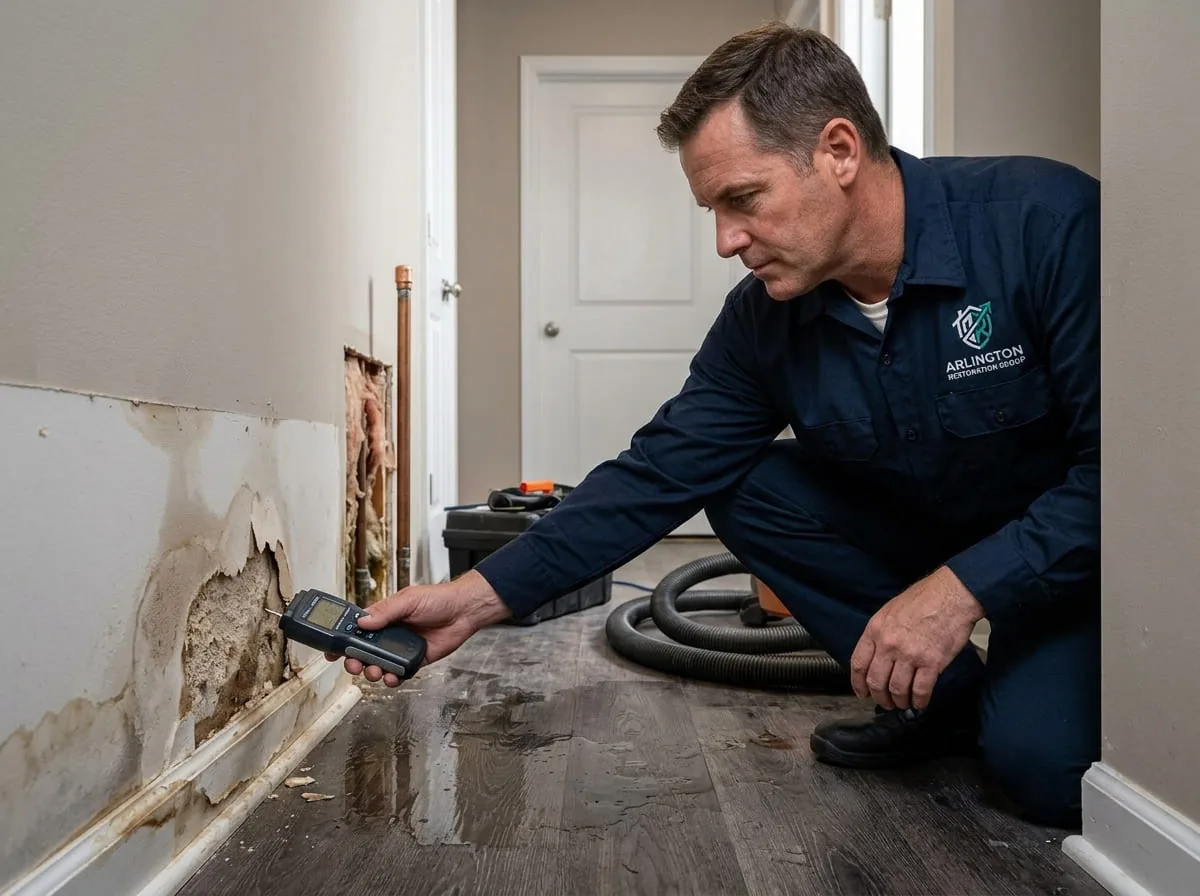
A call to the number on this page reaches a live line that routes directly to a licensed, insured restoration crew serving the Arlington area, available around the clock. The crew that responds typically walks through the same sequence: an initial assessment to identify the water source and category, extraction of any standing water, moisture mapping to find how far the water has traveled into building materials, and the start of structural drying using commercial air movers and dehumidifiers. From there, the crew documents the damage — useful for any insurance claim — and outlines what can realistically be dried versus what will need to be removed and replaced.
What Can Usually Be Saved vs. What Typically Needs Removal
Solid wood framing, subfloor, and many structural elements can often be dried in place if the response is quick and drying is thorough. Drywall that's been wet only briefly can sometimes be dried and repainted, though drywall that's been saturated for an extended period, or that was in contact with contaminated water, usually needs to be cut out and replaced. Carpet and pad are handled case by case — pad is frequently replaced even when the carpet itself can be saved, since it holds moisture against the subfloor. No restoration crew can honestly guarantee every material will be saved; the goal is to save what's genuinely salvageable and be direct about what isn't.
Residential and Commercial Emergencies
Emergency response covers both single-family homes and commercial properties, though the priorities can differ. In a home, the focus is usually on protecting personal belongings, flooring, and finished living space quickly. In an office, retail space, or multi-unit building, business continuity and containing damage to unaffected units or tenants become part of the equation too — which is where commercial water damage restoration considerations come into play alongside the emergency response itself.
What to Do Before Help Arrives
- Shut off the water source at the fixture or main shutoff valve if it's safe and accessible to do so
- Turn off electricity to the affected area at the breaker if water is anywhere near outlets or wiring — don't enter standing water to do this yourself if there's any doubt
- Move furniture, electronics, and valuables away from the water if you can do so safely
- Take photos or a short video of the damage before you touch anything, for insurance purposes
- Note the approximate time the water event started, if known
What to Avoid
- Don't use a household vacuum to remove standing water — it's an electrocution and equipment-damage risk
- Don't walk through standing water if there's any chance it's near an active electrical source
- Don't wait to see if it "dries on its own" before calling, especially with more than a small amount of water
- Don't run a dehumidifier or fans as your only response to a sewage or floodwater event — that water needs professional handling first
Related Services
Once the immediate emergency is under control, related pages cover the next steps in more detail: water extraction and removal goes deeper on how standing water is physically removed, and structural drying and dehumidification explains the science behind getting a structure back to a normal moisture level. For a full picture of how this service fits into the broader response, see the water damage restoration hub.
Serving Arlington's Neighborhoods Around the Clock
Emergency dispatch covers the full range of Arlington's housing types, from high-rise condominiums in Rosslyn to single-family homes throughout the county's residential neighborhoods, as well as nearby communities including Falls Church. Whatever time it is when the water starts, the response doesn't wait for morning.
Frequently Asked Questions
Is emergency water damage restoration available on nights, weekends, and holidays?
Yes. Emergency dispatch runs 24 hours a day, seven days a week, with no reduced availability on weekends or holidays.
How much water needs to be present before it counts as an emergency?
There's no strict volume threshold — active leaks, contaminated water of any amount, water near electrical systems, and anything that's been sitting for hours all warrant an emergency call. When in doubt, it's better to call and get guidance than to wait.
Can I turn off my own water main before crews arrive?
Yes, if you can safely access the shutoff valve, turning off the water at the source is one of the most useful things you can do before help arrives. If you're unsure where your shutoff is or it's not safely accessible, don't force it — wait for the crew.
Will the crew that responds also handle the insurance claim?
The restoration crew can document the damage thoroughly and typically works directly with insurance adjusters, but filing and managing the claim itself is between you and your insurance carrier. Documentation from the emergency visit is usually a key part of that claim.
What if I'm not sure whether the water is contaminated?
Treat any water from an unknown source, a drain backup, or outside floodwater as potentially contaminated and avoid direct contact. The responding crew will assess the water category on arrival and handle it accordingly.