 Arlington Restoration Group
The First Hours After a Fire Matter Most
Once the fire department clears a property, the property owner is usually left standing in a driveway or on a sidewalk trying to figure out what happens next. The building may have broken windows, a hole in the roof, standing water on the floors, and a smell that's already working its way into every fabric surface in the house. Nothing about that situation improves by waiting until morning. Emergency fire damage restoration exists specifically to close that gap — to get a qualified crew on-site quickly enough that the damage doesn't compound overnight.
Arlington Restoration Group routes emergency fire calls to licensed, insured restoration professionals who operate on a 24/7 basis across Arlington, VA and the surrounding area. The professionals we work with are equipped for 24/7 emergency response, which means a call placed at 2 a.m. gets the same urgency as one placed at 2 p.m.
Signs You Need an Emergency Response, Not a Scheduled Appointment
- Any fire that involved the fire department, even if it was extinguished quickly
- Broken windows, damaged doors, or a compromised roof that leaves the structure open to weather or entry
- Standing water on floors or dripping from ceilings from firefighting efforts
- Visible soot on walls, ceilings, or belongings throughout multiple rooms
- A smoke smell that's noticeable from outside the building or in rooms the fire never reached
- Electrical systems that were exposed to heat, water, or flame
What Happens During an Emergency Response
Dispatch and Arrival
A call to Arlington Restoration Group routes directly to a restoration crew serving the property's location. Because fire damage rarely happens on a convenient schedule, dispatch is built around round-the-clock availability rather than a next-business-day model.
On-Site Assessment
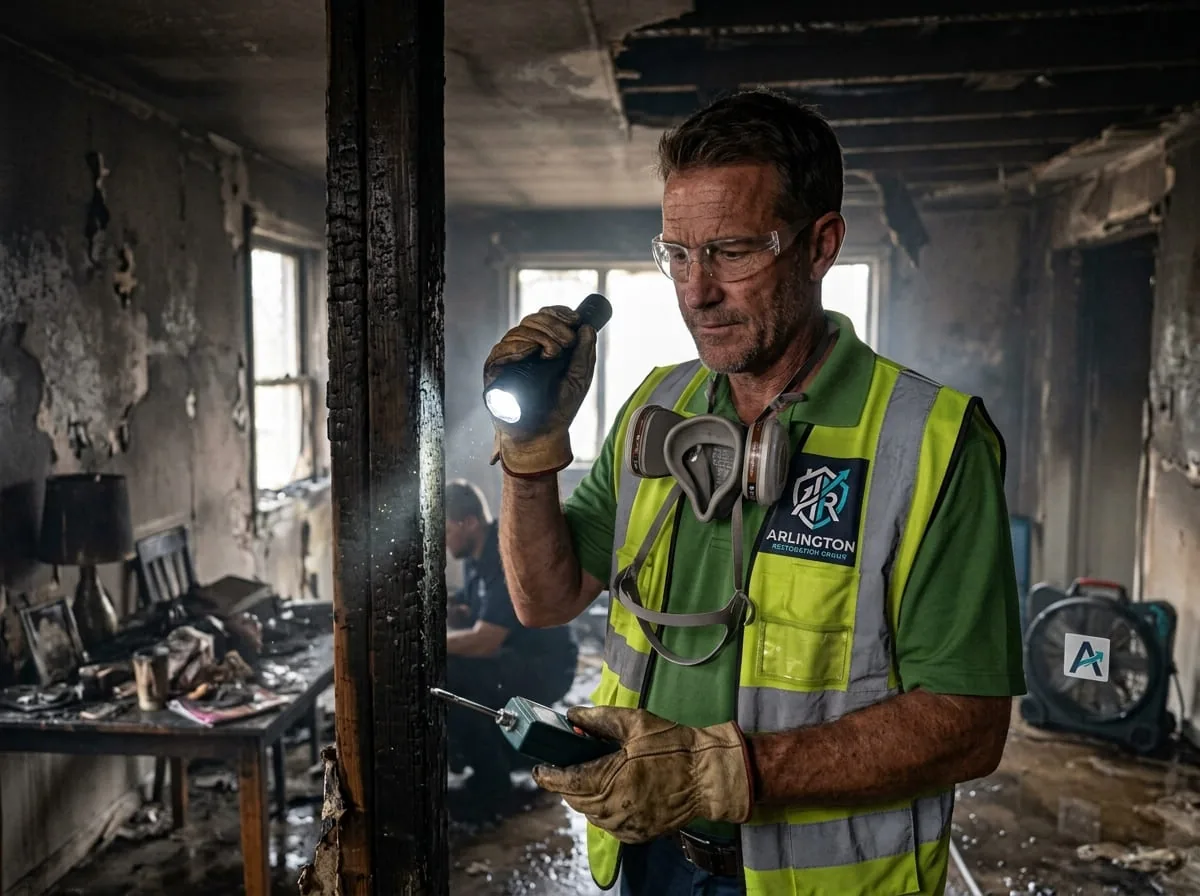
The first task on arrival is a full walkthrough — not just the room where the fire started, but the areas smoke and heat could plausibly have reached. Technicians check attic space, HVAC ductwork, wall cavities near the fire's origin, and any area with visible water intrusion. This assessment is what the rest of the restoration plan gets built around, and it's typically also where documentation for an insurance claim begins.
Stabilization
Stabilization covers whatever the property needs to stop getting worse before full restoration begins: boarding up broken windows and damaged doors, tarping a compromised roof section, extracting standing firefighting water, and setting up initial air movement to start drying the structure. Details on securing an open structure are covered on the emergency board-up and tarping page, and firefighting water removal is covered separately on the firefighting water damage cleanup page.
Why Delay Makes Fire Damage Worse
Every category of post-fire damage gets harder to reverse with time. Soot residue is acidic and continues etching metal, grout, and painted surfaces the longer it's left in place. Smoke odor compounds keep migrating deeper into drywall, insulation, and upholstery. An open structure left unboarded overnight is exposed to weather, pests, and the risk of secondary break-ins. And any water used to fight the fire that isn't extracted promptly sets up the conditions mold needs to take hold, often within 24 to 48 hours. None of that argues for panic — it argues for getting a professional response started the same day rather than the same week.
Residential vs. Commercial Emergency Response
A house fire and a fire in a retail space or office suite call for a similar first-hours playbook — secure the structure, assess the scope, start extracting water — but commercial properties often add layers: business records and equipment that need protecting, tenant or employee notification, and coordination with a property manager or landlord. Emergency response for a commercial property is scoped the same way as for a home, just with an eye toward getting the business back to some level of operation as quickly as it's safe to do so. More detail is available on the commercial fire damage restoration page.
What to Do Before Crews Arrive
- Do not re-enter the structure until the fire department or a qualified inspector has confirmed it's safe
- Call your insurance company to begin the claim and ask about emergency living expenses if the property isn't habitable
- Photograph visible exterior damage if it's safe to do so from outside the structure
- Keep the property secured — don't leave doors or window openings unattended if you can help it
- Gather any documents you'll need for the claim: policy number, photos of the property from before the fire if available, and a general inventory of major belongings
What to Avoid
Do not go back into a fire-damaged structure until it has been officially cleared — fires can weaken framing, compromise electrical systems, and leave carbon monoxide or other airborne hazards behind that aren't obvious on a walkthrough. Avoid trying to wipe soot off walls or belongings with household cleaners or a wet rag; many common cleaners react with soot residue and set the stain permanently instead of lifting it. And avoid running HVAC systems that were exposed to smoke, since that can spread soot and odor into parts of the building the fire never touched.
Related Services
Emergency response typically leads directly into smoke damage cleanup and soot removal once the structure is stabilized, and often into contents cleaning and pack-out if belongings need to be moved out during repairs. For the full scope of services, see the fire damage restoration hub.
Serving Arlington's Neighborhoods
Emergency fire calls are routed to crews serving all of Arlington, including dense corridors like Crystal City & Pentagon City and Ballston & Virginia Square, as well as the county's lower-density single-family neighborhoods.
Frequently Asked Questions
How fast can someone respond to a fire emergency in Arlington?
Fire emergency calls are routed immediately to a restoration crew serving your area, available 24/7. Because response depends on crew location and current call volume, no specific arrival time is guaranteed, but urgent fire calls are prioritized as emergencies.
Do I need to call my insurance company or the restoration crew first?
Either order works, but many property owners do both close together — call the insurance company to start the claim, and call for restoration to get the property stabilized. Waiting on one to finish before starting the other usually just delays the process.
What counts as an emergency versus something that can wait?
Any active fire damage, an open or compromised structure, standing water from firefighting efforts, or a strong smoke odor throughout the building should be treated as an emergency. If the fire department was involved at all, it's worth a same-day call.
Is emergency fire restoration covered by insurance?
Most homeowner's and commercial policies cover emergency mitigation services after a covered fire loss, though coverage specifics depend on the individual policy. Insurance claim assistance is available through the receiving restoration contractor.
Can I stay in my home after a small fire?
It depends on the extent of damage, smoke exposure, and whether utilities and structural elements are intact. A qualified inspector or the responding restoration crew can advise whether the property is safe to occupy or whether temporary relocation is needed.