 Arlington Restoration Group
Clarendon & Courthouse: A Corridor Built in Layers
Two Neighborhoods, One Building Pattern
Clarendon and Courthouse are two of the most historically layered neighborhoods along the Rosslyn-Ballston corridor, and that layering matters for water damage response. Clarendon's commercial strip was built out as a streetcar-era shopping district in the early 20th century and has been rebuilt repeatedly since — older two- and three-story commercial buildings sit directly next to glass residential towers along Wilson Boulevard and Clarendon Boulevard.
Courthouse, home to Arlington County's courthouse complex and county government offices, has followed the same pattern: dense mid-rise and high-rise residential and office construction wrapped around an older civic core.
Older Housing Stock Nearby
Just off that commercial spine, both neighborhoods border the Colonial Village Historic District, a National Historic Landmark garden apartment complex dating to the 1930s, along with the older rowhouses and garden apartments that extend into adjacent Lyon Park.
That means a restoration call in this service area could come from a 20-story residential tower with modern copper and PEX risers, a 1930s garden apartment with original plumbing runs, or a rowhouse somewhere in between — three genuinely different plumbing systems within a few blocks of each other, each with its own typical failure pattern.
Water Damage Restoration in Clarendon & Courthouse
How Crews Respond
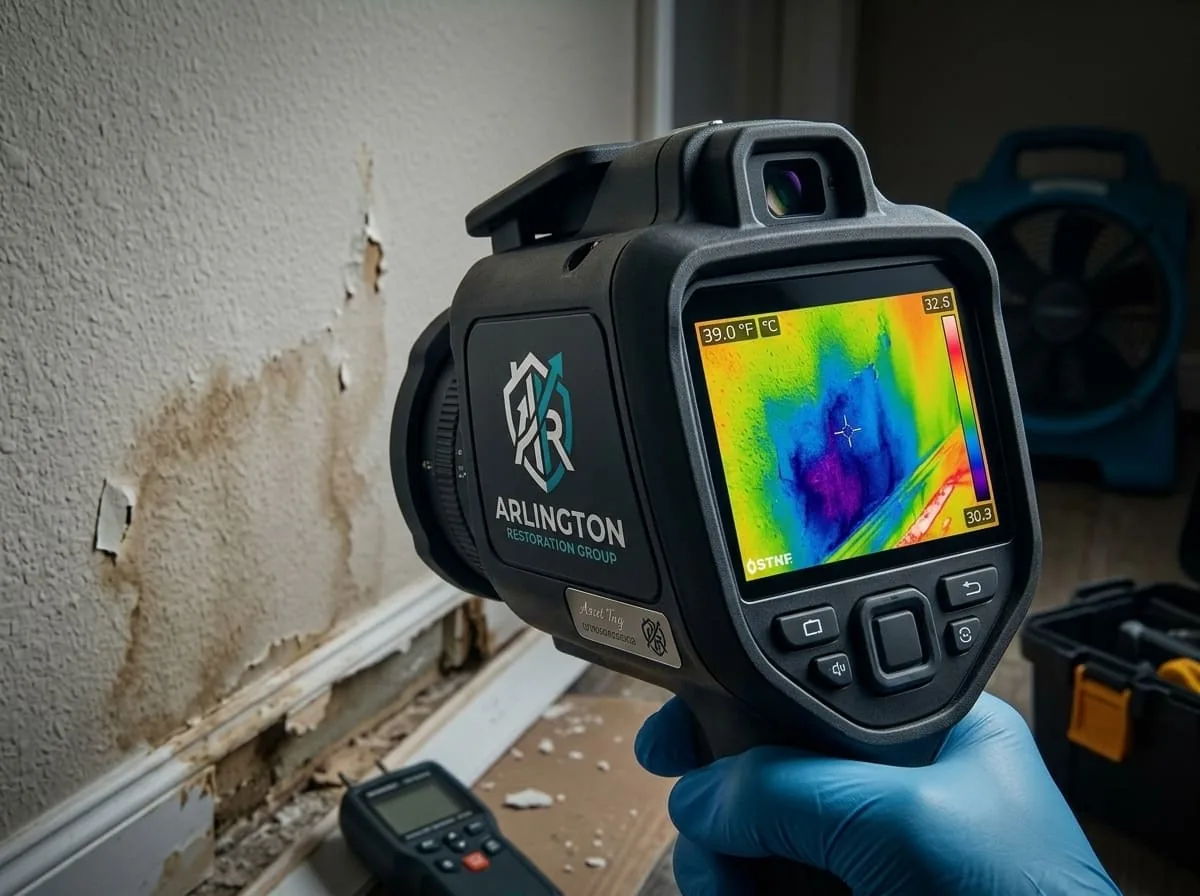
Whether the call is a burst supply line in a Courthouse high-rise, a slow leak in a Colonial Village-era garden apartment, or a flooded restaurant kitchen on the Clarendon commercial strip, the response follows the same core sequence: stop or contain the source where possible, extract standing water, map hidden moisture in walls and subfloor with moisture meters and thermal imaging, and set up structural drying equipment sized to the space.
Where the water is contaminated — a sewage backup or floodwater — decontamination happens before drying begins. Emergency response doesn't pause for a holiday weekend or a 2 a.m. call, and the building type doesn't change that either.
A crew dispatched to a Courthouse office tower after hours follows essentially the same emergency protocol as one dispatched to a Clarendon rowhouse — assess the source and extent first, stop further intrusion, then move into extraction and drying — with the specific equipment and access logistics adjusted to the building.
Related Services
The water damage restoration hub covers the full range of services available across Arlington. For the specific process crews follow when a call comes in after hours, see emergency water damage restoration. Pipe failures — common in both the older buildings and the newer towers here, for different reasons — are covered on the burst pipe water damage page.
Standing water removal specifically is detailed on the water extraction & removal page. Structural drying and the dehumidification equipment used to bring a space back to a safe moisture level are covered on the structural drying & dehumidification page.
Flood Risk, Storms, and the Local Sewer System
Flood Zone Status
Courthouse and Clarendon sit on higher ground away from Four Mile Run, Arlington's principal flood-prone waterway, so neither neighborhood carries meaningful exposure to the county's mapped 100-year floodplain. That's a genuinely different risk profile from South Arlington neighborhoods closer to Four Mile Run.
What Clarendon and Courthouse do share with the rest of the county is exposure to flash flooding from intense summer thunderstorms and to the occasional larger event — the remnants of Hurricane Ida in September 2021 triggered a statewide state of emergency and widespread flash flooding across the D.C. region, a reminder that a tropical system's remnant rainfall doesn't need to make direct landfall nearby to overwhelm storm drains well inland.
Sewer Backups in Older Buildings
Older sections of Arlington's sewer infrastructure have been linked to basement backups during heavy storms, which is a relevant risk for the rowhouses and garden apartments around Courthouse and Clarendon that still have below-grade or partial-basement space, even though most of the newer towers built since the 1970s don't have that exposure in the same way. For non-emergency water or sewer questions, Arlington County DES Water/Sewer Engineering is reachable at (703) 228-3677.
Common Water Damage Scenarios Here
- Riser and unit-to-unit leaks in Courthouse and Clarendon towers — water traveling through a shared floor slab or wall chase and surfacing as ceiling damage in a unit below the actual leak, covered further on the ceiling & wall water damage page.
- Aging plumbing in Colonial Village-era garden apartments — slower leaks from original or partially updated supply and drain lines that can go unnoticed for longer in an older unit.
- Commercial kitchen and restaurant flooding along the Clarendon strip — supply line failures, grease-trap backups, and appliance overflows in the ground-floor restaurant and retail space that defines Clarendon's commercial identity.
- Sewer backups affecting older rowhouses and garden units — see the sewage cleanup page for how contaminated water cleanup differs from a clean-water leak.
- Appliance and fixture leaks in condo and apartment units — washing machines, dishwashers, and water heaters in compact utility closets, detailed on the appliance leak & overflow cleanup page.
- Storm-driven water intrusion during heavy summer thunderstorms, particularly around older buildings with below-grade space — see storm & rain water damage.
Residential and Commercial Capability
A Government Seat and a Restaurant Strip
Courthouse's role as Arlington's government seat and Clarendon's identity as a dense restaurant and retail strip mean commercial water damage is a routine part of the picture here, alongside residential response in the surrounding towers, rowhouses, and garden apartments.
A leak affecting a county office building, a law firm near the courthouse complex, or a restaurant kitchen on the Clarendon strip needs a different response timeline than a residential unit — business interruption pressure is immediate, and drying often has to happen around continued foot traffic or limited operating hours.
The commercial water damage restoration page covers how that response is structured, while the residential water damage restoration page covers condo, apartment, and rowhouse response specifically.
Restaurants and Offices Near the Courthouse
Restaurant kitchens along the Clarendon strip bring a specific set of concerns beyond a typical commercial leak — grease-laden water, food-safety implications for anything affected near prep and storage areas, and pressure to reopen quickly given how thin the margin for a closed dining room can be. Office space around the Courthouse complex carries its own version of urgency: documents, electronics, and, for some tenants, records that can't simply be replaced.
In both cases the response prioritizes stopping further water intrusion and stabilizing the space first, with drying and repair sequenced around what the business or tenant needs to reopen or resume operations as safely and quickly as the damage allows — without promising a specific reopening date up front, since that depends on the extent of what's found once crews are on site.
Fire Damage Restoration in Clarendon & Courthouse
Smoke and Soot in Mixed-Use Buildings
A fire in a mixed-use building on the Clarendon strip — restaurant space below, residential units above — creates smoke and soot exposure that can spread well beyond the unit where the fire started, through shared HVAC systems, stairwells, and corridors. The same is true in a Courthouse high-rise.
Emergency board-up and tarping is available to secure a damaged storefront or unit immediately after a fire, followed by soot removal and smoke odor treatment; the emergency board-up & tarping page covers that first step in more detail.
Water Damage That Follows a Fire
Because firefighting operations put significant water into a structure, fire-damaged spaces here typically need water extraction and structural drying in addition to smoke and soot cleanup — addressed together, since delayed drying after a fire can lead to a secondary mold problem on top of the fire damage itself.
Full reconstruction is available through the receiving contractor's general contractor license. Start at the fire damage restoration hub for the complete range of services, or see commercial fire damage restoration for restaurant and office-specific response.
Mold Remediation in Clarendon & Courthouse
Two Building Types, One Underlying Cause
The mold risk profile here follows the same split as the water damage risk: modern towers with sealed, less-ventilated units where a hidden leak behind drywall can go undetected, and older Colonial Village-era garden apartments and rowhouses where original construction and less airflow around plumbing chases can let moisture linger longer than it should. In both cases, the underlying driver is usually the same — water that wasn't fully extracted or dried before mold-favorable conditions set in.
The mold remediation hub covers inspection, testing and sampling, containment, remediation, and post-remediation verification at a general level. The mold after water damage page is directly relevant to most calls in this area, since so much of the mold risk here traces back to an earlier leak, riser failure, or storm event that wasn't fully dried out.
Mold found in a rowhouse or garden apartment basement or crawl space near Lyon Park follows the same general principles covered on the basement & crawl space mold remediation page, even though most of the Clarendon and Courthouse high-rise stock doesn't have that kind of below-grade space at all.
What Can and Can't Be Saved
An honest note on mold: not every material affected by a water event that led to mold growth can be saved. Drywall and insulation with established mold growth typically need to be removed rather than treated in place, while structural framing and less porous materials can often be cleaned and dried successfully. A proper inspection determines which applies before any work begins, rather than assuming either outcome up front.
Signs of a Developing Problem Worth Calling About
- A ceiling stain in a Courthouse or Clarendon condo that appears with no obvious source in your own unit — likely a leak traveling from above.
- Warped or buckling hardwood flooring near an exterior wall or below a window in an older rowhouse or garden apartment, often a sign of slow moisture intrusion rather than a single spill.
- A musty smell in a below-grade or partial-basement space after a stretch of heavy rain.
- Discolored or bubbling drywall around a bathroom, kitchen, or shared plumbing wall.
- Any sewage odor or backup from a floor drain, tub, or toilet, which should be treated as contaminated water from the start.
None of these require an obvious flood to justify a call — some of the most damaging leaks in this corridor's building stock are the slow ones that go unnoticed for days or weeks before they're visible.
The Restoration Process, Start to Finish
Stopping the Source and Starting Extraction
The first step after finding water damage is stopping the source if it's safe to do so — a unit shutoff valve, a building engineer, or, for a suspected main break, Arlington County's emergency line. From there, a call to this line routes to licensed, insured restoration professionals who assess the extent of the damage, begin extraction, and set up drying equipment sized to the space and materials involved.
Moisture readings are typically taken at the outset and rechecked over the following days to confirm materials have actually reached a safe moisture level before drying equipment is pulled, rather than assuming a fixed number of days is enough — the how long does water damage take to dry resource explains the variables that affect that timeline.
Insurance and Documentation
Insurance claim assistance is available through the receiving contractor throughout, including documentation that supports a claim. For the categories of water involved in a loss and why they matter for cleanup, see water damage categories explained, and for what can and can't typically be salvaged, see can wet drywall be saved.
Nearby Service Areas
This line also serves the neighborhoods immediately around Clarendon and Courthouse. Rosslyn sits just to the northeast along the same Metro corridor and shares the high-rise, mixed-use building pattern. Ballston & Virginia Square is the next stop southwest on the corridor. Westover, Cherrydale & Lyon Park covers the older, lower-density neighborhoods that border Clarendon and Courthouse directly to the north and west.
Frequently Asked Questions
Do you respond to water damage in older buildings near Colonial Village, not just new condo towers?
Yes. Clarendon and Courthouse have a genuine mix of 1930s-era garden apartments and rowhouses alongside newer high-rise construction, and restoration crews dispatched through this line handle both, adjusting their approach to the plumbing type involved.
Can you clean up water damage in a restaurant or retail space on the Clarendon strip?
Yes. Commercial water damage response covers restaurant kitchens, retail space, and office space along the Clarendon commercial corridor and around the Courthouse complex, including situations that require working around limited operating hours.
Are Clarendon and Courthouse in a flood zone?
No. Both neighborhoods sit on higher ground away from Four Mile Run, Arlington's principal flood-prone waterway, and are not within the county's mapped 100-year floodplain. Flash flooding from heavy summer storms is still a risk, but this isn't a riverine flood-zone area.
What should I do if a shared riser fails in my Courthouse condo building?
Shut off water at the unit level if it's safely accessible, alert building management since the leak likely affects other units, and call this line for 24/7 dispatch of restoration crews experienced with multi-unit riser failures and shared-slab damage.
How is a sewage backup different from a regular water leak?
A sewage backup involves contaminated water that requires decontamination and different safety handling before drying can begin, unlike a clean water leak from a supply line. The sewage cleanup page linked above covers that process in more detail.
Do you handle water damage insurance claims for Clarendon and Courthouse properties?
Insurance claim assistance is available through the restoration contractor that receives the call, and documentation such as photos of the damage is typically collected as part of the response.
How quickly can mold become a problem after a leak in an older Clarendon apartment?
It depends on the extent of the water, the material affected, and how well-ventilated the space is, but mold-favorable conditions can develop within days in a wet, poorly ventilated area — which is part of why fast extraction and verified drying matter, especially in older buildings with less airflow around plumbing chases.