 Arlington Restoration Group
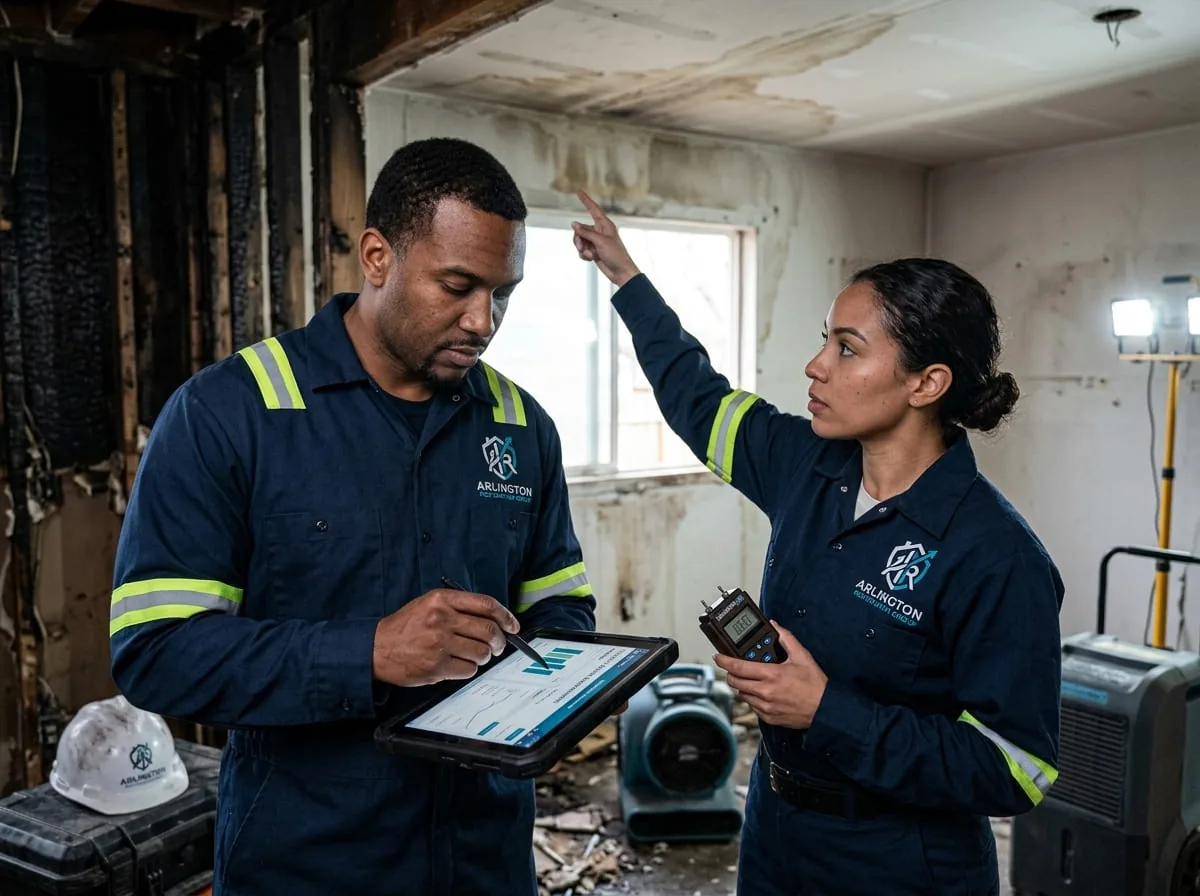
When Fire Damage Hits an Arlington Home or Business
A structure fire is one of the most disorienting events a property owner can face. Even a small, contained fire in a kitchen or laundry room rarely stays contained to that one room.
Heat cracks finishes and warps materials well beyond the flame's reach, smoke travels through ductwork and wall cavities into rooms that never saw fire, and soot settles on every horizontal and vertical surface it can reach. Add in the water and chemical residue left by firefighting efforts, and a property that looked survivable the morning after can have damage running from the attic to the crawl space.
Arlington Restoration Group connects property owners across Arlington, VA with licensed, insured, IICRC-certified restoration professionals who handle every stage of fire damage recovery, from the emergency board-up the same day as the fire through smoke odor removal, contents cleaning, and structural rebuild. One call starts the process, and the crew dispatched to your address is equipped to assess the full scope of damage rather than just the parts that are visible from the doorway.
Fire Damage Restoration Services in Arlington
Fire restoration is not a single task — it is a sequence of specialized services, and which ones a property needs depends on how large the fire was, what materials burned, and how much of the building firefighting crews had to access. The following services are available across Arlington and the surrounding area:
- Emergency Fire Damage Restoration — 24/7 dispatch, initial assessment, and stabilization in the hours right after a fire is extinguished.
- Emergency Board-Up & Tarping — securing broken windows, damaged doors, and roof openings against weather and intrusion.
- Smoke Damage Cleanup — addressing smoke residue on walls, ceilings, HVAC systems, and belongings throughout the property.
- Soot Removal — removing acidic soot deposits from surfaces before they permanently etch finishes and metals.
- Smoke Odor Removal & Deodorization — neutralizing smoke odor that has bonded to porous materials, not just masking it.
- Firefighting Water Damage Cleanup — extracting and drying the water used to put the fire out.
- Contents Cleaning & Pack-Out — inventorying, packing, cleaning, and storing salvageable belongings off-site during repairs.
- Commercial Fire Damage Restoration — restoration scoped for offices, retail spaces, and multi-unit buildings.
- Fire Damage Repairs & Reconstruction — rebuilding framing, drywall, flooring, and finishes to close out the claim.
The Water Problem Firefighting Leaves Behind
How Firefighting Water Spreads Through a Structure
Most fire damage claims are also water damage claims. Suppressing a structure fire typically means hundreds or thousands of gallons of water applied under pressure, and that water goes wherever gravity and the building's construction take it — down through floor assemblies, into wall cavities, and into finished basements below.
If that water isn't extracted and the structure isn't dried on the same general timeline as a standalone flood, it causes a second wave of damage layered on top of the fire itself.
Extraction and Drying After a Fire
Crews dispatched through Arlington Restoration Group bring the same extraction and structural drying equipment used on the water damage restoration side of the business, including tools detailed on the water extraction and removal page, and apply it to post-fire drying as a standard part of the job.
Why Waiting Makes Fire and Smoke Damage Worse
Soot and Smoke Odor Get Worse Over Time
Soot is acidic, and the longer it sits on metal fixtures, appliances, and countertops, the more permanently it etches and discolors them. Smoke odor compounds continue migrating into drywall, insulation, and fabric for days after the fire is out, which is why odor that seemed manageable on day one can seem to spread by day four.
Mold Risk From Firefighting Water
And any moisture left behind by firefighting water creates the conditions mold needs to establish itself, typically within 24 to 48 hours in the right conditions. A property that has been through both a fire and firefighting water intrusion is genuinely at elevated risk for the kind of residual moisture problem covered on the mold remediation pages, which is one more reason a fast, coordinated response matters more than trying to handle cleanup piecemeal.
Residential and Commercial Fire Restoration
A single-family home, a rowhouse in one of Arlington's older neighborhoods, and a mid-rise apartment or office building near the Rosslyn-Ballston corridor all present different fire restoration challenges.
Homes typically need full-property smoke migration checks even when the fire was confined to one room, while commercial and multi-unit properties often require phased restoration that keeps part of the building operational while affected units or floors are worked on, along with documentation suited to business interruption claims. The crews dispatched through Arlington Restoration Group are equipped for both.
Serving Arlington and the Surrounding Area
Fire and smoke damage calls are routed to restoration professionals serving Arlington neighborhoods and the wider Northern Virginia and D.C. metro area, including high-density corridors such as Rosslyn and Clarendon & Courthouse, along with the county's older, tree-lined single-family neighborhoods. Whether the fire happened in a high-rise unit with shared walls and corridors or a Cape Cod with an original chimney, the response is scoped to the property type and the building's construction.
Frequently Asked Questions
How soon should fire restoration start after the fire department leaves?
As soon as the fire marshal or fire department clears the property for entry. Soot becomes harder to remove the longer it sits, smoke odor continues spreading into porous materials, and any firefighting water left in the structure creates a window for mold growth. Same-day contact with a restoration crew is standard practice, not an overreaction.
Is it safe to go back inside after a fire?
Only once the fire department or a qualified inspector has confirmed the structure is safe to enter. Fires can compromise framing, roofing, and electrical systems in ways that aren't obvious from a walkthrough, and smoke can leave behind carbon monoxide and other airborne hazards in enclosed spaces.
Will insurance cover fire damage restoration?
Most homeowner's and commercial property policies cover fire damage, and typically the water damage and smoke damage that come with it, though coverage details vary by policy. Insurance claim assistance is available through the receiving restoration contractor, and documentation is typically started at the initial assessment.
Can smoke odor really be removed, or just covered up?
Genuine smoke odor removal targets the source — residue that has bonded to drywall, insulation, fabric, and other porous materials — using methods like thermal fogging, ozone or hydroxyl treatment, and sealing, rather than air fresheners or scented sprays that only mask the smell temporarily.
What's the difference between soot removal and general cleaning?
Soot is a fine, often greasy, acidic residue that continues to damage surfaces the longer it's left in place, and standard household cleaners can smear it or set the stain permanently. Professional soot removal uses techniques and products matched to the specific surface — chem sponges on some materials, specialized solvents on others — to lift soot without driving it deeper in.
Does a small kitchen fire really need whole-house restoration?
Often, yes, at least for assessment. Smoke and soot travel through HVAC ducts and gaps around doors and windows far beyond the room where the fire started, so a thorough assessment typically checks adjoining rooms and the duct system even when visible damage looks confined to one area.