 Arlington Restoration Group
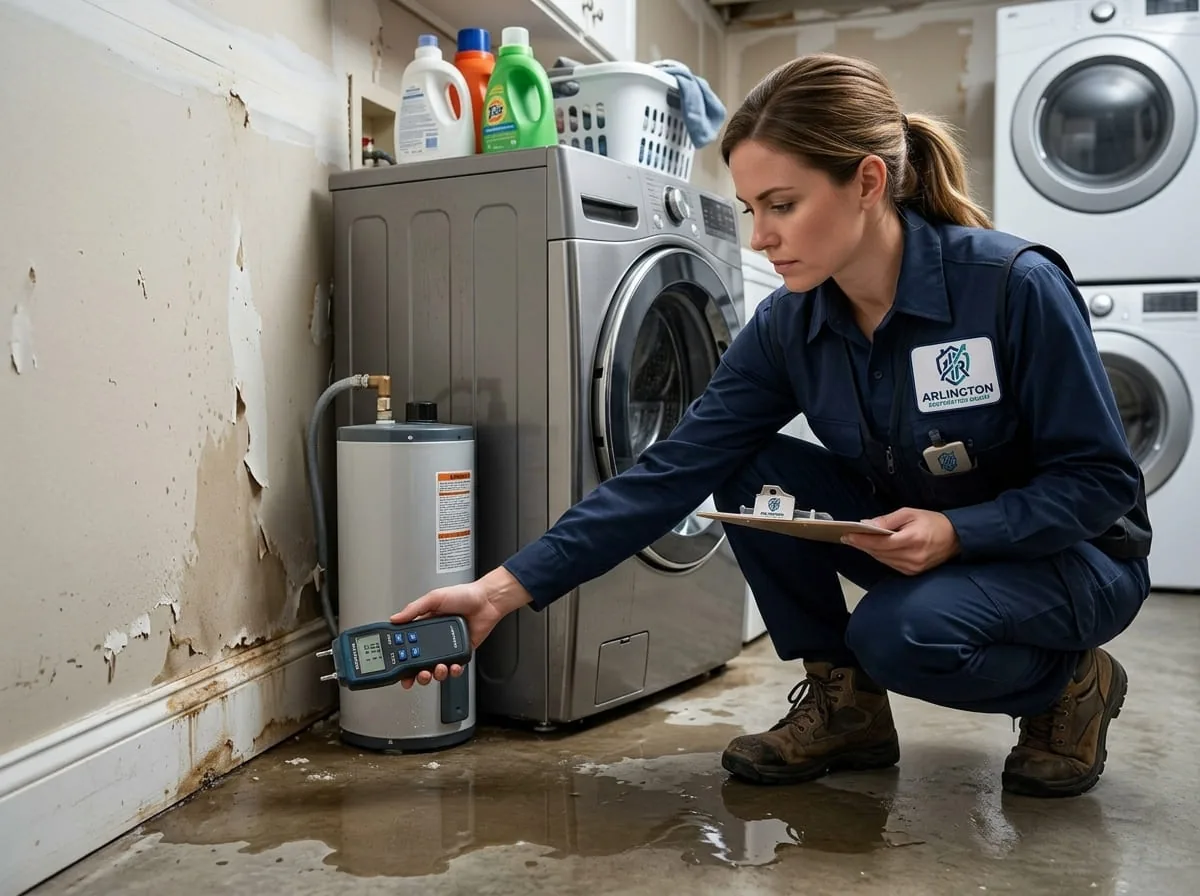
The first few minutes matter more than the first few hours
Finding water where it doesn't belong — a spreading stain on the ceiling, an inch of water across the kitchen floor, a soaked carpet under the washing machine — triggers an adrenaline response that makes people do one of two unhelpful things: freeze, or start grabbing towels before dealing with the source. Neither gets ahead of the problem.
Water damage behaves on a clock. Clean water sitting on a hardwood floor or inside a wall cavity starts wicking into porous materials within minutes, and the conditions that support mold growth can begin to develop in as little as 24 to 48 hours in warm, humid weather. What you do in the first hour has more effect on the final cost and scope of repair than almost anything that happens afterward.
A Short, Deliberate Sequence
This isn't a call to panic. It's a call to work through a short, deliberate sequence: control the source, control the electrical risk, document what you're looking at, protect what you can protect, and get water removal moving quickly. Below is that sequence in the order it actually needs to happen.
Step 1: Identify and stop the water source — if you can do so safely
Before anything else, figure out where the water is coming from and whether you can stop it without putting yourself at risk.
- Supply line leak or burst pipe: Shut off the water at the fixture's local shutoff valve if you can reach it (under a sink, behind a toilet, at a washing machine hose). If the leak is behind a wall, above a ceiling, or you can't isolate it locally, shut off the home's main water supply valve instead. Knowing where that valve is before an emergency happens is one of the most useful five minutes a homeowner can spend.
- Appliance failure (washing machine, dishwasher, water heater, refrigerator line): Shut off the appliance's dedicated supply valve, usually a small valve on the wall or floor behind or beneath it. Unplugging the appliance is a secondary step, not a substitute for stopping the water.
- Roof leak, wind-driven rain, or storm intrusion: There is often no fast way to "shut off" this source. Focus instead on containment — buckets, tarps over the specific area if you can safely access it from inside — and move to the documentation and extraction steps below rather than waiting for the leak to stop.
- Sewage backup or water that may be contaminated: Do not touch it, wade through it, or try to contain it by hand. Contaminated water carries health risks that clean supply-line water does not. Keep people and pets out of the area and skip straight to calling for professional help.
If you cannot identify the source, cannot reach a shutoff safely, or the water is rising faster than you can address it, stop trying to solve it yourself and call for emergency help. A flooded basement with water still climbing the stairs, or a ceiling actively sagging under the weight of trapped water, are both situations where waiting to "figure it out" costs more than calling immediately.
Step 2: Cut power to the affected area before you do anything else
This is the step people skip because it feels like an extra errand while water is actively spreading — and it's the one that actually protects you. Water and electricity sharing the same space is a serious shock and electrocution hazard, and it isn't always obvious where wiring, outlets, or a water heater's electrical connection sit relative to standing water.
How to Safely Cut Power
If the electrical panel is in a dry, safely reachable location, shut off the breaker(s) serving the affected area — or the main breaker if you're unsure which circuits are involved. Never enter standing water to reach a breaker panel, and never step into or through standing water if outlets, power strips, or plugged-in appliances are anywhere in or near it.
If the panel itself is wet, in a flooded basement, or only reachable by walking through water, do not attempt it — leave the power on or off as it is and call an electrician or the utility company, and treat the area as off-limits until a professional confirms it's safe. This same caution applies to space heaters, sump pumps, and any other plugged-in equipment sitting in a wet area.
Step 3: Document everything before you touch anything
Insurance claims move faster and more smoothly when there's clear documentation of the damage as you first found it, before cleanup begins and before anything gets moved or discarded.
- Take wide photos of each affected room from multiple angles, then close-up photos of specific damage — soaked carpet, water stains, buckled flooring, damaged drywall or ceiling.
- Photograph and, where practical, video the source of the water itself (the burst fitting, the overflowing appliance, the ceiling stain) before it's repaired or removed.
- Note the approximate time you discovered the damage and, if known, roughly how long the leak may have been active — this matters for both insurance and for how professionals assess drying feasibility later.
- List damaged belongings as you see them rather than trying to reconstruct the list later from memory. Include approximate value and condition.
- Keep any receipts for emergency measures you take yourself (a shop vac rental, a dehumidifier purchase, a hotel stay if the home is uninhabitable) — many policies reimburse reasonable mitigation costs.
Document first, then act. A few extra minutes with a phone camera does not meaningfully slow down the response, and missing documentation is one of the most common reasons a legitimate insurance claim gets delayed or disputed later.
Step 4: Move what you can move safely
Once the source is controlled and the area is confirmed safe from electrical hazards, focus on limiting how much gets damaged rather than trying to clean up the water yourself.
- Move furniture, rugs, boxes, and electronics off wet flooring and onto a dry, elevated surface. Aluminum foil or small wood blocks under furniture legs can prevent staining and wicking if you can't move a piece entirely.
- Pull curtains and drapes up off a wet floor.
- Remove and safely set aside items that are especially sensitive to water — paper documents, photographs, electronics, artwork — even if the rest of the room stays as-is until help arrives.
- If it's safe and the volume is small, you can begin blotting up water with towels or a wet/dry shop vac rated for water pickup. This is useful for limiting spread, but it is not a substitute for professional extraction on anything beyond a small, shallow spill — a shop vac moves gallons per pass; standing water in a flooded room is measured in hundreds of gallons.
- Do not use a regular household vacuum on wet surfaces under any circumstances — it is an electrical hazard and will damage the vacuum.
Resist the urge to start large-scale cleanup, ripping out carpet, or aggressively drying with fans before the extent of the water is fully understood. Materials that look dry on the surface can still be saturated underneath, and premature drying efforts sometimes push moisture further into wall cavities or subflooring rather than out of the structure.
Step 5: Get water extraction started quickly
Standing water and saturated materials need to be actively removed, not just mopped at — the longer water sits, the more it spreads laterally through flooring and vertically up drywall through capillary wicking, and the greater the risk that materials pass the point where they can be dried and saved rather than replaced. This is the point where a homeowner's own effort reaches its practical limit.
Professional water extraction uses truck-mounted or portable extraction equipment that removes far more water, far faster, than towels or a shop vac, followed by moisture mapping to find water that has migrated into places you can't see — under flooring, inside walls, beneath cabinetry.
Why This Is Time-Sensitive
For active leaks, flooding, or any situation where water is still spreading, treat it as a time-sensitive call rather than something to schedule for later in the week. Emergency water damage restoration response is built around the fact that the first 24 to 48 hours determine whether materials can realistically be dried in place or need to be removed and replaced.
What not to do in the first hour
- Don't run a household vacuum over wet carpet or flooring — shock hazard and equipment damage.
- Don't ignore a musty smell or visible mold and simply paint or cover over it — trapped moisture behind a fresh coat of paint keeps growing.
- Don't wait to "see if it dries on its own" on anything beyond a very small, shallow, clean-water spot. Materials that seem to dry on the surface can remain wet inside for days.
- Don't throw away damaged items before photographing them for your insurance claim.
- Don't assume a small visible stain means small hidden damage. A quarter-sized ceiling stain can represent a much larger area of saturated insulation and framing above it.
Residential situations vs. commercial and multi-unit buildings
In a single-family home, you're usually dealing with one water source and a contained area, and homeowner action in the first hour has an outsized effect. In condos, apartments, and commercial spaces — common throughout Arlington's high-rise corridors — a leak can move through floor slabs and shared risers into units below before anyone upstairs even knows it happened.
If you manage or occupy a commercial space or multi-unit building, notify building management or the property manager immediately in addition to taking the steps above, since access to shutoffs, electrical panels, and neighboring units is often outside a single tenant's control.
When to stop trying to handle it yourself
Some situations call for leaving the space and calling for help rather than attempting any of the steps above personally: water that may be contaminated (backed-up sewage, floodwater from outside, water that has been sitting for more than 24-48 hours), water anywhere near an electrical panel or outlets you can't safely avoid, a ceiling that is sagging or dripping under visible weight, or water damage combined with any structural concern like a buckling floor or wall.
In any of these cases, get people and pets out of the affected area, avoid contact with the water, and call for professional emergency response rather than trying to manage it manually.
Frequently Asked Questions
Should I turn off my electricity before or after stopping the water?
If you can reach your electrical panel without walking through or near standing water, cut power to the affected circuits first — electrical hazards are the more immediate danger. If the panel itself is wet or only reachable through water, don't attempt it yourself; leave the power as-is, stay out of the area, and call an electrician or your utility provider before doing anything else.
Is it okay to use my own shop vac to remove the water?
For a small, shallow, clean-water spill, a wet/dry shop vac rated for liquid pickup can help limit spread while you wait for help. For standing water covering a significant area, or any water that may be contaminated, a household shop vac isn't sufficient — the volume is usually far beyond what it can handle, and contaminated water shouldn't be handled without appropriate protective equipment.
How long can I wait before calling someone about water damage?
Materials that stay wet start to be at meaningfully higher risk of secondary damage and mold growth within roughly 24 to 48 hours, faster in warm or humid conditions. For anything beyond a very small, contained, clean-water spot, it's worth arranging extraction the same day the damage is found rather than waiting to see how it looks in a few days.
What if I don't know where my main water shutoff valve is?
It's worth locating it before an emergency happens — commonly near the water meter, in a basement, utility closet, or crawl space access point. If you can't find it during an active leak, shutting off the water at the fixture itself (or the appliance's dedicated valve) is the next best option. If neither is accessible, contact your local water utility or a plumber for emergency shutoff assistance.
Should I take photos before or after moving my belongings out of the water?
Photograph the damage as you find it first, including the source of the water if visible, before moving items or beginning cleanup. It only takes a few minutes and gives you documentation of the damage in its original state, which is typically more useful for an insurance claim than photos taken after items have already been relocated.
Is a musty smell right after a leak a sign of mold already?
A musty odor shortly after a leak is more often trapped moisture and off-gassing from wet materials than established mold growth, but it's a signal that materials are wet in places you may not be able to see and that drying should start promptly. If a musty smell persists for several days or visible growth appears, it's worth having the area assessed.