 Arlington Restoration Group
Water Damage Restoration in Arlington Ridge & Aurora Highlands
Arlington Ridge and Aurora Highlands climb the hillside above Route 1 and the National Landing corridor, with brick bungalows and Cape Cods dating mostly from the postwar decades sitting on the higher ground and newer construction filling in closer to Crystal City.
That postwar housing stock is a defining feature of South Arlington generally, and it more often sits on crawl spaces or partial basements rather than the full basements typical of North Arlington's Cape Cods — a distinction that changes where water damage actually shows up first in this neighborhood.
Crawl Space Leaks and Aging Plumbing
A crawl space under an Arlington Ridge or Aurora Highlands bungalow is an easy place for a plumbing leak to go unnoticed for a long time, since there's no finished living space above it to show a stain right away. Musty odors, buckling hardwood floors, or a spike in indoor humidity are often the first sign something is wrong underneath.
Crawl space water damage response addresses exactly this, and it pairs closely with burst pipe water damage cleanup, since an aging supply line under the house is a common cause. Some of these bungalows have been updated with a partial basement conversion over the decades, which changes how a leak presents but not how quickly it needs to be addressed.
Hillside Runoff and Upper-Level Leaks
The hillside terrain itself is worth a mention too. Homes lower on the slope, closer to where Arlington Ridge and Aurora Highlands meet the flatter ground near Route 1, can end up as the collection point for runoff from higher ground during a heavy thunderstorm, especially where storm drains are undersized for today's rainfall intensity.
Storm and rain water damage cleanup covers that scenario, and water damage restoration serving this neighborhood is dispatched 24/7 whether the water is coming from the ground up or from a fixture inside the house.
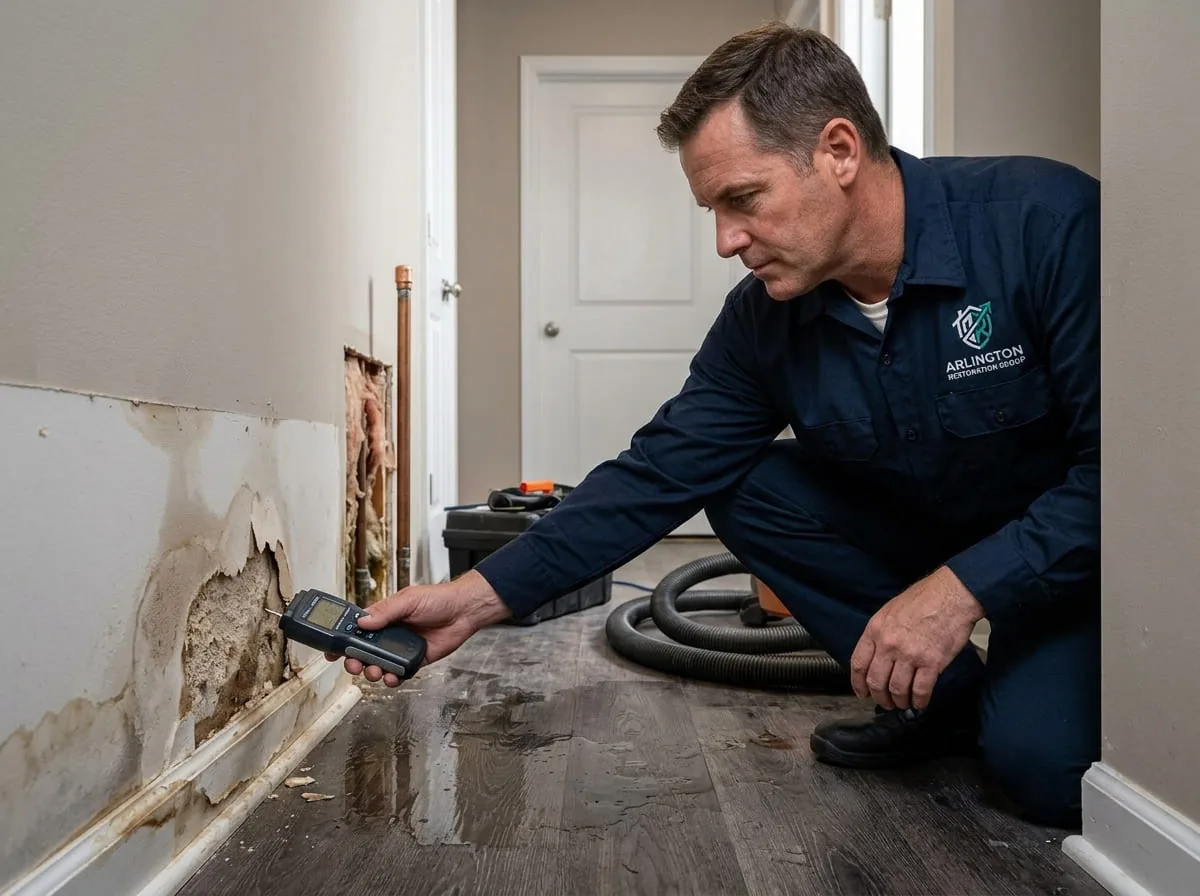
Upper-floor leaks are common here too — an older bathroom, a roof valley, or flashing around a dormer letting water into a wall cavity that isn't discovered until it reaches the ceiling below. That kind of damage often needs the wall opened up to confirm how far the moisture actually spread before drying can start properly.
Signs of Water Damage to Watch For in a Hillside Bungalow
Because the source is often underneath the house rather than inside a visible room, these are the signs worth paying attention to:
- A musty odor or unexplained humidity indoors with no visible leak
- Buckling or soft hardwood floors above a crawl space
- A water stain on a ceiling below an upstairs bathroom or roof valley
- Pooling water near the foundation on the downhill side of the property after a storm
- A spike in the water bill with no obvious cause
A crawl space leak can go on for a while before it's noticed, and homeowners sometimes worry that will be treated as a maintenance issue rather than a covered loss. Prompt documentation of when the leak was discovered and how it was found helps support a claim, which is part of why calling as soon as you notice the signs above matters.
Fire Damage Restoration in Arlington Ridge & Aurora Highlands
Kitchen fires and electrical issues in older wiring are the most common fire-related calls from this neighborhood's bungalows and Cape Cods. Fire damage restoration, from emergency board-up through full reconstruction, is available 24/7, and the water used to fight a fire is typically addressed as part of the same response.
A fire that starts on a lower level near a crawl space access point can also complicate ventilation and cleanup, which the responding crew accounts for during the initial assessment.
Mold Concerns in Arlington Ridge & Aurora Highlands
A damp crawl space that never fully dried out, or a slow roof leak that went unnoticed for weeks, is a common starting point for mold in this part of Arlington. Mold inspection and remediation services can evaluate a musty crawl space or a stained ceiling and scope the work needed without exaggeration.
Because crawl spaces are enclosed and poorly ventilated by design, a musty odor from below the house is often the first and only warning sign before an inspection confirms the extent.
What to Expect When You Call
A call from Arlington Ridge or Aurora Highlands is routed to a licensed local crew that knows to check the crawl space first if there's musty odor or floor buckling, not just the visible source. Expect moisture mapping under the house and behind affected walls, a drying plan suited to a crawl space or partial basement, and insurance claim assistance if you're filing.
Because access to a crawl space is often tighter than a full basement, expect the crew to use low-profile equipment to extract water and place drying equipment in that space.
Nearby Service Areas
The same network covers Crystal City & Pentagon City (National Landing) at the bottom of the hill, Shirlington & Fairlington a short drive south, and Alexandria just across the Arlington County line — useful to know if a property or a family member's home falls just outside the Arlington Ridge or Aurora Highlands boundary.
Frequently Asked Questions
How do I know if my Arlington Ridge crawl space has a water problem?
Musty odors inside the home, unexplained humidity, or hardwood floors that feel soft or buckled are the usual first signs, since a crawl space leak often isn't visible until it's affected the living space above.
Do Aurora Highlands homes have basements or crawl spaces?
It varies, but South Arlington's postwar bungalows and Cape Cods — which make up much of this neighborhood — more commonly sit on crawl spaces or partial basements rather than full basements.
Is stormwater runoff a bigger issue for homes lower on the hill?
It can be, since properties toward the bottom of the slope near Route 1 sometimes collect runoff from higher ground during heavy storms, especially when local storm drains are pushed past capacity.
Can you assess a roof leak that's been dripping into a wall for weeks?
Yes — that kind of slow leak usually requires opening the wall to confirm how far the moisture traveled, followed by structural drying and, if needed, a mold assessment.